

 Posts


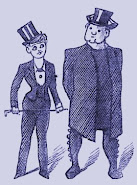


In its November 1909 issue, The Strand Magazine published a remarkable article. We remark, that is, in admiration for its clever concept; and in gratitude for how it arranged for prominent cartoonists of the day to "speak" to us via drawings and quotations.
"Style in American Comic Art" was inspired by the magazine's English edition -- an article displaying how one premise was given to various cartoonists for them to interpret, and share with readers their approaches and conceptualizations. Despite the popularity of Punch and other British magazines (and reprint books and postcards) in the United States, most of the English cartoonists would have been strangers to Americans. So the American edition of The Strand declared it independence and surveyed Yankees.

Actually, Yesterday's Papers can declare something, too -- a "gotcha" on one of the magazine-history field's most prominent authorities, Frank Luther Mott. Respected for his five-volume History of American Magazines and other works -- essential and exhaustive, all -- the estimable Dr Mott nevertheless wrote about the American Strand Magazine that it was "wholly British" -- that is, its contents entirely reprinted from the iconic British monthly.

Not so. Indeed the American magazine was spun off the British original, its contents dated one month differently to appear to be simultaneous. And many features were imported word-for-word. However, not every article in the fiction-and-current-events journal was pertinent or even intelligible to Americans. Also, there were rights entanglements with famous authors and popular series. Finally, to appeal to American readers, home-grown articles and domestic subject-matter was essential to its acceptance.
Hence, the American Strand became a hybrid; it was not "wholly British." (By the way, several otherwise impeccable internet magazine archives confuse, and cross-identify, the British and American editions...) It ran in the US, with respectable readership, between 1891 and 1916, eclipsed by the "mother" edition, whose dates were 1891-1950.

Bibliophiles, and fans of Sherlock Holmes, will immediately associate The Strand with Arthur Conan Doyle's writing. The original appearances of many Sherlock stories were in The Strand. Eventually Doyle wrote directly for the American Collier's; but he wrote other work for The Strand. Among the writers who contributed original work for its pages of both editions were Agatha Christie, P G Wodehouse, Rudyard Kipling, Graham Greene, Georges Simenon, H G Wells, Dorothy Sayers, Count Leo Tolstoy, Edgar Wallace, Max Beerbohm, and (a personal favorite) the great W W Jacobs.
An enterprising Strand editor in 1909 duplicated the original British theme (since YP has international readership, we will reprint that article in coming days) and prominent American cartoonists were approached. Their challenge was to illustrate this premise:
A large dog is rushing madly among a crowd of terrified pedestrians, who are scattering in all directions. Holding grimly to the "lead" attached to the supposedly ferocious animal is a very small boy who, far from having any control over the creature's actions, is being whirled through space at the joyous animal's pleasure. But he hangs on manfully, exclaiming as his body cleaves the air, "What's the matter with the folks? Can't they see I've got hold of the dog?"
Even granting for the changes in taste between the Edwardian Age and now, this idea promised fewer laughs than insights into cartoonists' creativity. It is interesting to note that of the nine artists, five were from the weekly comic magazines, and four were newspaper cartoonists -- a good sampling of perspectives and disciplines.

The cartoonists were Eugene Zimmerman (ZIM), Judge Magazine; the young James Montgomery Flagg, Judge and Life; Walt McDougall, various newspapers; Winsor McCay (also identified as "Silas"), the Bennett newspapers; W H Gallaway, Puck Magazine; Albert Levering, Puck; James Donahey, Cleveland Plain Dealer; William J Steinigans, New York World; and Hy Mayer, freelance cartoonist and illustrator.

The cartoonists' comments can be seen by enlarging these pages; and I will quote from them, with British cartoonists' ruminations, when we share the UK part of the story.


