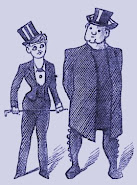
Showing posts with label Mutt and Jeff. Show all posts

Monday, October 28, 2024

AT THE INTERSECTION OF FUNNY AND FUNNY -- CHARLIE CHAPLIN AND BUD FISHER


 AMERICA'S FAVORITE
FUNNY-MAKERS OF THE 1910s MEET


by Rick Marschall

If a poll had been conducted in the early 'teens in America -- and there might indeed have been such surveys -- despite the heavy competition, it is certain that the nation's favorite comedian was Charlie Chaplin; and the nation's favorite comic strip was Mutt and Jeff.

Chaplin burst on the scene in 1914, and was an immediate hit. His tramp character evoked sympathy, affection, a bit of derision, and even identification, all at once. Seemingly overnight he was a major star of the nascent "movies"; there were Chaplin dolls and toys; and there would be two comic strip featuring him as a character (one would be drawn by the newcomer E C Segar, years before Popeye). In 1915 he was writing, producing, and starring in a series of shorts for Keystone; Mutual, Essanay, and United Artists in his lucrative future.

In newspaper comics, Bud Fisher was the virtual father of the daily strip, certainly the first successful one. After Mr A Mutt wowed readers in San Francisco, Fisher moved to New York, was hired by William Randolph Hearst, introduced a second-banana, Jeff; and -- where have we heard this before? -- had a national sensation on his hands. Toys, dolls, sculptures (!), lapel pins, and comics' earliest successful daily-strip reprint books flooded the nation. A coupon-clipping promotion of a Boston newspaper proved that the public would be interested in comic-strip compilations, and the Ball Publishing Company produced five reprint books during the 1910s. 

Here is the cover of Volume 4, published in 1915, the year Chaplin hit it "biggest" in moving-picture theaters... and the year that Mutt and Jeff was so popular that (thanks in part to the legerdemain of syndication pioneer John Wheeler) Bud Fisher slipped away from Hearst and drew his strip for Joseph Pulitzer's New York World.

In a "meeting of the mirths," we see in my copy of this book that the funnyman Bud Fisher inscribed it to his cinematic counterpart, Charlie Chaplin. (Even though he spelled Charlie's name wring. So, he didn't win any spelling bees...) And the book has Charlie's bookplate! This is how he saw himself at the beginning of his career -- the drawing (alas, unsigned) show the Tramp, rather more bedraggled than usual, as a new arrival in the Big City.

Chaplin recently had arrived in America from England as a member of Fred Karno's music-hall troupe (Stan Laurel, his young understudy) and this indeed might have represented his very first impressions of America. 


Monday, September 16, 2024

CARTOONISTS AT WORK - Bud Fisher

 When weekends are over, we (most of us) get back to work, or think of it. Some of us who freelance write or draw feel like weekends and weekdays are of one demanding sort. Think of cartoonists who draw newspaper strips. Until recently, words like "vacations," "hiatus," and "reprints" were not in their lexicons. (In fact, even "lexicon" was not in many of their lexicons.") More likely, "primal scream" was a term that tempted them.

So I will inaugurate a regular feature in Yesterday's Papers showing cartoonists at their drawing boards. In fact, here and in the imminent revival of NEMO Magazine, I will compile a different sort of trip through comics history -- a chronological compilation of informal photos and snapshots of cartoonists (that is, not promotional photos), sharing what they were like as "normal" (ha) folks; and weaving the narration of comics' growth as an art form. My good friends and great collectors (or vice-versa) Ivan Briggs and Jim Engel will collaborate.

The first subject is almost ironic, for Bud Fisher (Mutt and Jeff) was famous for hardly lifting a pen after the very first years of his strip... except when endorsing royalty checks. Many cartoonists have had assistants; and some abandoned their drawing boards early in their long careers (I will present the case Ron Goulart and I made that Alfred Andriola could barely draw at all, for instance).

Anyway, Bud Fisher was the first major strip cartoonist to employ ghost artists (separate from assistants, which was a rare thing anyway before 1907, when Mutt had his debut). Ken Kling, who later drew Joe and Asbestos, worked for Fisher; C W Kahles ghosted some licensing and ancillary items. Some folks believe that George Herriman subbed for Fisher, but during the few years they worked together Herriman was too big of a "name" to have pitched in anonymously on another strip; it was more likely that Fisher saw another style to swipe. Bill Blackbeard claimed that Billy Liverpool lent a hand, but with no evidence, certainly not in their drawing styles (typically and unfortunately -- for his assertion has made into history books) he admitted under pressure that "Billy Liverpool" was marvelous name that should be enshrined. Trust but verify...

What is true is that around 1916, Fisher hired the B-Team Hearst cartoonist Ed Mack. And Mack thereafter drew virtually every image of Mutt and Jeff -- strips, reprint books, toys and games, ads, merchandise, licensed products -- until 1933. At that point, Al Smith took over the strip 100 per cent. Al (the first cartoonist I ever met, when I was 10 years old; he attended our church, and filled in a lot of history for me) only signed the strip after Fisher's death in 1954.

So... it could be that a photograph of Bud Fisher at a drawing board is a rare thing, or an image of a rare event. 


Friday, May 25, 2012

Bud Fisher, A Captain of Comic Industry


‘A Captain of Comic Industry; And Other Interesting People,’ by John N. Wheeler, in The American Magazine (1906-1956), Vol. LXXXI, No. 5, May 1916, pp. 48-50.


Thursday, April 30, 2009

Mutt and Jeff


[ May 2, May 5, and May 6 1930]

When I was a young tad we had a great way of making my dad laugh. All it took was for one of us to say “Mutt and Jeff!” and repeat it every time he took a breath between bellows of laughter. I didn’t really appreciate Mutt and Jeff myself, Al Smith had been drawing the strip since I first picked up a funny paper and it was god awful. All the laughs had leaked out of the comic after Fisher’s death and it was now strictly a commercial concern limping along on its past glory.

According to a MacLean’s article of June 1916 titled Making a Fortune out of Comics, how “Bud” Fisher is Capitalizing “Mutt and Jeff,”: “As soon as the boy was big enough to hold a pencil he began expressing his infant soul in scrawls. His father’s linen collars, off or on, were his favourite drawing boards …” Bud Fisher never took a drawing lesson in his life but his bigfoot style was very influential, most noticeably with George Herriman, author of Krazy Kat. In 1917 a close study of Mutt and Jeff appeared in the shape of Hitt and Runn, by Oscar Hitt, seen HERE.


[April 29 1920]

Harry C. “Bud” Fisher was the unlikeliest person you could think of to draw Mutt and Jeff. John Wheeler, of the Wheeler Syndicate, described him as a belligerent “dapper cocky little guy,” a sun dodger, who hated the daylight. Fisher, along with most of his contemporary cartoonist-journalists pals, enjoyed fights, chorus girls, gambling, and saloons. Fisher liked to shoot up hotel rooms with his pistols, one of which was a gift from Pancho Villa, indoors when he was drunk. His first wife was a Vaudeville showgirl who led a tragic life. In 1927 his second bride, a Countess, charged Fisher with throwing her out of their luxurious Riverside Drive apartment and beating her on several occasions. “Bud” wasn’t present when she was granted separation, he was aboard a ship to Europe.

Wheeler seems to have studied Fisher carefully and concluded, “Fisher’s life was full of crises, most of which he made himself. He was a strange contrast of shrewdness and stupidity about his own affairs.”

Al Smith, one of Fisher’s ‘ghosts,’ told the Associated Press that “Ghosting for Fisher was rough. He fired me three or four times and I quit three or four times.” Smith ghosted Mutt and Jeff from 1932 to 1954, when Fisher died, and Smith took charge of Mutt and Jeff, and created its topper, Cicero's Cat. “I really love doing it. The years have passed so quickly, and Mutt and Jeff have become a part of me. I wake up in the morning, and there they are, waiting for me to go to work.”


[Augustus Mutt's family, Ma, Cicero and Desdemona. June 4 1913]

Look up Bud Fisher on Google and you will find that he was born in 1884 or 1885 in Chicago Illinois, which is probably wrong. According to the MacLean’s article cited above, Harry C. Fisher was born in 1885 in San Francisco and moved with his parents to Portland, Oregon, to Milwaukee, and then to Chicago, where he attended Hyde Park High School.

He attended a brief course at the University of Chicago before drifting west to San Francisco, where he earned fifty cents apiece doing cartoon drawings for tradesmen. His application for a job on the San Francisco Examiner was turned down but he was accepted at the San Francisco Chronicle at fifteen dollars a week. He worked for the Chronicle from 1905 until near the end of 1907. The San Francisco fire ruined the Chronicle offices and he found himself laid off and pounding the pavement again. Fisher moved on to Los Angeles.

“There he ran into a man named Steele, who was getting out an emergency Sunday section for the wrecked Chronicle, on the presses of the Los Angeles Times. Steele could not gat any good artists to work for him, because all the local men were employed by the Los Angeles Examiner, and could not accept retainers from another paper. He offered Fisher fifteen dollars a page.”

“I took him up,” says Bud, “and then I got a lot of the Examiner artists -- who could not work for Steele, but could work for me -- to make me these pages at seven dollars and a half apiece. I cleared the other seven-fifty. At that rate, I didn’t really care how long the fire lasted.”


[October 4 1913]

He returned to San Francisco and the Chronicle with sixteen hundred dollars in his pockets and went back to work at twenty-two-fifty a week. On November 15 1907 A. Mutt was introduced to the sports-page of the San Francisco Chronicle and on December 10 the Examiner, (a Hearst paper,) who years before had turned Fisher away, made him a mighty attractive offer which he accepted. Soon after Augustus Mutt was joined by little Jeff (Mar 27 1908) and Fisher’s reputation spread East, leading to another move, New York.

In 1913 Fisher’s Hearst contract (for $300 a week) would shortly run out. John Wheeler took the opportunity to visit Fisher in his New York office and offer him a guaranteed $1000 a week and sixty percent of the revenue from syndication. Hearing of the impending departure the art director at Hearst hired Ed Mack to ghost a supply of Mutt and Jeff dailies for stockpiling. When Hearst lost the ensuing lawsuit Fisher hired Mack as his assistant. In 1914 Ed Mack drew an obscure comic Sunday for the Star Company syndicate entitled “Living in Lonesomehurst,” drawn in a Fisher influenced style.

By 1916 Bud Fisher was the highest paid cartoonist on earth. He made $150,000 total a year at his peak. He and his ghosts’ drew six comic strips a week, for forty-eight weeks a year, for a total of $78,000. The remainder was made up from Vaudeville engagements, Mutt and Jeff theatrical shows, Mutt and Jeff animated cartoons, an annual Mutt and Jeff comic book and licensing for postcards, plaster statues, and buttons. When leaving the Examiner Fisher had used a subterfuge to gain copyright to his own creations and was now fabulously rich.


[Living in Lonesomehurst,

by Ed Mack, June 26 1918]