Showing posts with label William Randolph Hearst. Show all posts

Friday, May 2, 2025

AN INSIDE LOOK INTO THE BULLPEN OF EARLY HEARST CARTOONISTS - I

 "A Half-Million Dollar Feature Service."

by Rick Marschall


The history of newspaper syndication -- and specifically the distribution of cartoons and comic strips -- is a story yet to be told, and told well. 

There are many misperceptions in the tale(s), some surprising turns, and motivations of various parties. It is a tale that involved creativity on the part of innocent cartoonists having their fun... cigar-chomping businessmen... and casual decisions that set the course of an industry.

Our look at one corner of this world, as it was created by a handful of gods, lifts a curtain or two. And it will provide a look at some of the earliest of cartooning stars in the orbit of William Randolph Hearst. The newspaper mogul was in a real sense one of comic strips' godfathers. Lesser but consequential members of that galaxy are Rudolph Block, who will be represented here; and Moses Koenigsberg, a behind-the-scenes manager of the material we will share.

By the mid-'teens of the 20th century, syndication had become a side-effect of big-city newspapers and the spread of journalistic empires. But its growth was sloppy and disorganized -- or, as some historians might maintain, merely "organic." I will skate through history in generalities, because generalities are collections of truth without being adorned by details and statistics. 

Around 1884 the publisher S S McClure introduced the modern concept of syndication by securing agreements from authors like Robert Louis Stevenson to serialize chapters of new books to newspapers. The idea simultaneously promoted new books and attracted newspaper readers, especially if they bought papers to satiate their curiosity about each next episode. Charles Dickens and W M Thackeray had serialized their books in English publications in the same manner, but for weekely and monthly periodicals.

In the United States, small enterprises follow, modestly, McClure's lead, nut major syndication began in earnest almost by accident when newspaper titans Hearst and Joseph Pulitzer distributed their own material, generated by their flagship papers (in, respectively, New York and San Francisco; and New York) to other of their properties in between. The next step: the practice morphed into sales in smaller cities. Rural papers that could not afford their own high-salaried cartooning stars, or print full-color comic supplements, could sign syndication deals that gave them big-city patinas.

Smaller operations were de-facto syndicators: the World Color Printing Company and (ironically) several McClure-owned properties offered pre-printed material and full color sections to rural newspapers.

Another irony, or anomaly, is how the larger concerns of Hearst, Pulitzer, Col McCormack of the Chicago Tribune, and others, long regarded income from syndication as a minor consideration versus publicity, covering their costs of salaries and production, and consolidation of territorial monopolies.

(In a 1952 letter to Al Capp, Harold Gray recalled that long-held priority of syndicates. And in a 1937 King Features Syndicate internal corporate report, it held that even licensing and merchandising income was secondary compared to the publicity that accrued to client newspapers.) 

Back to the mid-'teens. 

The competition, particularly among their comics and cartoons, between Hearst and his rivals, had become so intense that some services had a surfeit of talent. By 1917 his comics operation filled the daily and Sunday pages of the dozen papers in the Hearst chain.  A few years earlier the Hearst organization had spun off Buster Brown, Little Nemo, Polly and Her Pals, and other strips under a purportedly rival umbrella, the Newspaper Feature Service. This enabled Hearst papers to run two comic sections every weekend, perhaps one on Saturday, or to provide Hearst rivals in certain cities with their own comic sections that didn't appear to be generated by Hearst! (In New York City, for instance, Hearst's deadly competitor the New York Tribune was able to run a four-page NFS color comic section that appeared to readers to be the Trib's own.)

By 1917, Hearst's lieutenant Moses Koenigsberg split up the syndicate operations even further. Eventually there was King Features, a sort of holding company or sales agent for all the syndicates; Central Press Association; International Feature Service, Newspaper Feature Service; and others. The material we will be sharing here and over subsequent weeks is from a rare book published for prospective clients by the International Feature Service.


The book in my collection was once the property of the Hearst cartoonist Tom McNamara, whose bio and drawings are featured therein. His name and address (in the Bronx) are featured on the cover, and Tom designed a colophon in colored pencil and affixed it to the cover. 

There is also a page devoted to a brief bio and a photograph of one of Hearst's chief lieutenants, an architect of two decades of Hearst comic-strip activities. Rudolph Block was editor of comic sections and cartoons; he suggested many ideas for the cartoonists; and directed promotions and themes. He might be better remembered today if he had not been -- evidently -- a bastard to work with. Some time ago in Yesterday's Papers I wrote about him:
 
Rudolph Block was a de facto director of the Comic Art departments in the Hearst enterprises. He was talented enough (in his "other life" he was a short-story and Yiddish-theater writer as Bruno Lessing) and Hearst relied on him. But by a lot of evidence in my research I could find no cartoonist who did not bristle under his tutelage. Block was the real reason that Rudolph Dirks took Hans and Fritz, and his Katzenjammer Kids, to Hearst's rival, the Pulitzer chain. I have a letter by Frederick Opper (Happy Hooligan) to Block's successor expressing relief that Block was gone. When I interviewed the daughter of R F Outcault (The Yellow Kid; Buster Brown) the sweet, diminutive, 96-year-old lady responded to my question about whether she knew anything of her father's relations with Block. She leaned forward and said, "My father though he was a son of a bitch."

And a similar story about why Frank Willard did not remain with Hearst as Billy DeBeck did: Ferd Johnson told me that Block interfered and criticized Willard so much that one day "he punched Block in the face." Of course the cartoonist parted from Hearst; returned to Chicago, and, now with the Tribune, he created Moon Mullins.

... and so forth!

So to an extent this book was a panegyric to Block / Lessing. However, after the first spread, the pages were devoted to the cartoonists (and feature writers) of IFS. 


Out of deference to Tom McNamara, this installment will feature his page, his bio and photo. McNamara was not the most accomplished of cartoonists, and his several strips through the years were only of moderate success. Us Boys, On Our Block, and other titles for Hearst were minor presences in the daily and Sunday sections. He later drew Teddy, Jack, and Mary for the Chicago Tribune Syndicate with less credit, losing in a famous poll of readers.

But McNamara was accomplished in other fields. He scripted many plots on the Hal Roach lot, most notably many Our Gang comedies. And he was a great friend and frequent companion of cartoonists. I have letters that Hearst Editor Arthur Brisbane wrote him, suggesting gags for his strips; and George Herriman was a particular friend. He addressed his letters to McNamara "Dear Rubber Nose," and this book was acquired from Herriman's daughter among letters, sketches, and photographs in my collection by the creator of Krazy Kat. 

One regret about this great book is the space taken up by the awful drivel of text. What could have been valuable documentary information is a minimum of that, and awful poetry carrying promotional foofaraw. We will, however, take what we can get. After all, this represented a "half-million dollar feature service." 


The blank spots and the penciled Xs suggest that McNamara was supposed to draw more of his characters, besides Skinny Shaner and Shrimp Flynn. Perhaps he was out on a bender at deadline time,or simply overslept. He was one of Us Boys in the Hearst stable.


Monday, January 27, 2025

PRESIDENTS vs POLITICAL CARTOONISTS


I:Political Cartoonists Have Reflected (and Moved) Events, Decisions, and... History

by Rick Marschall


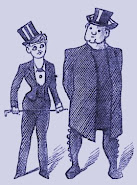
Politics and cartoons have not always been ingredients in an adversarial recipe. This drawing from PUCK is about a politician (publisher William Randolph Hearst) and his own cartoon characters, stars in his chain of newspapers. In 1904 he sought the Democrat Party nomination for President; he would have run against the incumbent Theodore Roosevelt. Around him are the creations of F Opper, Rudolph Dirks, James Swinnerton, and Carl Schultze.  

I recently returned from Washington DC, the Inauguration and related events, and while this will be old news to any who read this after it is archived, it will not be a news report. I was inspired, if that is the right word, to share a little history of presidents and cartoons. Campaigns and commentary by comic artists. It will run over several postings.  

Editorial cartooning, specifically politically cartooning, thrives at times of urgent public debates and vivid personalities.

This statement sounds trite or self-evident, barely a thesis except that – in a corollary of the “Great Man” theory of studying history – urgent public debates and vivid personalities sometimes are shaped and propelled by speeches, tracts… and cartoons.

The timing and the passions of the Revolutionary War, the French Revolution, the Spanish-American War, the New Deal, and various anti-war movements all mightily were influenced by cartoons and cartoonists.

Cartoons not only reflected events but have influenced history. Napoleon said that history was written by the victors – and it is just as true that our views of history often have been shaped by artists, including cartoonists.


The legendary Thomas Nast, a self-caricature, sharpening his most lethal weapon, a pencil. His support of the North in the Civil War, and of President Abraham Lincoln, earned the latter's honorific, "The North's Greatest Recruiting Sergeant." On the other hand, his vicious cartoons against Democrat presidential candidate Horace Greeley helped defeat U S Grant's opponent in 1872. Greeley died only days after the election.

Much of what we think – and know; or think we know – of kings, presidents, generals, candidates, and leaders of movements, has been codified by cartoonists. Oftentimes, major figures in history have been portrayed to their detriment. Sometimes unfairly, sometimes falsely, often spot-on. No matter: our general opinions of: say, Andrew Jackson or Williams Jennings Bryan frequently are what the cartoonists said through their art.

Consider Theodore Roosevelt and Richard Nixon. Do we “know” them through their portraits? Speeches? Caricatures? Truth? Generalizations? Slander? Gossip? Facts? Cartoonists work on the blank slates of daily journalism in ink, but might as well carve in stone.

King Tut: What do we know of how he lived and loved? But his image endures. We have thousands of hours of Nixon on film, yet we remember him mostly through the cartoons of Herblock.

Anyway, it was once so. Henry Major, a caricaturist of an earlier generation, noted that cartoonists more than occasionally were thrown in jail for what they drew. He said that later cartoonists should be arrested for what they don’t draw. If we return to our thesis – that political cartooning thrives during times of urgent debates and vivid personalities, and vice-versa – then we might well be entering a new Golden Age of political cartooning.

Time will tell, but signs are at hand. The Trump presidency, indeed the Trump phenomenon, provides an unprecedented opportunity for political cartoonists to spread their ink-stained wings as seldom before. Stand-up comedians and cable-news wiseguys have stolen a lot of cartoonists' thunder... but, really, only to the extent that artists and newspapers have weakened their platforms and surrendered their turf.

To appreciate the art form of the political cartoon, as much as to contextualize the opportunity presented by Trump, it is instructive to survey the history of political cartooning in America. We will see that the most powerful and memorable – and prescient – work has been at times when vivid personalities have predominated. Whether cartoonists have accurately or satirically recorded, or helped create, their victims, is an open question. That questions is as intractable as the chicken-or-egg conundrum.

Our job – as citizens, commentators, voters – is to appreciate and learn from this amazing art form of graphic humor, variously called “Wordless Journalism,” the “Ungentlemanly Art”: the political cartoon.

At a conference held by the American Association of Editorial Cartoonists in the mid-1970s, Meg Greenfield of the Washington Post addressed the assembled cartoonists and thanked them for providing “laughs” and “morning chuckles.” The assembled cartoonists mostly were outraged. After investing in careers as pictorial commentators they were being dismissed as court jesters. False News. By 
the Washington Post of all institutions (surprise, surprise in view of recent events? See the recent travails of cartoonist Ann Telnaes, chronicled in these columns) .


Several times in American history, there were calls to restrict and even censor, political cartoons. Sometimes these calls, by politicians of course, became legislative proposals. These bills never became laws. Spangler, Montgomery Advertiser, in the 1910s. The most serious of these efforts occured in Pennsylvania about the same time, by an aggrieved Senator Pennypacker.

It was outrageous that someone from the staff of the newspaper home of Herblock could so totally misunderstand the unique gift – yes, art form – of the political cartoon. Maybe cartoonists make their points through laughs. But that one creative tool among many others, is not the only special attribute of cartoons – there is the ideal of truth itself.

Next: The birth of American political cartoons, and the early American cartoonists Benjamin Franklin and Paul Revere. 


Monday, October 28, 2024

AT THE INTERSECTION OF FUNNY AND FUNNY -- CHARLIE CHAPLIN AND BUD FISHER


 AMERICA'S FAVORITE
FUNNY-MAKERS OF THE 1910s MEET


by Rick Marschall

If a poll had been conducted in the early 'teens in America -- and there might indeed have been such surveys -- despite the heavy competition, it is certain that the nation's favorite comedian was Charlie Chaplin; and the nation's favorite comic strip was Mutt and Jeff.

Chaplin burst on the scene in 1914, and was an immediate hit. His tramp character evoked sympathy, affection, a bit of derision, and even identification, all at once. Seemingly overnight he was a major star of the nascent "movies"; there were Chaplin dolls and toys; and there would be two comic strip featuring him as a character (one would be drawn by the newcomer E C Segar, years before Popeye). In 1915 he was writing, producing, and starring in a series of shorts for Keystone; Mutual, Essanay, and United Artists in his lucrative future.

In newspaper comics, Bud Fisher was the virtual father of the daily strip, certainly the first successful one. After Mr A Mutt wowed readers in San Francisco, Fisher moved to New York, was hired by William Randolph Hearst, introduced a second-banana, Jeff; and -- where have we heard this before? -- had a national sensation on his hands. Toys, dolls, sculptures (!), lapel pins, and comics' earliest successful daily-strip reprint books flooded the nation. A coupon-clipping promotion of a Boston newspaper proved that the public would be interested in comic-strip compilations, and the Ball Publishing Company produced five reprint books during the 1910s. 

Here is the cover of Volume 4, published in 1915, the year Chaplin hit it "biggest" in moving-picture theaters... and the year that Mutt and Jeff was so popular that (thanks in part to the legerdemain of syndication pioneer John Wheeler) Bud Fisher slipped away from Hearst and drew his strip for Joseph Pulitzer's New York World.

In a "meeting of the mirths," we see in my copy of this book that the funnyman Bud Fisher inscribed it to his cinematic counterpart, Charlie Chaplin. (Even though he spelled Charlie's name wring. So, he didn't win any spelling bees...) And the book has Charlie's bookplate! This is how he saw himself at the beginning of his career -- the drawing (alas, unsigned) show the Tramp, rather more bedraggled than usual, as a new arrival in the Big City.

Chaplin recently had arrived in America from England as a member of Fred Karno's music-hall troupe (Stan Laurel, his young understudy) and this indeed might have represented his very first impressions of America. 


Sunday, July 19, 2020

Notes on the American News Company – the Founders


By John Adcock

Mr. (Robert) Bonner’s methods of conducting and advertising the Ledger led, among other things, to the establishment of the American News Company. Many of his advertisements to smaller cities referred would be purchasers of the Ledger to local booksellers. Letters from such Mr. Bonner turned over to Mr. (Sinclair) Tousey of Ross, Jones & Tousey, who prepared a circular letter suggesting the regular sale of periodicals. Mr. Tousey afterward became the President of the American News Company, whose first business was so built up. ‘Robert Bonner, the Story of his Life,Gazette and Courier, Greenfield, Mass., July 22, 1899
Histories of dime novels record (briefly) that the American News Company was founded in 1864 by Sinclair Tousey in New York City as a distributor of story papers, magazines, and dime novels.  In time, with a near total control of newspaper and book distribution in the United States, Tousey became the richest and most powerful man in American publishing.

Sinclair Tousey was born in New Haven in 1815 and was working for Erasmus Beadle from the firm’s beginning. The title page of Malaeska, the Indian Wife of the White Hunter by Ann S. Stephens (Beadle's Dime Novels, No. 1, June 9, 1860) shows Beadle & Co. of 141 William Street (they had moved to these premises in May 1860) as the publisher. The firm was run by Irwin Beadle and Robert Adams, with some backing by Erastus Beadle. Also, on the title page at bottom is the name Sinclair Tousey of 121 Nassau Street, NY. Nassau and Ann streets were in “the Swamp,” where Robert DeWitt and most cheap publishers of the fifties and sixties had their offices.

Mary Noel (Villains Galore) notes that by 1860 the two largest newsvendors in America were Ross & Tousey and Dexter & Brother. Ross, Jones & Tousey were wholesale news agents in Nassau Street from 1854 to 1856. From then until 1864 the firm operated as Ross & Tousey. They also sold British periodicals like Punch’s Almanac. Robert M. DeWitt also had offices on Nassau street. In 1858 advertisements show that Dexter & Brother, Long & Farrelly, Hendrickson & Blake, and Dick & Fitzgerald all operated out of Ann street, Samuel Yates on Beckman street, and WM Skelly on Greenwich street. The Phunny Phellow, “a comic illustrated paper” published by Okie, Dayton & Jones, was puffed in the NY Daily Tribune on Dec 3, 1860. It was sold by Ross & Tousey, H. Dexter & Co., Samuel Yates, Hamilton, Johnson and Farrelly, and John F. Feeks & Co.

Henry Dexter, Busy Mans Magazine, May 1, 1910
Poking around in newspaper archives from 1864 I found two advertisements, both in Horace Greeley’s Daily Tribune (Greeley was a good friend of Sinclair Tousey’s). The first from February 6 advertises the American News Company as “successors to Sinclair Tousey and H. Dexter Hamilton and Company.” The second is from March 3 and lists the officers of the ANC

Sinclair Tousey, President
Henry Dexter, Vice-President
John E. Tousey, Secretary
S.W. Johnson, Treasurer
John Hamilton, F. Farrelly} Superintendents

New York Tribune, March 3, 1864
A newspaper paragraph from the June 11, 1904 Rockland County Times identifies Patrick Farrelly as one of the founders. F. Farrelly may have been a typo.  In an article titled News Butchers in The American Mercury (April 1947) Stewart H. Holbrook writes In a fat, handsome brochure the company published in 1944, for its eightieth birthday, a mere nineteen lines of text serves to relate the concern’s long history. Today it has nearly four hundred branches in the United States and Canada and supplies ninety thousand retailers, many of them train butchers, with wares. The brochure displays portraits of The Founders, seven in number, who were George Dexter, Henry Dexter, Solomon W. Johnson, John E. Tousey, John Hamilton, Sinclair Tousey, and Patrick Farrelly.


Rockland County Times, June 11, 1904
The bulk of the ANC founders’ fortunes came from the dime novel and story paper publishers; the Beadle’s. Norman and George Munro, and Frank Tousey. ANC distributed the New York Ledger, New York Weekly, Family Story Paper and Fireside Companion, all published in New York, as well as the Saturday Night published in Philadelphia.

It may be asked why, if these five papers are so successful, others do not become so. The American News Company control this. There is no other News Company, and this has over 50,000 newsstands and stores under its control. It will not send out any other paper of the Ledger class except the five named, and this gives them full control of the situation. More than one unfortunate individual has been swamped in his expectations and purse, by finding that ho could not got his papers upon the newsstands of the country, try as hard as ever he might. – ‘Story Papers, What They Are and How They Manage To Live,’ Amenia Times, June 25, 1888
The growth of the ANC was greatly aided by the growth of railroads after the Civil War. By 1869 railways stretched from coast to coast. Telegraph stations and news depots sprung up at nearly every stop. Railroads were required to transport newspapers and periodicals as second-class bulk mail at a special low subsidized price. This was the era of the street newsboy and his railroading counterpart, the news butcher. News butchers sold candy as well as paper on the trains.

The continuity becomes confusing from here on. Sinclair Tousey died June 16, 1887. Although Tousey continued working in his office up to the day of his death newspapers reported in 1880 that David P. Rhoades was the acting president at the time. Henry Dexter took over as President of the ANC in 1887. Newspaper reports identify Patrick Farrelly, who began life as a news butcher on the railroads, as president in May 1890. Dexter died July 11, 1910, age 98, of cerebral hemorrhage.

Of books the largest dealing is in paper covers. The company bring them to the attention of the news agents all over the world and before the circulating libraries. The establishment is of inestimable value to the small publishing houses, and the immense business carried on by the company Is evidenced by the fact that millions of books and periodicals pass through their hands during the year. Their goods go across the Atlantic, up the Mediterranean, through the Suez Canal, until they meet the current coming from the western coast that goes to Japan and India. A department devoted to wholesale stationery has grown out of the necessities of the business. There are 250 employees in the New York house alone, which is situated in Chambers street, and has been the headquarters of the company since 1877.
The business, probably the largest of its kind in this country, was founded by Sinclair Tousey and Henry Dexter and their associates, Hamilton, Johnson and Farrelly, about twenty-seven years ago. Since Mr. Tousey’s death Mr. Dexter has been president of the company. Mr. Dexter takes no part in public affairs, nor did Sinclair Tousey; but the latter was very well known as a member of the Prison Association, for his connection with the Union League Club and as a close friend of Horace Greeley. The only other business house in the world to which the American News Company may be compared is the one in London known as W.H. Smith & Co. The head of that firm, Mr. Smith, is the government leader in the House of Commons. ‘The American News Company,’ New York Press, 1890
The Sun, June 17, 1887
Canada’s Busy Mans Magazine reported in July 1, 1908 that Henry Dexter “ is in his ninety-sixth year, and although he resigned the presidency of the American News Company some ten or twelve years ago, he still retains a large interest in the company.” George Tyson reportedly acted as President until November 1895. Next (Wild American Pulp Artists tells us) was Solomon W. Johnson, the last survivor of the original founders’ group, who became President and held that office until 1913. A contradiction however: one Henry W. Bellows died in 1913 and was described as formerly a president of the ANC. No dates or further information about Bellows has come to light.

From here we move into the period when ANC (allegedly) threw in their lot with organized crime. During Prohibition, the New York mob was run by Lucky Luciano who brought Italian, Jewish, and Irish gangs under one roof. 

Solomon W. Johnson’s presidential successor was Samuel Shipley Blood, formerly ANC Treasurer. He was in the service of the company and its subsidiaries for 66 years.

Mr. Blood organized the New York News Company as a young man and became manager of International News Company and a vice president of the American News Company, which absorbed the New York News Company. In 1915 he became president, treasurer, and chairman of the board of the American News Company, and soon afterward president of the International News Company.‘S.S. Blood Dies; Retired Head of American News Co.,’ Brooklyn Daily Eagle, Oct 23, 1934
Stephen Farrelly of the ANC was arrested and fined in 1890 for selling the works of Balzac and Tolstoi. In 1917 Farrelly was described as “Directing Manager and Vice-President” of the ANC. 

Harry Gould became President after S.S. Blood. Gould died in 1945 although it was reported he had retired some years previously. William A. Eichhorn was Secretary. There is a seven-year gap in my continuity until 1952 when a July 18 article in the Ottawa Citizen identifies P.D. OConnell as President of the ANC. Henry Garfinkle, who started out in life as a newsboy on the Staten Island Ferry, served as the last president of the American News Company.

I will end with the following paragraph from the online Field Guide to Wild American Pulp Artists. The statement is unsourced, although I believe it may have been based on the memories of pulp artist Norman Saunders, maybe of stories heard or rumored. These allegations will be the subject of a future post. 

Of interest is that mob killer Dion O’Bannion was on the payroll of William Randolph Hearst. According to Ferdinand Lundberg’s 1936 biography Imperial Hearst the gangster was the chief circulation agent for Hearst’s Herald-Examiner from 1917 to 1922 and was bumped off in 1925 over a bootlegging beef. Hagiographies of the historic cast and crew usually gloss over this long period of corruption and collaboration between publishers and organized crime in New York, Chicago, Philadelphia... 

Leaving huge gaps and disinformation in the historical record.


Moses Annenberg, May 1947
During the "roaring twenties" organized crime acquired control of the nationwide system of distribution, trucking, warehousing, and labor unions. The American News Company (ANC) was the most powerful force in publishing. It was controlled by organized crime, but it was headed by William Randolph Hearst, Arthur Brisbane, and Moe L. Annenberg. ‘H.K. Fly,’ Field Guide to Wild American Pulp Artists.

UPDATE: The above quote may be partly true but there is no evidence Hearst, Brisbane and Annenberg headed the ANC. Theodore Peterson noted that
The company practically monopolized the distribution of periodicals when the low-priced magazine appeared in the nineties, but at mid-century it had some competition from the few other distributing agencies, S-M News Company, and organizations controlled by Curtis, Fawcett and Hearst. Magazines in the twentieth century, 1956
To Be Continued…

Part 2 HERE

Tuesday, February 7, 2017

The final Hearst Building at Market and Third in San Francisco, 2017

           
[1] Hearst Building.
WILLIAM RANDOLPH HEARST, for his daily newspaper The Examiner, used several buildings in San Francisco, California. His final one still stands, on the corner of Market and Third — the rebuilt office tower from 1911. The city had eight cable car routes at the time and many cable cars crossed in front of the building. But paper as well as cable cars have since long moved elsewhere. These photos were especially taken for Yesterday's Papers on the 4th of February, 2017.

Photos by Bas Peters
          
[2] In 1938, the 1911 front and lobby were revamped.
[3]
[4] The cut-off SE corner with front entrance. View into Third Street at the South of Market side.
[5] Market Street. View southwest, to Upper Market. Hearst’s earlier office in Market Street (1887 to 1898) was just a block away on the right, corner of Market and Grant.
[6] Market Street. View northeast, to the Ferry Building. Palace Hotel second block on the right. Former San Francisco Chronicle building on the left. Drive down or zoom in on the Ferry tower…
[7]
[8] Entrance to the cocktail bar now housed in Hearst’s former printing basement. Huge rolls of newsprint for The Examiner were loaded down here since 1898 in Hearst’s first office tower, a building destroyed in the 1906 earthquake. 

H

More about Hearst in the upcoming biography and reading of Jimmy Swinnerton (1875-1974) by Huib van Opstal.

Saturday, December 24, 2016

Friday, October 7, 2016

The first five comic books published in 1902

          
Swinnerton’s cover for On and Off the Ark (1902), 1 of the first 5 comic books published by W.R. Hearst.

THE RESULTS ARE IN. Yesterday’s Papers co-editor Huib van Opstal took a closer look at Jimmy Swinnerton (1875-1974). After nearly two years the results of his findings may be published here any day now — a long ‘biography and reading of James Guilford Swinnerton’s life and work.’ 

Many international contacts kindly helped. Shown above is one of the images before it was restored for Yesterday’s Papers.


★ ★ ★ 
   

Monday, July 18, 2016

EXTRA! Hearst’s Yellow Kid Art Trampled – Outcault Furious


 UNSIGNED TRACING OF YELLOW KID ART! 

 ORIGINAL!   New York Journal, Sunday, October 18, 1896. 

 TRACED!   The Denver Evening Post, Friday, October 23, 1896.


W.R. HEARST & R.F. OUTCAULT. The Historic, Glorious, Grand and Colorful move the Yellow Kid made from Pulitzer’s The World to Hearst’s New York Journal on Sunday, 18 October 1896 had a peculiar follow-up, five days later, in The Denver Evening Post, which published a badly traced black-and-white version of the first Hearst page. No further details known. But had Outcault known he would have been furious. The Kid even misses a foot. Click and compare!