Friday, August 31, 2012

Wartime Japanese Postcards


by E.M. Sanchez-Saavedra

The first official postcards appeared in Japan in December 1873, shortly after postage stamps were introduced under emperor Meiji. Return postcards were introduced in 1885, sealed postcards in 1900, and private postcards became common after 1900. Traditional cultural standards of illustration, design and meticulous craftsmanship were applied to the new medium of pictorial postcards. Half-tone photographic printing techniques, mated with delicate color separations, soon made Japanese postcards world famous.

Early 20th Century Japanese Postcard
In addition to providing souvenirs of travel and formal holiday greetings, postcards were recognized early on as a useful propaganda tool to stress the virtues of loyalty, nationalism, reverence, hard work, family ties and military glory. From the Russo-Japanese war of 1904-5 through the early stages of “The Great East Asian War” of 1931-45 (otherwise known as WWII), Japan’s armed forces were plentifully supplied with patriotic postcards at nominal fees. The posed happy soldiers smiling out of the March 1939 cover of Reikishi Shashin (Historical Pictures) in their well-appointed recreation room, could purchase 100 government-authorized cards for the U.S. equivalent of six cents, to send to loved ones at home. These came in sets, wrapped in tissue paper, and featured plain cards – with a place for the censor’s stamp – and pictorial cards. The example with the purple overprint was supplied to units in Manchukuo, Japan’s puppet state in North China. The printed stamp featured a soldier’s helmet surmounted by the dove of peace.

Rekishi Shashin, March 1939
Pictorial card topics were varied. Unlike the bloody scenes of historical samurai combat issued earlier in the century (and echoed by an Italian card commemorating Japanese naval victory over Britain) Japan’s troops generally preferred more artistic depictions of troops in jungle terrain and peaceful, pastoral scenes of Chinese landscapes and buildings. The work of many talented war artists appeared in this miniature form. Styles ranged from austere Zen sketches to hyper realistic full color renderings. Some recalled the incredibly subtle woodblocks of the Ukiyo-e tradition. Comic postcards, featuring crude cartoons and thought balloons, were also available through private purchase, and were widely used on the home front.

Soldier’s Guide to the Japanese Army
Unlike the wild exaggerations of ultra nationalism that filled home front magazines and posters, the postcards used by combat troops reflected a more sober and restrained view of the war. Scenes of a peaceful Chinese countryside evoked nostalgia for the pre-war landscapes that were then being ravaged by the very troops sending these cards to the folks at home.

Tissue Paper Postcard Wrap
In 1940, Premier Hideki Tojo authorized an elaborate illustrated volume, entitled Yasukuni no Emaki (Yasukuni [Shrine] Picture Scroll) to be distributed twice a year to the families of personnel killed in the war. The “Peaceful Kingdom” Shrine in Tokyo, dedicated to Japan’s war dead, was a familiar icon, appearing in all media, including paper money. According to later Shinto belief, the souls of the war dead gather at the shrine to be honored by their families and by the State. All the double-page spreads in the book closely resemble enlarged versions of the military postcards. A touching illustration at the beginning shows a man, woman and child praying at a small shrine for a lost serviceman.

Bloody Samurai Postcard
Two of the cards illustrated below (paratroopers at Palembang and a Chinese bridge) were torn by the same bullet, which must have passed through the owner’s haversack.
  

Italian Postcard

Plain Japanese Military Cards

Yasukuni Shrine Postcard Currency

Soldier, Farmer, and Mechanic

Japanese Machine Gunners with Captured US Flag

Bataan Bombing Raid

Artillery in the Jungle

Japanese Army Heavy Bulldozer

Pushing a Cart Through the Mud

Japanese Paratroops in Palembang, Bullet Damaged

Bridge Postcard with Bullet Damage

Mountain Goat Pagoda

Blue Tile House

Camouflaged Vehicles

Army Camp Show

Yasukuni no Emaki Cover

Yasukuni no Emaki 1

Yasukuni no Emaki 2

Yasukuni no Emaki 3

Tropical Wharf

Thursday, August 30, 2012

Continental Crimes Illustrated


1
2
3
4
5
6
7
8
9
10
11
12
13
14
15
16
17
18
19
20

Source: FLORA.

Wednesday, August 29, 2012

World War I Postcards


The ultra-sentimental World War I era German cards are a good counterpoint to the brash, breezy American comic images.


Courtesy of E.M. Sanchez-Saavedra

Tuesday, August 28, 2012

Mysterious Truelove


Once A Week, December 11, 1859
October 26, 1901.

SWEENY TODD (9th S. vii, 508; viii. 131, 168, 273). – If this gruesome topic is not yet quite exhausted, it may be as well, by way of completion, and in confirmation of the conclusions of myself and MR. CLAYTON, to add the late Mr. Sala’s own words:

“He [an editor] lived long enough to see my first story in print, and mildly to reproach me for some slight grammatical error of which I had been guilty. That was in the year of grace eighteen hundred and forty-six.” – ‘Dead Men Tell No Tales, but Live Ones Do’ (the first of nine stories entitled ‘That Man’s Life; the Story of an Old-fashioned Editor’) by George Augustus Sala. London: John Dicks, &c., n. d.

I have always been under the impression that the legend of ‘The Demon Barber of Fleet Street’ was suggested to the “penny shocker” of the 1830s by the incidents of the cause célebrè in Scotland of the sixteenth century, the revolting trial of Sawney Bean and his associates, introduced by Mr. S.R. Crockett in his powerful romance of ‘The Grey Man of Auchinleck,’ the scene in ‘Sawney Bean’ transferred to London and Fleet Street, where, to my personal knowledge, a penny pie-shop carried on its business in the forties of last century on the very site attributed to it in the tale under discussion. Whether the adjacent house (at that date thriving as a cook-shop, conspicuous for that succulent kind of Yorkshire pudding described by Dickens in ‘David Copperfield’ under the name of “spotted covey,” from the raisins liberally adorning its greasy surface) was a barber’s shop once I do not know.

These two apparently very ancient houses stood about the centre of a group extending from the east corner of St. Dunstan’s Church-yard to the south-west corner of Fetter Lane. Many readers will remember them, for they were demolished but a very few years ago; their upper stories were of wood, and they were surmounted by a peculiar wooden parapet or balustrade gallery overlooking the busy thoroughfare below. When the pie-shop discontinued purveying its special comestibles (and I have, as a boy, many, many times ‘sampled’ its excellent wares), it was carried on as a bookseller’s business under the conduct of a dealer of extremely peculiar views named Truelove, who also long ago disappeared. The house was said to be formerly occupied by the celebrated Mrs. Salmon’s waxworks, when that exhibition early in the 19th century was transferred from “over the way.”

I take the opportunity of adding that the “melodramatic playwright named Saville Faucit” mentioned by MR. CLAYTON, was also an eminent melodramatic actor, Edward Faucit Saville, a predecessor in the ‘breezy’ line of jeune premier, of which an able modern representative of the London stage was the lamented William Terriss, whose tragical death at the hands of an assassin appalled us but, as it were, the other day. To those who fondly remember in the days of their boyhood a partiality for Skelt’s “penny plain and twopence coloured” theatrical portraits, pleasant memories will be recalled by the limned likenesses of E.F. Saville as the pirate king, the bold smuggler, the heroic naval officer, &c. but all will be interested in identifying this player-playwright as the brother of one of the most accomplished actresses that ever with resplendent talents adorned the annals of the British stage, the venerated and respected Lady Martin, whom we all in youth, maturity, and middle age warmly appreciated under the name of Helen Faucit.

GNOMON.

Temple.

(The Athenaeum of 29 April, 1899, mentioned that “Mr. Truelove, the publisher, formerly of the Strand, and latterly of Holborn, has died at an advanced age.”)

November 16, 1901.

SWEENY TODD (9th S. vii, 508; viii. 131, 168, 273, 348). – I trust the Editor and readers of ‘N.&Q.’ will not think me too troublesome if, before this subject is finally wound up, I venture, speaking as a “hack-artist” (descended from a long line of artist-hacks), to say a few words in the hope of saving from total oblivion the name of W. Hornigold, who was the champion artist of the “penny dreadful,” “penny plain and twopence coloured,” school during the forties. In his day he was regarded as unequalled in this line. Vile drawings, extravagant attitudes, overdone action; still there was life, spirit – what you will – let us say, the old Coburg method. Unfortunately he was even better known as a victim of the ubiquitous drink fiend than as an artist. He was, in short, a vulgar modern edition of Richard Savage or Mitford. But I prefer not to say too much about the career of this ill-starred genius. During the later fifties he was sent to the wall by the superior talents of the late Robert Prowse, who combined the dash of “old Horny” with good drawing and a more brilliant style. Thirty or forty years ago publishers who could not afford to pay “Bob” Prowse’s terms used to employ an artist of nearly equal talents named Clifton. Robert Prowse the Younger is, I am glad to say, still “in the thick of the fight.” Hornigold died somewhere during the sixties. I last remember hearing of him as an artist on active service during the winter of 1861-2, when he designed a record poster for Sanger’s (Astley’s) Christmas pantomime. It represented an elephant (the living original of which used to be trotted up and down the Westminster and Kennington roads during the season as an advertisement.) The poster was cut on soft wood and roughly coloured by hand. I would like to add that it was not through ignorance, but through fear of giving offence, that I refrained from mentioning the relationship between Saville Faucit and Lady Martin. Before concluding may I, as an old enthusiast in old china, draw attention to what one might style “criminal crockery”? Some few months back there was a loan collection of old English china at Bethnal Green. I have stupidly forgotten the name of the collector, and the collection has since been removed. But one special feature was a glass case filled with specimens of crude, vulgar, coarsely coloured china-ware, representing murder subjects, such as “The Murder in the Red Barn,” “Stanfield Hall and J.B. Rush,” and so on. Now and then one may see samples of this sort of old crockery in the shop windows; sold for but a few pence fifty years ago; chiefly got up to be hawked through villages and usually swopped for old clothes. Nowadays specimens of this art fetch, I believe, far better prices than they did in the last century. In conclusion, I would wish to thank GNOMON for his kindly references to myself- and to the late G.A. Sala.

Herbert B. Clayton.

The Melodramatic actor referred to by GNOMON was named Edmund (not Edward) Faucit Saville. Mr. Truelove, unless I am mistaken, was in the British Museum Reading-Room a few days ago.

Wm. Douglas.

125, Helix Road, Brixton Hill.

Monday, August 27, 2012

Red, White and Blue – Patriotic Mail of WWII


WWII Patriotic Stickers Cover.
WWII Patriotic Stickers.
WWII Patriotic Stationery.
V Mail Package.
V Mail Folded.
V Mail Opened.

*Images Courtesy of E.M. Sanchez-Saavedra

Saturday, August 25, 2012

WANTED! Yesterday’s Artist…


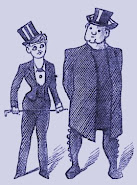
Q. The small illustrations above were recently donated to the archives of the Center for Cartoon Studies at White River Junction, Vermont. CCS would like to identify the artist if possible. Student archivist Cole Closser writes: “Each illustration is in ink, drawn very small on Bristol board, cut to (usually) 7.5 x 6 inches.” When signed, the cartoonist used initials, followed by the year composed. The initial seems to be an A but closer examination discloses a possible J as well, so it may read ‘A.’ or ‘J.A.’ The two samples here are dated 1862 and 1863.

The illustrations would have been drawn as a guide for reproduction by wood-engraving and most likely intended for a comic periodical or boys’ story paper. Punch, begun July 17, 1841, was at the top of the comic pile but was the hardest for an aspiring cartoonist to break into. Often one of the towering mainstays had to die before a cartoonist would be summoned to the Punch offices. Mediocre artists were only occasionally made use of.

The first issue of Punch’s rival Judy; or, the London Serio-comic Journal was not published until May 1, 1867. There was, however, one other paper which had a long life, although few of its cartoonists are remembered today, and that was Fun. It began on September 21, 1861 and lasted until 1900, second in longevity to Punch. At one time the entire run was available digitally but seems to have gotten lost in the memory hole. Google Books has the first volume available HERE.

Another possibility is The Comic News, a short-life weekly penny paper edited by H.J. Byron which ran from July 18, 1863, to May 14, 1864. These periodicals were the most prominent comic journals of the early sixties but there were a dozen fly-by-night comics (the Arrow, The Comet, The Earwig &c., &c.) published by seat-of-the pants publishers floating round London at that time.


When anyone has any suggestions or clues to the identity of the cartoonist we would greatly enjoy hearing about it in the Comments section. Thanks.