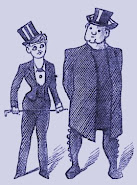
This curious undated print showing a Swiss caricature shop is from Eduard Fuchs “Die Karicatur Der Europaischen Bolter” published by Albert Langan in 1903. The artist is given as "Rudolph Töpffer" but has been identified as a caricature by his father Adam Töpffer.* Rodolphe Töpffer was, according to many scholars, the father of the graphic novel, the father of the American comic book, and recently father of the comic strip.
I strongly disagree with the last assertion, that Töpffer, brilliant as his work was, fathered the comic strip. In England the evolution of the comic strip was a development that was entirely home grown. Leonardo De Sá has a great website devoted to Töpffer and a synopsis of his publishing history is found
here which shows that The Adventures of Obadiah Oldbuck was the first of Töpffer’s comic albums to be introduced in England, in 1841, by the publishers Tilt & Bogue. It was actually an unauthorised copy, of an unauthorized French copy, of the original. The copyists were the brothers Cruikshank.
Even if we discount
George Cruikshank’s early experiments with comic strip conventions in the Scourge in 1815 as a fluke we find an early comic strip appeared in Series seven of The Gallery of Comicalities (c. 1840), a supplement published by Bell’s Life in London and Sporting Chronicle. Although the strip was not signed, William Bates (Notes & Queries 4th S. V. 8 Jan 1870), attributed the comic to John Leech who would later become famous for his Punch caricatures. Quoting Bates >
“Here, too, possibly by the same facile pencil, though in no stray corner is the medicinal worm seen to wriggle, is a remarkable series of fourteen sketches, entitled “Ups and Downs of Life; or Vicissitudes of a Swell,” in which the career of the hero is traced from the “Farewell Spread” in the college-rooms, through many a scene of folly, vice, and extravagance, to the “Closing Scene” in the wards of a hospital. The verses by which this series is illustrated are worthy of their subject.”
Comic strips had appeared even earlier in William Heath's Glasgow based
Looking Glass, first published on 25 Jun 1825. Heath moved to London in 1828 and started a new Looking Glass, which made ample use of the caricatures of Robert Seymour and Robert Cruikshank.

Renton Nicholson's Cockney Adventures illustrated by C. J. Grant One of the earliest British caricaturists to publish sequential strips was Charles Jameson Grant, who signed his works CJG. His comic strips appeared in “
Every Body’s Album and Caricature Magazine,” a bi-weekly single-page broadsheet begun on 1 Jan 1834 and running for at least 37 numbers. Grant was author, artist and editor. This was probably not his first sequential work, Grant was prolific and popular, advertising himself in
Every Body’s as “Author of Maclean and Aiken’s Sporting Ideas, the (original) Caricaturist, a monthly Show-Up, Comic Songs, Tregear’s Flights of Humour, Frontispieces to the Penny Magazine &c., Comic Almanac, Emigration, and upwards of 400 of the most Popular Caricatures of the Day.” In 1842 he was published in “Cleave’s Picture Gallery of Grant’s Comicalities.”
A copy of “Emigration Detailing the Progress and Vicissitudes of an Emigrant” found it’s way to Canada and since it was mentioned circa 1834 in Every Body’s it must have been issued prior to that broadsheet. Emigration is a comic strip dealing with a British family’s adventures in the US and Canada. Emigration is rude, funny, and totally unlike the work of Töpffer. Töpffer’s first comic album “Histoire de Mr. Jabot” did not see print until 1833 in a privately distributed edition of 800 copies. The work did not become available commercially until 1835 and nothing is recorded of the work being noticed at all in England until 1841. Grant’s style owes nothing to Töpffer, his main influence was George Cruikshank. Note also his use of word balloons.


There is a curious entry for the innovative Charles Jameson Grant in the Oxford Dictionary of National Biography for 2004, curious because nothing is known about his life, not his date of birth, not his date of death, nothing save what can be gleaned from his published works. However I did find one newspaper account that appears to refer to our subject in 1842 >
A Very “Gentlemanly” Affair Altogether (6 Feb, 1842)
Two young men of fashionable appearance, who gave their names James Grant and William Wilson, were charged at the Clerkenwell police-court, on Wednesday, with assaulting a quiet, harmless little cobbler and his wife, who were proceeding homewards through Judd-street, Brunswick-square, at eleven o’clock the preceding evening. Grant was a slightly formed young fellow, about six feet high; while his co-defendant was a chubby, and withal a very sunny, good-humoured looking person, seemingly quite incapable of anything like the violence charged against him.
It appeared from the evidence of William Bunyan, the complainant, that he and his wife were walking towards their residence in Brill-row, Somers-town, when, on passing through Judd-street, he heard one of the defendants, who were behind him, say to the other, “I say, let us give this old man and woman a sit on the road,” and upon turning round he saw his old “‘ooman” sprawling in the kennel, the “action” having been suited to the word” instantaneously. He (the complainant) went up to the taller man to expostulate with him on such gross misconduct, but the only explanation granted was a severe cudgelling about the shoulders with a stout cane, which Mr. Grant carried with him, and which he exercised with great vigour, and then put himself in a boxing attitude, as if desirous of showing his skill and dexterity in the “game of fives.” Witness, though unused to the milling mood, was not to be daunted by his superior display of physical force. He “tackled” with his antagonist, they had a struggle together, and both fell, when the “old woman” rushed up, not in wrath but
“With the tender fierceness of the dove,
Pecking the hand that hovers o’er her mate,”
Took the cane from Grant’s possession, and practised with good effect the lesson which he himself had just inculcated. -- This evidence was corroborated in its main points by the wife, who proved that “Bunyan’s progress” had been rudely interrupted, and she herself pitched into the “slough of despond,” in the way described.
Her clothes were covered with mud, and she was much hurt by the ill-treatment to which she had been subjected. A constable coming up the defendants were given into custody, both being drunk at the time, according to the evidence of the policeman who took them to the station-house. -- Grant denied that he was the aggressor in the first instance. He was rudely pushed against, he said, by the old man and woman. -- Mr. Greenwood suggested that, instead of endeavouring to palliate his conduct, it would be better for the defendant to make some recompense for the injury and assault which had been proved against him. -- With this understanding the parties retired; but on returning to the court it appeared that Grant had made the princely offer of 5s., which was afterwards raised to 10s., but rejected. -- Mr. Greenwood: Unoffending persons shall not be knocked down in the streets with impunity. As no charge has been established against Wilson, he is dismissed. I had hoped you would have acted upon my suggestion, and made some compensation; but, as you have not done so, you are fined 50s., or a months imprisonment. -- Grant was then locked up, but the fine was subsequently paid by “Mr. Wilson.” -- The prisoners, it was generally surmised, had given fictitious names.
They treated the matter very lightly, and the taller one, who was said to be an eminent artist in the Cruikshankian line, amused himself during the investigation by sketching on his thumb nail the “phiz” of the constable who took him into custody - quite a subject, by the way, for the exercise of the genius of a comic artist.
*
Thanks to Thierry Smolderen


 Posts
Posts