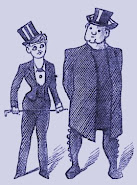
Friday, March 15, 2013

Bull and His Burdens – in 1870s Punch

       
[1] Zulu War & Bull in Punch, February 8, 1879, double-page spread by John Tenniel.
  
by E.M. Sanchez-Saavedra

The Zulu War lasted a little over 5 months, from January 11 to July 4, 1879. This first Zulu War image above, by John Tenniel, shows a weary John Bull, mired in ‘HARD TIMES,’ bearing the burdens of (l. to r.) a Russian, an Afghan, an Egyptian, a Scot, an Irishman and a Zulu. And the ‘Phrase-Book’ below is devastatingly true. Deposed King Cetewayo was shamelessly exploited by advertisers, much as Geronimo would later appear in U.S. car ads.

[2] Punch staff artist John Tenniel (b.1820), who signed his work ‘JT’. Portrait in Review of Reviews, London, 1891.
[3] Franco-Prussian War in Punch, July 23, 1870, by Tenniel.
[4] Franco-Prussian War in Punch, September 10, 1870, by Tenniel.
[5] Zulu War & Morals in Punch, March 1, 1879, by Tenniel.
[6] Zulu War & Phrase-Book For The Use of General Officers, in Punch, March 15, 1879, illustrated by J. Priestman Atkinson.
[7] Zulu War & F.-M. Punch, in Punch, March 22, 1879, by Tenniel.
[8] Zulu War & King Cetewayo in Punch, July 8, 1882, by Linley Sambourne.
•¡•
     

Tuesday, March 12, 2013

The faces of The New Boy

    
[1] Brooklyn Daily Eagle, February 2, 1896.
I’M VERY pleased to read Peter Jensen Brown’s The Real Alfred E. which raises new questions about the origin of the Alfred E. Neuman image so familiar to readers of MAD magazine. However, Brown’s findings raise a few other questions in my mind. First a short chronology of The New Boy on the stage will set the scene. 

[2] Grossmith, in The Bookman, Volume 37.
The New Boy, a play inspired by F. Anstey’s popular book Vice Versa, opened in London on February 28, 1894, with Weedon Grossmith in the title role, and ran for fourteen months in England, ending round April 1895. The first American show of The New Boy was produced in Bethlehem, Pennsylvania, on September 14, 1894 with British actor Willis Searle, whom one writer described as ‘droll and diminutive,’ as the boy. 

[3] Grossmith, in Munsey’s Magazine, 1909.
Searle’s acting was criticized by many including New York’s Spirit of the Times who on October 13, 1894, reported
‘Following the advice of the Spirit, shrewd manager Charles Frohman has sent Willis Searle into the provinces and engaged a new boy for the New Boy, at the Standard. Any change would have been for the better; but James T. Powers is a decided improvement. He looks the part and gets some fun out of it.’ 
[4] James T. Powers, 1897.
The words ‘he looks the part’ may be significant; suggesting that the actors were imitating the promotional image used on posters and advertising rather than the poster being inspired by the phiz of any particular actor. 

As Brown notes: 
‘James T. Powers performed the role until early December, 1894, and continues performing the role on the ‘original cast’ tour through April, 1895. Bert Coote played the role in the first national tour that started in mid-November, 1894, and continued for more than a year, ending in early 1896. Bert Coote later purchased the rights to produce the play himself. His independent production toured the country through 1899.’
[5] Grossmith, in Behind the Footlights, 1904.
THE FIRST actor to take on the role was Weedon Grossmith (1854-1919), who began life as an aspiring artist, studying at the West London School of Art before becoming a successful portrait painter. He illustrated his brother George Grossmith’s celebrated book Diary of a Nobody and exhibited paintings at the Royal Academy. In 1888 he took to the stage, touring America with Rosina Vokes theatrical company. Back in London he appeared in Sir Henry Irving’s Robert Macaire and Richard Mansfield’s Prince Karl. He was manager and lessee of Terry’s Vaudeville Theatre in London from 1894 to 1896, and it was here that the farce The New Boy was first produced. 
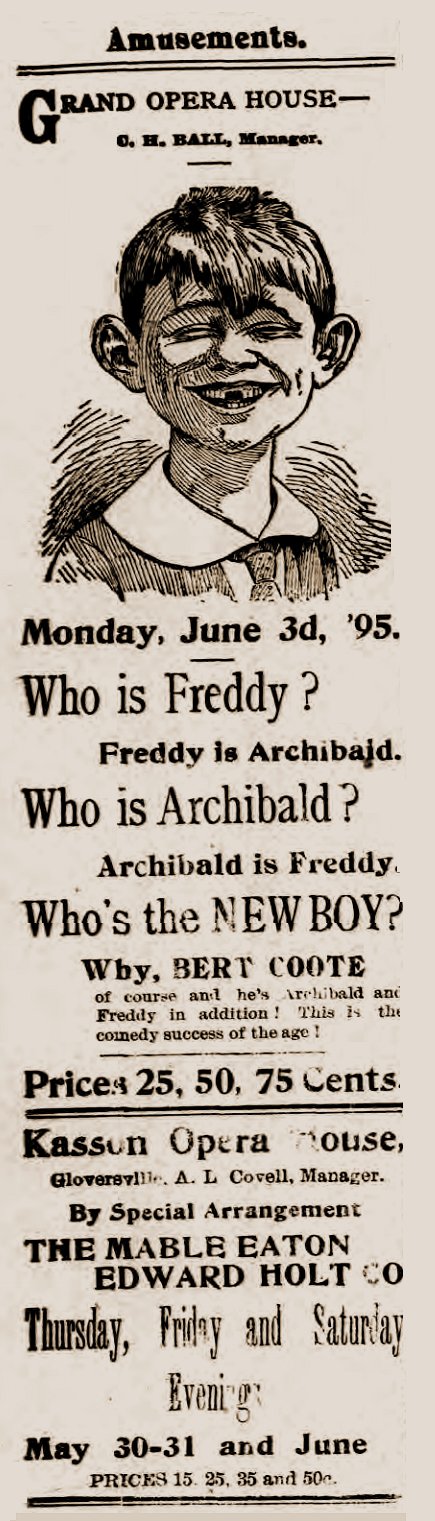
[6] ‘Who’s the NEW BOY?…’ June 3, 1895.
One tantalizing fact is that Weedon Grossmith was also well regarded as a caricaturist and as a member of the Savage Club formed close friendships with all the leading caricaturists of the day, including Harry Furniss and Linley Sambourne. This may be significant since it still has not been established if the caricatured face on The New Boy advertisements originated in London or America. Grossmith or one of his friends may actually have designed the original poster image (shown HERE when Bert Coote was enacting The New Boy) on which all others were based. That’s pure speculation at this point in time but intriguing nonetheless. 

[7] New York Dramatic Mirror, April 6, 1895.
Like Brown I could find no images of Willis Searle, also an Englishman, but his acting in the part of The New Boy was widely criticized. And, contrarily, he was widely praised in America for his part as the female impersonator in Charlie’s Aunt. 

[8] Bert Coote, Rochester Democrat, February 5, 1899.
One of the most popular New Boys, and the last, was British born Bert Coote. He took to the footlights at age 5 and spent twenty years as a stage comedian in the United States. He began working in films in 1930 and died at his London home on September 3, 1938. He was seventy years old. 

[9] James T. Powers, Marie Burroughs Art Portfolio of Stage Celebrities, 1894.
James T. Powers was born in New York on April 26, 1862, and began life as a Western Union messenger boy and clerk in a tea store. He first ventured on stage with a minstrel troupe in Vernon, NY, which gave one performance before folding. He knocked around in variety and vaudeville until 1882 when he played a comic policeman in Evangeline. In 1897, after playing The New Boy, he toured with Daly’s musical comedy company and the Shuberts.

[10]
[11] James T. Powers as The New Boy, November 18, 1894.
Many of the images of comedian James T. Powers do bear a ‘real-life’ resemblance to Alfred E. Neuman but as seen in newspaper drawings of Powers playing the Boy onstage the resemblance is nonexistent, another reason to suppose that the image may have been prepared before the actor was hired for the part. On the other hand the artist may have pictured the scene from the vantage-point of a newspaper desk, or a barstool.

[12] F.M. Howarth strip cartoon in Puck, September 6, 1893.
A few questions remain – did the face of the Boy originate in England or America? Who designed the face, was it a nonentity or the work of an already celebrated English or American cartoonist? Who drew the original image – the Ur-image? In previous posts I pointed out the Neuman resemblance in pre-1894 Puck cartoons by F. Opper and F.M. Howarth. 

[13] F. Opper, March, 1888.
WAS that serendipity or was The New Boy image taken from a previous source? Thanks to The Real Alfred E. we have new avenues to explore. At this point a thorough search for New Boy advertisements in British periodicals for the period 1893-96 is needed to ascertain whether the face originated in England or America. 

[14] New York Tribune Illustrated Supplement, unknown date.
*‡*

Monday, March 11, 2013

The Real Alfred E. Neuman?

 
James T. Powers, Tacoma Times, March 7, 1911
Is the quest for the origin of Alfred E. Neuman over? Read The Real Alfred E. by Peter Jensen Brown HERE and judge for yourself...

Sunday, March 10, 2013

Charlie Peace at the Nottingham Playhouse

    
Opening Night early October 2013!
If you happen to be in Nottingham in October keep your eyes open for the melodrama Charlie Peace – His Amazing Life and Astounding Legend (HERE). Michael Eaton is the dramatist, celebrated graphic artist Eddie Campbell (‘From Hell’) worked on the set designs by Barney George, and the director is Giles Croft. If this property ever gets optioned as a film might I suggest hiring Daniel Day-Lewis for the title role?

The Cream of FUN


[1] cover by Frederick Barnard, c.1872.

E.M. Sanchez-Saavedra turned up the following squibs and cartoons from his ‘mouldy crypt.’ Fully titled The Cream of FUN. Selected and Arranged by Tom Hood. With Two Hundred and Fifty Pictures. It is undated but an internal advertisement refers to a pamphlet on wines for 1873, so that’s as good a clue as any. Tom Hood lived from 1835 to 1874. The cover is monogrammed by Frederick Barnard (aka Fred); the others seem to be by Barnard, John Gordon Thomson and ‘Fitz.’ There is a nice image of the crowds outside the Fleet Street offices of FUN monogrammed with a mirrored B and an arrow — definitely a puzzler as to the identity of this artist.
 
[2]
[3]
[4]
[5]
[6]

Tuesday, March 5, 2013

The Detective, 1888 – A Trade Newspaper for Gumshoes


[1] 1924, Buster Keaton, film still of Sherlock, Jr.
 by E.M. Sanchez-Saavedra

SINCE the days of Edgar A. Poe’s Monsieur C. Auguste Dupin, fictional detectives have loomed large in the American consciousness. Lost in the flood of Victorian sleuths, Hawkshaws, ferrets, gumshoes and Peelers were the genuine articles, both official police officers and private investigators. The term ‘private eye’ was derived from the motto of Allen Pinkerton’s national agency: ‘We Never Sleep’ and a wide-open eye.  At least one dime novel, Frank Dumont’s 1878 Wide-A-Wake, The Robber King; or, The Idiot of the Black Hills, published in Beadle’s New York Dime Library, appropriated the logo without permission. (Pinkerton himself was not above publishing sensationalized versions of some of his notorious cases in dime novel format.)

[2] Beadle’s New York Dime Library, No. 60, Vol. 5.
A small publishing firm in Cedar Rapids, Iowa began issuing an eight-page monthly trade paper called simply The Detective, around 1885. Unlike Richard Kyle Fox’s National Police Gazette in New York, or Boston’s Illustrated Police News, this paper was not geared to sensational pictorial coverage of crimes and society peccadillos. Although lead articles, such as ‘How To Carry A Pistol,’ evoked a blood and thunder atmosphere, the paper reported on innovations in crime-fighting techniques and apparatus and published mug shots of wanted felons. Only a few years after New York’s Daily Graphic began printing grainy halftone photographs, rather than redrawn zinc cuts, The Detective’s rogue’s gallery columns included halftones among the traditional sketches. (‘Political correctness’ obviously played no role in the descriptions of these evildoers.)

[3] The Detective, Vol. IV, July 1888.
According to publisher P.C. Holland, his paper was intended ‘for public inquiry, not only in regard to criminals, but very largely, in the employment of inquiries for missing people and stolen property.’ For what he termed ‘secret correspondence and inquiries,’ a ‘branch of the business,’ called The Iowa Detective Association, employing independent ‘good live’ agents throughout the U.S., Canada ‘and other English speaking countries,’ had been incorporated in January 1883.

[4] 
The 1880s was the decade in which scientific criminology began to infiltrate law enforcement. The over-elaborate and subjective Bertillon system of accurate physical measurements and photography soon replaced vague verbal descriptions, such as ‘he has a down look,’ or ‘a hangdog expression,’ or ‘exhibits a criminal physiognomy.’ (One of the major obstacles to capturing Jesse James was the lack of an accurate physical description or a photograph taken after the age of sixteen.) The forensic sciences were still in their infancy, but the chain of events leading from basic fingerprint comparison to today’s DNA procedures was put into motion in the 1880s and ’90s. (Although human fingerprints had been proven individually unique as early as 1788, the next step took a century to put into practice.)

[5]
Perhaps the most intriguing feature to modern eyes is the array of woodcuts of police equipments, from badges to concealed cane guns, including a chilling array of ‘darbies,’ handcuffs, ‘nippers,’ ‘come-alongs,’ and other restraints. Fans of period detective dramas such as The Murdoch Mysteries will recognize the dark lanterns, truncheons, whistles, tin cash boxes and padlocks advertised for sale. Bostonian Edward Davis Bean manufactured a line of such paraphernalia. His breechloading cane gun, first patented in November 1885, was manufactured by the Cyclist’s and Sportsman’s Gun and Rifle Company of Kittery, Maine. Intended as a defense for hikers and cyclists against vicious dogs and footpads, this nasty concealed firearm could obviously be put to more sinister uses. The Detective Publishing Company was – surprise, surprise – the Northwest agency for Bean’s products. His portrait figured prominently in his ad.

[6]
The ‘wages of sin’ received fair coverage as well. On page one of the July 1888 issue is a rather flippant notice that New York was about to substitute electrocution for the gallows during the year. This announcement was a bit premature. Although Thomas Edison conducted a series of lethal experiments on animals during 1888, largely to prove that rival George Westinghouse’s Alternating Current was a deadly menace, New York did not adopt the electric chair until 1889. William Kemmler would be the first condemned prisoner to die in the device in August 1890. (The procedure was so botched that Kemmler took eight minutes to die horribly.) As The Detective put it, the future ‘taking off’ of a murderer by electricity promised to be a ‘shocking affair.’

[7]
Thanks to the romantic aura conferred on detectives by dime novels, it is likely that this trade paper had a wider readership than merely law enforcement professionals. No doubt small boys tried to memorize the features of wanted fugitives in the hopes of spotting ‘Bill the Brute’ or ‘Pugsley Hurley’ and claiming the reward.

[8]
The image of the hard-boiled square-jawed two-fisted investigator rescuing damsels in distress and carting legions of malefactors to jail continues to fascinate. He is Dick Tracy, Sam Spade, Mike Hammer, Sherlock Holmes, et al., operating in a film noir world of trench coats, wet streets and garish neon lights, or Hansom cabs, noisome slums and suffocating fog. Keen of eye, sharp of intellect and handy with a revolver, the classic detective remains an enduring cultural myth

[9]
[10]
[11]
[12]
[13]
[14]
[15] Detective Library, No. 724.
[16]
[17]
[18]
[19]
[20]
[21] Beadle’s New York Dime Library, No. 749, Vol. LVIII.
[22]
[23] Murdoch Mysteries, CBC Television.