Happy New Year...
and
Old Years Too!
Happy New Year...
and
Old Years Too!
Peanuts, however, will not soon leave the houses of our memories – fond recollections, conversations, even attitudes toward life and wisecracks about the heavenlies.
There will never be a Good Bye. Hardly even a Good Grief, except when we need that sort of security blanket.
+++
by Rick Marschall
One of cartooning's natural talents, an "artist's artist," the gentle genius Gluyas Williams was asked for an autograph in 1932. He responded to the aspiring cartoonist (named Tom Sanders) with more -- a hand-written letter.
Mr Williams at the time was a nationally admired cartoonist who recently had switched his prodigious work from Life magazine to The New Yorker; also drew for other publications; produced a daily newspaper panel for John Wheeler's Bell Syndicate (many featuring the urbane character Fred Perley); was illustrating many books, most notably the collections of Harvard classmate Robert Benchley; drew advertising art... and much more. An unending fount of brilliant humor, flawlessly executed, and (as the owner of many Gluyas Williams originals, I can attest) drawn almost always perfectly -- that is, almost never a correction or cross-out. Amazing.
There was joy in his work -- or at least satisfaction. He never showed malice, though he focused (and titled) his series "life's little foibles." His was a happy world, inhabited by petite bourgeoise folks, going about everyday tasks with which his comfy middle-class readers identified. He never aimed for slapstick nor guffaws; rather comic irony and chuckles.
In fact, Gluyas Williams told me (for I became a friend at the end of his life) that very early in The New Yorker's days he actually scolded the magazine's founder Harold Ross who wanted one of his submissions to show more physical humor. Mr Williams returned the artwork unchanged and explained that the best humor was understated. Ross agreed, and this exchange possibly changed the trademark tone of New Yorker humor forevermore. Gluyas Williams was a modest man, and I cannot believe this story was an empty boast. Not even a full boast, just a memory of an exchange.
Quietly (the typical mode) Mr Williams slipped into semi-obscurity later in life. Brian Walker of the Museum of Cartoon Art edited the National Cartoonists Society album in the 1970s, compiling biographies of living and dead cartoonists, and listed Gluyas Williams as "deceased." In a Nietzschean sense, to some I suppose he was.
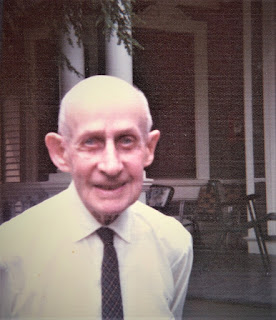
On a visit with Gluyas Williams exactly 50 years ago, I took his photograph. (He was then living in a nursing home, not for any disability of his, but to be with his wife who was infirm.) I interviewed him -- versions have appeared in Cartoonist PROfiles, The Comics Journal, and nemo magazine. I asked him to counter-sign a book he had illustrated exactly 50 years before that -- an "association-piece" that was an inscription by the author, the brilliant Robert Benchley to his fellow Life staffer, Robert E Sherwood, later an award-winning playwright and assistant to Franklin Roosevelt.
Reverting To Mr Williams' fan letter of 1932. "I am very glad to send you my autograph, and I hope that you will realize your ambition of becoming a cartoonist. It's lots of fun (at times) to be one, but there are lots of days when I'd rather be a brick-layer." An urbane reflection of frustration -- perhaps short-lived in Williams World -- not a primal scream but a primal sigh, just as might have been quietly vented by Fred Perley.
The "wars" also featured cartoonists themselves as weapons, objectives, prizes, and goals. many of the great early artists of the Funny Pages switched employers and venues, sometimes dissatisfied with their employers (we have documented that Block seriously annoyed numerous of his cartoonists to the point of their quitting Hearst)... but usually having their services bid and outbid by hungry publishers.
There is a story -- if not true it virtually encapsulates the truth of the times -- that T E Powers spent an afternoon in a Park Row bar, not working for Joseph Pulitzer of the New York World nor William Randolph Hearst of the Journal, but receiving reports from office boys how his salary was going up and up as the two publishers bid against each other for his services. (Hearst won out.)
Frederick Burr Opper drew for the New York Herald (and Puck Magazine) until purloined by Hearst. Rudolph Dirks was hired away from Hearst by Pulitzer; so was Bud Fisher with the assistance of syndicate pioneer John Wheeler. Winsor McCay drew for James Gordon Bennett's two newspapers before Hearst hired him away. George Herriman drew for the World but eventually settled in the Hearst stable. R F Outcault, whose Yellow Kid can be cited for inaugurating this crazy transmigration, worked for Pulitzer, then Hearst, then Pulitzer again, then the Herald, then Hearst until his retirement.
In the eyes of the voracious publishers (benign godfathers they were, when all is said and done; or wet-nurses) there was no bigger star in their constellations than George McManus. He had attracted the attention of Pulitzer in their original working environs of St Louis; then McManus drew for Pulitzer's New York World.
McManus the cartoonist had a short gestation as a struggling stylist; soon his artwork was polished, handsome, mannered... and funny. As a creator, he created multiple strips starring in multiple titles. His premises were funny, and his narratives flowed like stage-plays. In fact his several creations did become Broadway musicals. And his characters appeared on the market as toys and in games.
Probably the most popular of his strips was The Newlyweds, a one-premise strip (as most early comics were) about an obstreperous baby. When McManus switched to Hearst he continued the strip but renamed it Their Only Child!, finessing a sticking-point of other mutinies like Mutt and Jeff and The Katzenjammer Kids whose titles became bones of contention.
McManus created another strip for Hearst, a Sunday page called The Whole Bloomin' Family. It is curious to note that Bringing Up Father, which commenced full-term as a Hearst feature in 1913, never was a Sunday page until six years later. After that it became the major strip among Hearst and King Features' properties for years. It owned the front pages of the Hearst chain's Sunday comic sections until supplanted by Blondie in the early 1950s.
In the 1917 promotion book, McManus was allowed to illustrate the stars in his galaxy including characters he had created, and left, at Pulitzer's shop. We see the eponymous star of Let George Do It; Rosie and her Beau; and Panhandle Pete. In addition, Snookums Newlywed and his parents; the Whole Bloomin' Family; and Jiggs and Maggie of Bringing Up Father.
by Rick Marschall
Ann Telnaes has won her second Pulitzer Prize. The freelance political cartoonist was profiled in Yesterday's Papers on January 4 of this year when she resigned as the Washington Post's editorial cartoonist. Her citation this year read: "For delivering piercing commentary on powerful people and institutions with deftness, creativity—and a fearlessness that led to her departure from the news organization after 17 years."
| Year | Winner | Organization | Rationale |
|---|---|---|---|
| 1922 | Rollin Kirby | New York World | "For 'On the Road to Moscow.'" |
| 1923 | No award given. | ||
| 1924 | Jay Norwood Darling | Des Moines Register & Tribune | "For 'In Good Old USA.'" |
| 1925 | Rollin Kirby | New York World | "For 'News from the Outside World.'" |
| 1926 | D. R. Fitzpatrick | St. Louis Post-Dispatch | "For 'The Laws of Moses and the Laws of Today.'" |
| 1927 | Nelson Harding | Brooklyn Daily Eagle | "For 'Toppling the Idol.'" |
| 1928 | Nelson Harding | Brooklyn Daily Eagle | "For 'May His Shadow Never Grow Less.'" |
| 1929 | Rollin Kirby | New York World | "For 'Tammany.'" |
| 1930 | Charles R. Macauley | Brooklyn Daily Eagle | "For 'Paying for a Dead Horse.'" |
| 1931 | Edmund Duffy | The Baltimore Sun | "For 'An Old Struggle Still Going On.'" |
| 1932 | John T. McCutcheon | Chicago Tribune | "For 'A Wise Economist Asks a Question.'" |
| 1933 | H. M. Talburt | The Washington Daily News | "For 'The Light of Asia.'" |
| 1934 | Edmund Duffy | The Baltimore Sun | "For 'California Points with Pride!'" |
| 1935 | Ross A. Lewis | Milwaukee Journal | "For 'Sure, I'll Work for Both Sides.'" |
| 1936 | No award given. | ||
| 1937 | C. D. Batchelor | New York Daily News | "For 'Come on in, I'll treat you right. I used to know your Daddy.'" |
| 1938 | Vaughn Shoemaker | Chicago Daily News | "For 'The Road Back.'" |
| 1939 | Charles G. Werner | Daily Oklahoman | "For 'Nomination for 1938.'" |
| 1940 | Edmund Duffy | The Baltimore Sun | "For 'The Outstretched Hand.'" |
| 1941 | Jacob Burck | Chicago Daily Times | "For 'If I Should Die Before I Wake.'" |
| 1942 | Herbert Lawrence Block | Newspaper Enterprise Association | "For 'British Plane.'" |
| 1943 | Jay Norwood Darling | Des Moines Register & Tribune | "For 'What a Place For a Waste Paper Salvage Campaign.'" |
| 1944 | Clifford K. Berryman | The Evening Star | "For 'But Where Is the Boat Going?'" |
| 1945 | Sergeant Bill Mauldin | United Feature Syndicate, Inc. | "For distinguished service as a cartoonist, as exemplified by the cartoon entitled, 'Fresh, spirited American troops, flushed with victory, are bringing in thousands of hungry, ragged, battle-weary prisoners,' in the series entitled, 'Up Front With Mauldin.'" |
| 1946 | Bruce Alexander Russell | Los Angeles Times | "For 'Time to Bridge That Gulch.'" |
| 1947 | Vaughn Shoemaker | Chicago Daily News | "For his cartoon, 'Still Racing His Shadow.'" |
| 1948 | Reuben L. Goldberg | New York Sun | "For 'Peace Today.'" |
| 1949 | Lute Pease | Newark Evening News | "For 'Who Me?'" |
| 1950 | James T. Berryman | The Evening Star | "For 'All Set for a Super-Secret Session in Washington.'" |
| 1951 | Reg (Reginald W.) Manning | Arizona Republic | "For 'Hats.'" |
| 1952 | Fred L. Packer | New York Mirror | "For 'Your Editors Ought to Have More Sense Than to Print What I Say!'" |
| 1953 | Edward D. Kuekes | Cleveland Plain Dealer | "For 'Aftermath.'" |
| 1954 | Herbert L. Block (Herblock) | The Washington Post and Times-Herald | "For a cartoon depicting the robed figure of Death saying to Stalin after he died, 'You Were Always A Great Friend of Mine, Joseph.'" |
| 1955 | Daniel R. Fitzpatrick | St. Louis Post-Dispatch | "For a cartoon published on June 8, 1954 entitled, 'How Would Another Mistake Help?' showing Uncle Sam, bayoneted rifle in hand, pondering whether to wade into a black marsh bearing the legend 'French Mistakes in Indo-China.' The award is also given for distinguished body of the work of Mr. Fitzpatrick in both 1954 and his entire career." |
| 1956 | Robert York | Louisville Times | "For his cartoon, 'Achilles' showing a bulging figure of American prosperity tapering to a weak heel labeled 'Farm Prices.'" |
| 1957 | Tom Little | The Nashville Tennessean | "For 'Wonder Why My Parents Didn't Give Me Salk Shots?' Published on January 12, 1956." |
| 1958 | Bruce M. Shanks | Buffalo Evening News | "For 'The Thinker,' published on August 10, 1957, depicting the dilemma of union membership when confronted by racketeering leaders in some labor unions." |
| 1959 | William H. (Bill) Mauldin | St. Louis Post-Dispatch | "For 'I won the Nobel Prize for Literature. What was your crime?' Published on October 30, 1958." |
| 1960 | No award given. | ||
| 1961 | Carey Orr | Chicago Tribune | "For 'The Kindly Tiger,' published on October 8, 1960."[12] |
| 1962 | Edmund S. Valtman | The Hartford Times | "For 'What You Need, Man, Is a Revolution Like Mine,' published on August 31, 1961." |
| 1963 | Frank Miller | Des Moines Register | "For a cartoon which showed a world destroyed with one ragged figure calling to another: 'I said we sure settled that dispute, didn't we!'" |
| 1964 | Paul Conrad | The Denver Post | "For his editorial cartooning during the past year" |
| 1965 | No award given. | ||
| 1966 | Don Wright | The Miami News | "For 'You Mean You Were Bluffing?'" |
| 1967 | Patrick B. Oliphant | The Denver Post | "For 'They Won't Get Us To The Conference Table...Will They?' Published February 1, 1966."[13] |
| 1968 | Eugene Gray Payne | The Charlotte Observer | "For his editorial cartooning in 1967." |
| 1969 | John Fischetti | Chicago Daily News | "For his editorial cartooning in 1968." |
| 1970 | Thomas F. Darcy | Newsday | "For his editorial cartooning during 1969." |
| 1971 | Paul Conrad | Los Angeles Times | "For his editorial cartooning during 1970." |
| 1972 | Jeffrey K. MacNelly | Richmond News-Leader | "For his editorial cartooning during 1971." |
| 1973 | No award given. | ||
| 1974 | Paul Szep | The Boston Globe | "For his editorial cartooning during 1973." |
| 1975 | Garry Trudeau | Universal Press Syndicate | "For his cartoon strip Doonesbury." |
| 1976 | Tony Auth | The Philadelphia Inquirer | "For 'O beautiful for spacious skies, For amber waves of grain,' published on July 22, 1975."[14] |
| 1977 | Paul Szep | The Boston Globe | |
| 1978 | Jeffrey K. MacNelly | Richmond News Leader | |
| 1979 | Herbert L. Block | The Washington Post | "For the body of his work." |
| 1980 | Don Wright | The Miami News | |
| 1981 | Mike Peters | Dayton Daily News | |
| 1982 | Ben Sargent | Austin American-Statesman | |
| 1983 | Richard Locher | Chicago Tribune | |
| 1984 | Paul Conrad | Los Angeles Times | |
| 1985 | Jeff MacNelly | Chicago Tribune | |
| 1986 | Jules Feiffer | The Village Voice | |
| 1987 | Berke Breathed | The Washington Post Writers Group | |
| 1988 | Doug Marlette | The Atlanta Constitution and Charlotte Observer | |
| 1989 | Jack Higgins | Chicago Sun-Times | |
| 1990 | Tom Toles | The Buffalo News | "For his work during the year as exemplified by the cartoon 'First Amendment.'"[15] |
| 1991 | Jim Borgman | The Cincinnati Enquirer | |
| 1992 | Signe Wilkinson | The Philadelphia Daily News | |
| 1993 | Stephen R. Benson | The Arizona Republic | |
| 1994 | Michael P. Ramirez | Commercial Appeal | "For his trenchant cartoons on contemporary issues." |
| 1995 | Mike Luckovich | The Atlanta Constitution | |
| 1996 | Jim Morin | The Miami Herald | |
| 1997 | Walt Handelsman | Times-Picayune | |
| 1998 | Stephen P. Breen | Asbury Park Press | |
| 1999 | David Horsey | The Seattle Post-Intelligencer | |
| 2000 | Joel Pett | Lexington Herald-Leader | |
| 2001 | Ann Telnaes | Los Angeles Times Syndicate | |
| 2002 | Clay Bennett | The Christian Science Monitor | |
| 2003 | David Horsey | The Seattle Post-Intelligencer | "For his perceptive cartoons executed with a distinctive style and sense of humor." |
| 2004 | Matt Davies | The Journal News | "For his piercing cartoons on an array of topics, drawn with a fresh, original style." |
| 2005 | Nick Anderson | The Courier-Journal | "For his unusual graphic style that produced extraordinarily thoughtful and powerful messages." |
| 2006 | Mike Luckovich | The Atlanta Journal-Constitution | "For his powerful cartoons on an array of issues, drawn with a simple but piercing style." |
| 2007 | Walt Handelsman | Newsday | "For his stark, sophisticated cartoons and his impressive use of zany animation." |
| 2008 | Michael Ramirez | Investor's Business Daily | "For his provocative cartoons that rely on originality, humor and detailed artistry." |
| 2009 | Steve Breen | The San Diego Union-Tribune | "For his agile use of a classic style to produce wide ranging cartoons that engage readers with power, clarity and humor." |
| 2010 | Mark Fiore | Self-syndicated; appearing on SFGate.com | "For his animated cartoons appearing on SFGate.com, the San Francisco Chronicle Web site, where his biting wit, extensive research and ability to distill complex issues set a high standard for an emerging form of commentary." |
| 2011 | Mike Keefe | The Denver Post | "For his widely ranging cartoons that employ a loose, expressive style to send strong, witty messages." |
| 2012 | Matt Wuerker | Politico | "For his consistently fresh, funny cartoons, especially memorable for lampooning the partisan conflict that engulfed Washington." |
| 2013 | Steve Sack | Star Tribune | "For his diverse collection of cartoons, using an original style and clever ideas to drive home his unmistakable point of view." |
| 2014 | Kevin Siers | The Charlotte Observer | "For his thought provoking cartoons drawn with a sharp wit and bold artistic style." |
| 2015 | Adam Zyglis | The Buffalo News | "Who used strong images to connect with readers while conveying layers of meaning in a few words." |
| 2016 | Jack Ohman | The Sacramento Bee | "For cartoons that convey wry, rueful perspectives through sophisticated style that combines bold line work with subtle colors and textures." |
| 2017 | Jim Morin | Miami Herald | "For editorial cartoons that delivered sharp perspectives through flawless artistry, biting prose and crisp wit." |
| 2018 | Jake Halpern and Michael Sloan | The New York Times | "For an emotionally powerful series, told in graphic narrative form, that chronicled the daily struggles of a real-life family of refugees and its fear of deportation." |
| 2019 | Darrin Bell | Freelancer | "For beautiful and daring editorial cartoons that took on issues affecting disenfranchised communities, calling out lies, hypocrisy and fraud in the political turmoil surrounding the Trump administration." |
| 2020 | Barry Blitt | The New Yorker | "For work that skewers the personalities and policies emanating from the Trump White House with deceptively sweet watercolor style and seemingly gentle caricatures." |
| 2021 | No award given. | ||
| 2022 | Fahmida Azim, Anthony Del Col, Walt Hickey and Josh Adams | Insider | "For using graphic reportage and the comics medium to tell a powerful yet intimate story of the Chinese oppression of the Uyghurs, making the issue accessible to a wider public." |
| 2023 | Mona Chalabi | The New York Times | "For striking illustrations that combine statistical reporting with keen analysis to help readers understand the immense wealth and economic power of Amazon founder Jeff Bezos."[16] |
| 2024 | Medar de la Cruz | The New Yorker | "For his visually-driven story set inside Rikers Island jail using bold black-and-white images that humanize the prisoners and staff through their hunger for books." |
| 2025 | Ann Telnaes | The Washington Post | "For delivering piercing commentary on powerful people and institutions with deftness, creativity—and a fearlessness that led to her departure from the news organization after 17 years." |