

 Posts
Posts




The Forgotten Comic-Strip Pathfinder
by Rick Marschall

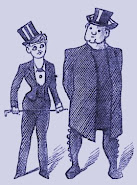
A Christmas card by C W Kahles, ca 1930, produced for family and fans. Hairbreadth Happy, and probably his fair maiden Belinda, are downstairs, frustrating Santa. But we do see the nasty villain (boo! hiss!) Rudolph Rassendale about to administer his patented form of holiday greeting.
Recently we profiled Thomas Nast, the Father of American Political cartooning; and mentioned the native Bavarian artist's prolific work, and his comic-connection to Santa Claus.
Another American cartoonist was born in Bavaria: Charles William Kahles (1878-1931) was born in Lengfurt, western Bavaria, actually about the center of three cities of Frankfurt, Nuremberg, and Würzburg; across the Main River from Triefenstein. We will see a couple of his Santas in this essay.
The Kahles family settled in Brooklyn, and the cartoonist lived there and in Queens and on Long Island the rest of his life. Kahles did early work for the New York Recorder, a pioneer of color newspaper printing; and then, enormously prolific, cartoons and comic strips for the New York World, Hearst's American and Journal, the Press and Ledger in Philadelphia, the pre-print syndicates of McClure and the World Color Printing Company, the weekly humor magazines Judge and Puck, and many freelance and ghost-artists assignments.
Some day soon we shall profile the career of C W Kahles. Here we will merely visit, and present in best thematic tradition, a Christmas drawing or two.
I can note a melancholy (and personal, I suppose) aspect to Kahles's career. He drew dozens of strips, often simultaneously, even for rival papers or syndicates. His work was much-published when the cartoon weeklies flourished; and he was a pioneer strip cartoonist as the art form was establishing its language and structure. His work was nestled among the greats like George Herriman, Rudolph Dirks, ZIM, Jimmy Swinnerton, and George McManus.
Yet none of his strips prominently survive in memory or the histories, except his eventual claim-to-fame, Hairbreadth Harry. Many of his "hits," like Clarence the Cop, actually were originated by other cartoonists; Kahles probably inherited more strips than any cartoonist in history. He died at the relatively early age of 53, and his successor on Harry, F O Alexander, clearly was a better cartoonist. Kahles seems to have been burdened with two unhappy marriages, and was described as a work-obsessed recluse who ventured out onlt to feed his passion for chess matches.
Yet none of his strips prominently survive in memory or the histories, except his eventual claim-to-fame, Hairbreadth Harry. Many of his "hits," like Clarence the Cop, actually were originated by other cartoonists; Kahles probably inherited more strips than any cartoonist in history. He died at the relatively early age of 53, and his successor on Harry, F O Alexander, clearly was a better cartoonist. Kahles seems to have been burdened with two unhappy marriages, and was described as a work-obsessed recluse who ventured out onlt to feed his passion for chess matches.
Kahles was blessed with a daughter, Jessie, who provided the adulation that the critics withheld. Until her death -- I knew her and acquired pieces of original art and documentation from her father's career -- she was an indefatigable booster of C W Kahles. All fathers should have such children! Yet her campaigns were uncritical, historically inaccurate, and perhaps irritating to those historians and publishers she might otherwise have recruited to join her virtual fan club.
I am not damning with faint praise; perhaps the opposite. Kahles pops up, seemingly, with every page you turn in musty bound volumes or early Sunday funnies or humor magazines; the fecundity of his drawings and strips is astonishing; and his awkward figures are discernable, even when unsigned, in ghost-artist work, for instance on several pages of Slim Jim and brochures for Mutt and Jeff animated cartoons.
I present here two Christmas cartoons, interesting in their non-traditional aspects. The first is a rough sketch, a submission, perhaps for Judge Magazine, of Santa Claus delivering presents to soldiers in World War I trenches. A drawing given to me Jessie Straut, who knew no more of its acceptance nor eventual publication.
The other cartoon is a Christmas card that Kahles drew and color-printed near the end of his life. It features characters from his popular strip Hairbreadth Harry -- yes, he finally received deserved success; the parody of cliffhangers ran for years and even inspired motion-picture treatment.
To be continued... as those cliffhangers always promised at the end of each episode!
I present here two Christmas cartoons, interesting in their non-traditional aspects. The first is a rough sketch, a submission, perhaps for Judge Magazine, of Santa Claus delivering presents to soldiers in World War I trenches. A drawing given to me Jessie Straut, who knew no more of its acceptance nor eventual publication.
The other cartoon is a Christmas card that Kahles drew and color-printed near the end of his life. It features characters from his popular strip Hairbreadth Harry -- yes, he finally received deserved success; the parody of cliffhangers ran for years and even inspired motion-picture treatment.
To be continued... as those cliffhangers always promised at the end of each episode!

Rough sketch by C W Kahles for a magazine gag cartoon, probably for Judge, ca 1918 -- "The Kind of Bombing Raid the Boys Would Like."


