

 Posts




The Candle That Burns Twice As Bright
Burns Half As Long
by Rick Marschall

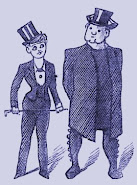
Ralph Barton and his friend Charlie Chaplin
A few words about Ralph Barton (1891-1931), one America's great cartoonists, caricaturists, writers, and wits. In his day he was prolific to an almost superhuman degree. Beginning in his early 20s he sprang like a desert flower, his cartoons appearing in major publications. He was tapped to illustrate many books, including some of the decade's best sellers; and he wrote several books of his own. As a wit, he was sought out as an intimate companion by some of the greatest talents of the day. As a caricaturist he ranks with the best of American artists, in apparent effortlessness "capturing" the likenesses of hundreds of notable celebrities.
Ralph Barton's collected work would fill proverbial volumes -- there ought to be a catalogue raisonné of his work -- and is, in fact, a challenge to track because of the many and varied outlets for which he drew. I have many of the magazines he drew for, and most of the books he wrote and illustrated. I also have original art -- "more than I need but not all that I want" -- as well as photographs and correspondence with his many friends.
Actors populated his world as much as cartoonists did. Charlie Chaplin was a friend, as was the actor Roland Young (who was himself an excellent, published caricaturist; the Barton-Young correspondence of which I have many pages, and the actor's drawings, will be a feature in the upcoming revival of NEMO Magazine); and of his four wives, two were in the arts -- the actress Carlotta Monterey and the jazz composer (Les Six) Germaine Tailleferre.
Barton in his early 20s became a prominent contributor to Puck Magazine after it had been sold to the Straus family which sought to transform it into an American version of the iconoclastic German and French cartoon magazines. In the early days of the Great War Puck sent the young Barton to Paris as its European correspondent. In those days his drawing style resembled the linear and avant-garde hallmarks of Lawrence Felloes and the Russian-French fashion designer Erté, at that time being introduced to American in the pages of Harper's Bazar (a young John Held Jr was similarly influenced at this time).

Puck cover, 1916
After Puck Barton worked for Judge, Photoplay, Vanity Fair, and The New Yorker. In fact Harold Ross named Barton a Contributing Editor of The New Yorker from its first issue, an honor in company with Dorothy Parker, Alexander Woollcott, and Marc Connolly despite the fact that no contributions were required and no compensation exchanged. As with the others he did soon contribute many clever and memorable pieces -- in his case, caricatures, theatrical criticism, and full-page cartoons.

An example of caricatures -- spot on! -- that Ralph Barton frequently created. He executed these for magazines and newspapers; for ads and theatre programs; even for fabrics and huge theater curtains.
The books Barton illustrated are testaments to his eclectic vision. He drew full-page cartoons for a deluxe edition of Balzac's Droll Stories; wrote his own humorous books including God's Country and Science In Rhyme Without Reason. The great editor H L Mencken suggested to the movie scenarist and humorist Anita Loos an idea for a series of stories that were collected in one of the 1920s' greatest books, Gentlemen Prefer Blondes. Her friend Ralph Barton illustrated it and its sequel and a spate of similar humor books. His work with Loos inspired many spinoffs in print, stage, and movies, down unto Marilyn Monroe and Carol Channing's theatrical versions.

Illustration from Anita Loos' s Gentlemen Prefer Blondes
The world was, as the saying goes, his oyster. Barton, as the 1930s dawned, had more assignments than he could handle... yet he did. His output was amazing. He continued to write as well as draw, and he even had dabbled in the movies himself, with the assistance of Charlie Chaplin. He generously introduced another great caricaturist, Miguel Covarrubias, to the American public. However, living half his life in France, his letters to Roland Young reflect a man experiencing severe mood swings about his art, his real-estate searches, and his love life.
His love life, or lack of one, became an obsession after his third wife, Carlotta Monterey, left him. She soon married the playwright Eugene O'Neill, and that loss sent Barton into -- so to speak -- a long day's journey into nightmares. (Note: this is a cheap attempt at a literary pun; there was no relation between the play and Barton. It is ironic, however, that Oona, daughter of O'Neill, eventually married Barton's friend Charlie Chaplin.)

A caricature of Marion Davies (I believe) (if any reader can identify the actress, please let me know!). From the original art; published in Photoplay Magazine.
One evening in 1931 the increasingly distraught Barton, in his Manhattan penthouse, wrote a note about having lost the only woman he ever loved. He raised a pistol to his temple and blew his talented brains out.
There are many geniuses in humankind's history that have lived relatively brief lives; perhaps disproportionately. I have tracked such lives, and deaths, in desultory fashion, and in the 1980s wrote an article for The Comics Journal on the anomaly of cartoonists' suicides. But among creative figures in history -- not all cartoonists; and not all suicides -- there is the very sad list of geniuses who died young: Caravaggio, Raphael, Van Gogh, Toulouse-Lautrec, Beardsley; Purcell, Mozart, Schubert, Mendelssohn, Gershwin; Bix Beiderbecke, Fats Waller, Jimmie Rodgers, Hank Williams, Buddy Holly, Gram Parsons.
Different factors took these creators from us. Schubert died of syphilis. Van Gogh was a presumed suicide (I am persuaded it was not suicide); as I said there have been many cartoonists, and many "distraught" creators who overdosed or otherwise committed "soft suicides." And of course accidents have claimed the lives of many such as Buddy Holly.
The word "tragedy" is often applied, or misapplied, and these days vulgarized: stripped of its distinctions. Oftentimes, deadly storms are, really, just bad weather (and when not categorized as tragedies are more seriously mischaracterized as "acts of God"). When people "tsk-tsk" over someone's momentary encounter with bad luck, we can be inured to the healthy and contemplative grief wherewith we should reflect on cultural losses. "What if?" is more than a parlor game.
Mozart and Schubert and Van Gogh created bodies of work that would have exhausted other creators who might have lived to 100. So we think of the adage at the top of this essay (an ancient Chinese proverb, allegedly). If tragedy is, as Aristotle defined and as Elizabethan dramatists thematically affirmed, more than a horrible circumstance but something from which a protagonist is virtually doomed or finds inextricable due to inherent "character flaws," then we must choose our words carefully.
In that view we can imagine what works might have been produced if, say, Ralph Barton had lived to twice his age. Eighty is not an unusual age for artists to attain, and moreover "active till the end." We might have had Ralph Barton's cartoons and caricatures and illustrations and written humor into the 1970s. I am tempted say that the tragedy is ours, too.

An admirer asked Ralph Barton for an autographed and was blessed to receive one... and a self-caricature... and a poem he wrote!
"My autograph cannot be read, (a frightful task to start on!) I'll draw my effigy instead -- Sincerely yours, Ralph Barton"


