Showing posts with label Jimmy Swinnerton. Show all posts

Monday, January 6, 2025

Little Jimmy in a Big Book

 
Meanwhile:
The Modest Pioneer
Jimmy Swinnerton

by Rick Marschall

Comics fans and scholars, and everyone in between, will be happy to learn that the latest production of Sunday Press Books has been released. JIMMY! is the multi-tasking title, referring to one of the Founding Fathers of the American comic strip, Jimmy Swinnerton, and his major creation, Little Jimmy.

There is everything major about this book, as it is a typical production of SPBooks and its genial genius Peter Maresca -- oversized, many pages, in all color, chock full of rare artwork, and chocker full of information, dates, and critical appreciation.


Swinnerton was hired by the young William Randolph Hearst when the latter no-yet newspaper mogul was commencing his empire -- not the least as Godfather of the Comics -- in San Francisco. It was in the '90s, and Swinnerton was to live, himself, into his 90s. In the years in between he created cartoons and strips based on California bears and New York City tigers; animals on the Ark and Mount Ararat; the irrepressible Sam and his laugh; the irascible Mr Batch; the Canyon Kiddies of the Far West (whose adventures took them to color magazine pages and animated cartoons); and even an adventure Western strip, Rocky Mason

There is more, far more, in Swin's colorful life and career. Sent to the desert in a doctor's attempt to ameliorate his death-sentence of TB, Swin lived there for many decades -- legendarily the sixth White man to settle in Palm Springs -- and became as one with nature and Indian culture. Along the way he became a respected painter of Western landscapes. And he lured his cartooning friends to visit; Rudolph Dirks passed through, George Herriman remained.

I once talked to, but never met, Jimmy Swinnerton (Milt Caniff asked me to help Swin sell his artwork) as I had briefly met Rudolph Dirks. The Sunday Press book JIMMY! fills in the gaps of things we might have talked about. Despite my voluminous collection of Swin's newspaper and magazine work (and paintings my son now owns, and collects), Pete Maresca has characteristically discovered treasures including sketches, photos, and personal drawings. More, his selection from decades of Sunday pages expertly chose the funniest and (yes) visually stunning examples.


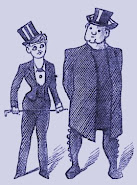
 Somehow escaping inclusion in JIMMY! is this drawing from almost 130 years ago, 1895. It has been on my wall for years and I take  delight in appreciating its youthful and random spirit. Presumably the man with the hat is young Swinnerton -- who ought to have been smiling, as Hearst plastered this poster all around San Francisco, making the young artist a star.

As I say, there is a cornucopia of surprising and excellent artwork and information in this book. Swinnerton's reserved style managed to mask humor and even mayhem whose comic excesses easily rivalled that found in neighboring strips like the Katzenjammer Kids and Happy Hooligan. In addition he quietly made substantial contributions to the nascent art form of the comic strip -- like parallel action ("Meanwhile -->") and flat blacks and areas of colors, likely inspired by poster art and Japonisme, which look was adopted by George McManus. 


JIMMY! and other Maresca Masterpieces can be found at www.SundayPressBooks.com  An imprint of Fantagraphics Books. 

Friday, December 10, 2021

Christmas with the Cartoonists –


JIMMY
SWINNERTON

Chicago Examiner, Dec 20, 1909

Chicago Examiner, Dec 18, 1910


Friday, May 17, 2019

Comic Shorthand – The Melee


by Jimmy Swinnerton 
   
encounter between a dog and a bad mans

another encounter between a dog and a bad mans

encounter between a dog and an artist

encounter between a cat, a dog and a bad mans


Saturday, March 9, 2019

Tuesday, December 11, 2018

Christmas With The Cartoonists


JIMMY SWINNERTON


December 17, 1911
Chicago Tribune
🕭

Thursday, November 15, 2018

Sunday with the Chicago Examiner


COMIC SECTION
of the 
Chicago Examiner
July 24, 1910


Wednesday, August 15, 2018

Jimmy Sundays in 1908


Jimmy — He Goes To School,
 Jimmy Swinnerton, Chicago Examiner, March 29, 1908

Jimmy Goes Camping, Jimmy Swinnerton,
Chicago Examiner, March 15, 1908


🔼

Sunday, April 29, 2018

Eddie Campbell’s The Goat Getters

     
“Goat getting” long has been a favorite stunt of many great ring-men. But I’ve never practiced the art. I’ve never tried by one ruse or another, by trickery or subterfuge, to take the nerve or the confidence out of my opponent. I felt it wasn’t necessary … This “goat getting” is supposed to get a man so excited and so frothy that he loses control of his poise and his calmness, and in his own furious anger swings wildly, and is always off balance because of frantic eagerness to deliver a killing punch. Gene Tunney, heavyweight boxing champion,  March 10, 1927
     
by John Adcock

MAJOR THESIS. Comic artist Eddie Campbell’s latest book — elaborately titled inside as, THE GOAT GETTERS: A new angle on the beginnings of comics casting a bright spotlight on THE FIGHT OF THE CENTURY. And Reserving a Few Mellow Sidelights for The San Francisco Graft Trials, Harry Thaw’s Murderous Crime Of Passion, The Story of the Lemon. ARTISTS: JIMMY SWINNERTON!! TAD DORGAN!! ROBERT EDGREN!! BUD FISHER!! RUBE GOLDBERG!! GEORGE HERRIMAN!! written and designed by Eddie Campbell — is not yet available but already causing some conversation over its major thesis; that the early sporting cartoon, as practiced by men like Tad Dorgan, George Herriman and Rube Goldberg, is the “missing link” in histories detailing the origin of the daily black & white newspaper comic strip.

BIRTHPLACE SAN FRANCISCO. The Amazon blurb (where the reader can sample a chapter or two) in similar fashion presents the book as “a new take on the origin of the comic strip,” while Eddie Campbell claims that the sporting page was the venue for the invention of the daily comic strip, and that San Francisco was its birthplace. Is it a coincidence that the best of these cartoonists, Tad Dorgan, George Herriman, Rube Goldberg, and Milt Gross (once Tad’s office-boy) carried their slang-heavy verbal and artistic slapstick into the most successful of the daily newspaper comic strips? I think not — and each and all of them drew their verbal inspiration from Tad Dorgan.

SPORTING LANGUAGE. Critics like myself do not have to agree with Campbell’s conclusions to enjoy this splendid book, a sprawling epic which aims and succeeds in providing “a reconstruction of the whole picture,” with a focus on boxing, counting the days when the sporting pages — modeled on the British sporting newspapers like Pierce Egan’s Life in London and Sporting Guide (1824) and Bell’s Life in London (1827) — gave several sporting cartoonists ample column space to experiment with vivid language and pictures. The language was the language of the sporting underworld; rich in slang, celebrating the gambler, the pug, the bum, the gangster, and the rube. This was during a period when boxing was illegal in most states and fights were staged on barges, in farmer’s fields, and in sweltering boomtowns in the desert. Ears were torn, eyes were gouged, and tons of blood were spilled. Most of the sporting cartoonists of this era (approximately 1894-1913) not only celebrated this preoccupation with the lag’s life — they lived it. To them it was the most significant and fondly remembered time of their lives.

FIRST TIME. The Goat Getters is the first time an author has attempted to chronicle the entire early days of the sporting cartoon and my hat is off to Eddie Campbell for his superb work in hunting down, cleaning up, and collecting together over 500 illustrations from those far off golden days. Campbell is a marvelous writer too. He brings the natural insight of a cartoonist and a humorist to his observations. Among the many artists covered are Homer Davenport, Jimmy Swinnerton, Tad Dorgan, Robert Edgren, Bud Fisher, Harry Warren, Rube Goldberg, George Herriman, Kate Carew, Fay King, Clare Briggs, Harry Hershfield, A.D. Condo, Nell Brinkley, Dan Leno, Hype Igoe, Robert Ripley, Sid Smith, Pete Llanuza, and a large number of other comickers both famed and forgotten. And oh yes, there are goats, plenty of goats — fifty on the last 4 pages alone.


Front cover title: 
THE GOAT GETTERS. Jack Johnson, the FIGHT of the CENTURY, and How a Bunch of Raucous Cartoonists Reinvented Comics, by Eddie Campbell, IDW Publishing/Ohio State University Press (The Library of American Comics), Hardcover, 320 pp., ISBN 978-1684051380 — available May 1, 2018

Saturday, April 1, 2017

I Thought of a Tramp — The birth of Happy Hooligan


 “The awful part of this work is its speed. (…) It almost seems to me now like shoveling coal into a furnace, or pouring water into a bucket without a bottom. It just goes on and on. lF.lOpper, 1930

“MR. OPPER has drawn Happy Hooligan for the past 30 years (1900-30), and a daily cartoon, when he has the time and inclination to do so.” Frederick Burr Opper was born in Ohio in 1857, in Madison, a small town in the middle of the state. He never went to college and only attended school until he was fourteen.
“First I went to work in the little general store there, and after that on the village newspaper. No, not to draw or write, just a general factotum all over the place. When I had been there about a year and a half, I decided to come to New York, and took a job in a dry goods store doing a little of everything, writing price tags and such things. All this time I had an idea of selling my drawings to the comic papers.”
[2] Happy Hooligan’s dreams, 1908.

FOR THREE YEARS, in between his other work, he sold cartoons and comic pictures to Frank Leslie, who eventually took him on his staff. He then went to Puck for eighteen years, leaving there to work for Mr. Hearst.
“It happened that they wanted a new series of comics, and I set about inventing one. I thought of a tramp. Tramps were not so very new; there had been all kinds of tramps, so I decided to make him a little different by putting a can on his head. What gave me the idea was that at that time all the saloons put their empty kegs in the streets for the breweries to pick up and refill. The tramps would hang empty tomato cans around their neck, go to these kegs and tip the remains of the beer from the empty barrel into their cans.”
[3] Chicago Examiner, January 22, 1911.
“Besides the comic strip Mr. Opper does several cartoons a week, more or less of a political nature, for the daily papers. In order to do this he has to do a great deal of newspaper reading, so as to be absolutely up to date on current events. (…) His only relaxation? Sketching! He likes to go to Europe, preferably the little English villages, and sketch with a soft pencil and a sketch book, even as you and I. (…) Incidentally, he is much more proud of his sketch book than his comic strip. He has two children and six grandchildren.”
[4] Tomato can hat. Cartoon by Jimmy Swinnerton in San Francisco weekly The Wasp, Sep 2, 1893.
HE MOVED with his family to an old-fashioned home in New Rochelle in 1916. His workroom is the sun parlor on the first floor. “Before that we lived near Stamford, Conn. We had a great big old-fashioned farmhouse a hundred and fifty years old, although I’ve never farmed in my life.” He sold their farm and part of the sales agreement is the present house in New Rochelle. They lived on 78th street in New York at first, with the house in New Rochelle used as a Summer place. At the time of this article and interview, F. Opper is seventy-three years of age.
“Comics have become a great industry. Years ago, when I was first in the game, there were only three or four of them. Every city in the country now has its comic artist, and also buys from feature syndicates. The business is getting bigger and bigger, until I do not see how it can grow anymore without toppling over.”
[5] Chicago Examiner, June 21, 1908.

With text extracts from: ‘Our Famous Neighbours — Frederick Burr Opper Of New Rochelle — Creator of Happy Hooligan, New Rochelle Cartoonist Finds ‘Fans’ Prone to Criticize Slightest Errors — Sketching His Chief Relaxation,’ By Alissa Keir, in The Yonkers Statesman, Wednesday, December 31, 1930, page 5.

NOTE. In this article the ‘32 years’ of Happy Hooligan has been changed into a more correct ‘30 years’ by Yesterday’s Papers. Our lead picture was first published on a 1904 Valentine’s Greetings postcard.

Saturday, December 24, 2016

Friday, October 7, 2016

The first five comic books published in 1902

          
Swinnerton’s cover for On and Off the Ark (1902), 1 of the first 5 comic books published by W.R. Hearst.

THE RESULTS ARE IN. Yesterday’s Papers co-editor Huib van Opstal took a closer look at Jimmy Swinnerton (1875-1974). After nearly two years the results of his findings may be published here any day now — a long ‘biography and reading of James Guilford Swinnerton’s life and work.’ 

Many international contacts kindly helped. Shown above is one of the images before it was restored for Yesterday’s Papers.


★ ★ ★ 
   

Thursday, July 2, 2009

The Blue Waterfall


Best story ever featuring George Herriman and Jimmy Swinnerton: The Lincoln Star, October 11, 1922

A trip through the Arizona Desert, taken two weeks ago in the cause of art, came close to having a tragic ending for George Herriman and James Swinnerton, the cartoonist creators of “Krazy Kat” and “Little Jimmy” when a search for water led them to a “hole in the wall” hedged by steep cliffs which for centuries has been a strategic stronghold for Hopi Indians but which has not been visited by white men since a United States survey party was guided through it thirty years ago.

Swinnerton and Herriman found their way into it by accident and remained inside its baffling labyrinth for two days when a sudden fog descended and obscured the narrow point of entry which forms the only opening by which anyone can get in. When finally they were rescued by friendly Indians they had eaten the last of their food and had lost all hope of finding their way out.

It was in the expectation of finding a certain “blue waterfall” which is one of the wonders of the desert country and which Swinnerton was anxious to embody in a landscape painting that the two artists began the journey which so nearly ended fatally for them. Both men have spent many summers in the southwest country and know the desert well. They began their journey from a trading post sixty miles away from the waterfall, travelling on horseback with their food and camp equipment strapped to a pack horse.

It was on the second day while seeking water for the horses that they lost themselves in the strange rock formation from which they were rescued just in time. They had come to a known water hole clearly marked on the chart they carried. They had found it dry but decided that there must be water in a steep formation of cliffs which lay to the north of the trail about a mile away.

Riding up to the foot of the cliffs they found what appeared to be a natural path up the face of the steepest of them and leaving their horses made their way up, carrying only a small amount of food for they were certain that they would find water and be back in a couple of hours. Fog is the exceptional phenomenon in the part of the country through which Herriman and Swinnnerton were travelling and they did not notice, as they toiled up the steep wall of rock that a heavy vapor had filled all the valley below and was growing denser every moment and slowly creeping up behind them as they climbed. Neither of them looked back when they had reached an opening, just large enough to crawl through, in the blank face of the rock and saw that it led into a wide bowl among the cliff tops several hundred feet in area and filled with upstanding rocks many of them as high as fifty feet and all set close together. What mostly interested them was a shining pool of water at almost the exact center of the natural amphitheatre. Then they stepped through into the open space and the fog followed them and filled it.

For two days they were prisoners there. Their compasses were of no use to them for by the time they tried to get their bearings from them they had lost the general location of the small opening by which they made their way in. It seemed to disappear, as they have explained since, as soon as they were a few feet away from it, and in the semi obscurity created by the fog all the high stones about them became alike for any help they offered as distinctive points from which to work a way out to safety.

As Herriman describes it:

“It was exactly, but in deadly earnest, like being in one of those made labyrinths which used to be such a feature of expositions and the amusement parks. It was completely baffling. Every rock and rock face appeared exactly like every other piece of stone, and although we gave every moment of our daylight to the search for the way out we had come in by, or some other way if there was one, we found no success whatever and we were getting close to the lowest frame of mind there is – frantic despair – when at almost one and the same moment the fog was dispersed and help came.

The help arrived in the form of two Indians who had come upon the artists’ horses in the valley and figured that their owners must have gone up the face of the cliffs, and lost their way. The Indians happened to be two who were familiar with the entrance to the cliff pocket and who knew how to get out again after getting in. The circumstance was fortunate for Herriman and Swinnerton for many of the younger Indians thereabout no nothing of the place.

Years ago it figured conspicuously in the hill wars of the Indians, for it had great strategic value to a war party since the single entrance to it could be guarded indefinitely by a few warriors against hundreds. The only entrance and exit is the one by which the artists stumbled in, and although they think they could find it again they do not expect to make the attempt but on the contrary propose to avoid it the rest of their natural lives.