Showing posts with label Hal Foster. Show all posts

Monday, December 23, 2024

Don't Open Till XMas...!


Under the Tree...
More 
Surprises!

by Rick Marschall

I have been sharing Christmas cards and drawings from my collection, and I wanted to share a rare "corporate" card, and then miscellaneous cards from a variety of artists... no theme except Christmas itself. All the cards were produced for the three Fs -- family, friends, and fans. That is, not for stationers marketing in stores. Enjoy!


Back during the high-flying (literally) days of EC Comics, this was the "corporate" card Bill Gaines sent out. Among the elves are John Severin, Maries Severin, Al Williamson, Jack Davis, Al Feldstein, Harvey Kurtzman, Will Elder, Joe Orlando, Wally Wood, and Bernie Krigstein.


As with many of the cards here, if a Christmas came and went without certain cartooning friends' cards, it would feel like a bleak midwinter. Wonderful Edwina Dumm, the creator of creator of Tippie the dog and Jaspurr the cat (her strip was the long-running Cap Stubbs and Tippie), sent cards every year. Some were privately printed; some were hand-drawn. As my children met her, and she cherished them, she often wrote greetings to them too.


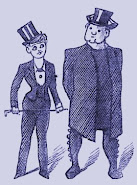
This card was sent by Sidney Smith, before The GumpsThis 


In the last year of his life, the greatest mixing in a touch of his perennial themes. He was optimistic about the world's future...


Hal Foster, sans Prince Valiant


Fred Lasswell, in his early Barney Google and Snuffy Smith cards, emulated the style and shading that the strip's creator Billy DeBeck used in his cards.


Even after retirement from his great Toonerville Folks panel and strip, Fontaine Fox sent out cards -- literally, postcards. His drawn greeting was printed, but every card would have some pen-and-ink addition, and, always, hand-coloring.   


The great (and great friend) Al Kilgore usually sent custom-drawn images. In 1964 he reprinted a daily strip of his great BullwinkleThe great (and great friend) Al Kilgore usually sends custom-drawn images. In 1964 he reprinted a daily strip 


How to read a Nancy Christmas card...?


The great Cliff Sterrett drew Polly and ALL her pals, ca. 1927


Walt Scott's card was a custom silk-screen printed, a true and charming craft-driven creation. The characters are his classic Little People from his Sunday comic strip. 


Friday, August 16, 2019

A Crowded Life in Comics –


Derek, Son of Thane –
Hal’s Foster Son


by Rick Marschall

You probably do not know Derek, as a character or as a strip title.

But that was the name of the eponymous King Features proposal that the world knows today as Prince Valiant.

Overhead view of Foster at the drawing board in his Redding CT studio, reference at his side, drawing his Prince Valiant page typically from the bottom up. Most pages took him a full week to produce.
Creator Hal Foster was born this week in Halifax, Nova Scotia, in 1892. My “mind” raced back in time to several stops along the way with the elegant, distinguished master Harold Rudolf Foster. He once told me that he learned to draw fast in those northern climes because the frigid air obliged him to slip mittens on every few minutes. Good anecdote, especially from a usually reserved man.

In 1921 Hal rode a bicycle to Chicago, where he studied art and drew (and painted) for advertising agencies. It was in Kansas, I think, about a decade later, that Hal was offered  the job of illustrating Tarzan, not for books or magazine, but for serialized newspaper installments. He was less than enthused, but the Depression’s grip was colder than Canada’s wintry blasts; and – paraphrasing the Bible’s account of Esau selling his birthright in Genesis 25 – he said he sold his soul for a mess of pottage. “But pottage tasted pretty good at that moment.”

Advertising painting by Harold R Foster, 1931.
Hal was not the first cartoonist to tackle the strip, which was a substantial hit especially when his Sunday pages attracted attention. Eventually he wrote his own jungle (and non-jungle, for instance Egypt) tales. I once owned – in fact I technically still own – a multi-page typescript account How I Came to Create the Tarzan Stories not by Foster but by Edgar Rice Burroughs. The founder of ERBdom and a keeper of the Burroughs flame, Camille Cazdessus, agreed to trade a Sunday Foster Tarzan for that manuscript. I sent it to him but, for decades, he has not honored the trade nor returned the manuscript. Tracked down in Illinois, no longer Louisiana, he admitted to still having it; and asked that I provide the postage for its return – an infantile and perhaps desperate condition, I thought. But I agreed… and still have not received either element of the transaction. A Crowded Life of Rogues, unavoidable.

Foster put the strip, and himself, on the map along the way. King Features, that vacuum-cleaner of talent, lured Hal with the promise to own his own creation (he received only a salary, no percentage or royalties, from Tarzan) and editorial freedom. Proud of his heritage and a student of history – and an admirer of the storytelling illustrator Howard Pyle – he staked a claim for a Medieval epic.

Its original title was Derek, Son of Thane, as attested here in this King Features promotion from 1936 (long buried in my archives). Myself, I will not attest to the fact that King ever published the strip under that title (although I have seen a reprint page, not a contemporary tearsheet with a Derek title-bar) nor that Foster’s second choice was Prince Arn.

A paragraph from an inside page of the “King Pins” brochure, announcing the new strip by the pride of Topeka.
The full-page Sunday (first a tabloid page) commanded attention, and had immediate impact, a prestige feature for American newspapers. In its early years Hal infused fantastic elements – Merlin was a regular character – and was exacting with visual references like furniture, castles, weapons, and clothing. He bent or condensed history, however, over approximately 600 years.

All that really mattered to readers, about a timeline, was every next Sunday.

The first fan letter that ever produced a response when I was young was Hal Foster’s polite, elegant explanation to me that he could not respond with an original Sunday page. I was making a scrapbook of Val Sundays (with my own running captions beside his!), and told him so. In later years we were Connecticut neighbors – he in Redding; I in Bethel – and was surprised to learn that Wayne Boring, whose work on Superman I considered stiff and klunky, did backgrounds on Val.

A letter from Hal Foster to a 12-year-old fan, 1961…
Around 1971, age and arthritis caught up with Hal and his lovely wife Helen, and they moved to Florida. I still have letters and Christmas cards from them, a long run. My wife and I visited them in their retirement in Spring Hill FL. On one of those visits I asked Hal what he thought – how he would assess – the work of his successor on Tarzan. In probably the most critical but diplomatic statement this gentleman could make, he thought and said, “It always interested me how Hogarth managed to draw all the muscles on top of the skin.”

In my old Nemo magazine I recruited two old European friends to address Hal Foster. Fred Schreiber dusted off an old interview with Hal; and Prof Giulio Cesare Cuccolini analyzed the influence of Howard Pyle. For the German publisher Carlsen I helped produce (with my friend the historian and publisher Andreas Knigge) The Big Hal Foster Book (never yet appearing in the US).

The cover of the book treatment of Foster’s career and Prince Valiant’s place in history. With Andreas Knigge; Carlsen Verlag, Hamburg, Germany.
Hal passed off the production of Prince Valiant to his Fairfield County neighbor John Cullen Murphy. Jack was predisposed – culturally, racially, politically – to be the simultaneous heir to Foster and the good Prince himself. Other artists auditioned, but there was no real competition. At first Foster provided the scripts and penciled layouts; and he finally surrendered all aspects. Murphy, and eventually other family members including his writer son Cullen, valiantly sustained the epic. In recent years other hands have continued.

When Foster died, my friend Bill Crouch proved that he was more than a Pogo fanatic. He and his brother Miller, when younger – I am not sure how much younger; but that might be another column. Or not – used to dress in licensed Prince Valiant pajamas and have mock sword fights. He felt a proprietary interest in Val, and somehow got Helen to share Hal’s King Features’ contract when she was a fresh widow. It turns out that Foster still owned the strip – and its rights and royalties – a rare situation that the syndicate somehow neglected to reference in their Good-byes; and that Helen actually did not realize. How long thereafter she received the surprising royalty checks, or what settlement was reached, I have forgotten.

A detail from “King Pins,” a King Features Syndicate mailer, in 1936. Hal Foster is #9.
Movies (including a 1950s epic with Robert Wagner in pageboy coiff), many reprint books, board games, costumes and, um, pajamas, flourished through the years. At times the strip was more popular overseas, for instance in Germany, than in the US. For me, I remember the first reply from a cartoonist; a warm friendship and visits; a few projects together; and material for a book of my own, the memories of a Crowded Life in Comics.

Also, Prince Valiant is where I first read and learned the meaning of the word Synopsis. 

⚔

49

Friday, March 8, 2019

Sunday with Hal Foster –


 PRINCE VALIANT 
Star Weekly
May 29, 1965


♰

Friday, February 8, 2019

Sunday with Hal Foster –


 PRINCE VALIANT 
Vancouver Sunday Sun
April 24, 1954


♰

Friday, December 28, 2018

Christmas With The Cartoonists


Hal Foster
❄ (Tarzan, Prince Valiant) ❄

❄

Friday, February 12, 2016

Hal Foster’s happy memories of the Ben Day dot

    
1 [1921] HIGH SKILL REQUIRED. The Ben Day Department at Jahn & Ollier Engraving in Chicago.

Those first engravings were beautiful things. They had Ben Day process then and those Ben Day men were artists — they could get the colors. Then they got cheaper and cheaper and now finally there’s no Ben Day work at all now. They use a different process that’s cheaper and not nearly so good.
 — Hal Foster 1971
  
DESIGNER Phil Normand — master restorer of classic Edgar Rice Burroughs dust jackets — corrects Hal Foster’s memory in his 2013 article article Tarzan and the Ben Day Men, or The Mechanics of Color in the Sunday Comic. 

In the early ’20s Prince Valiant creator Hal Foster (1892-1982) worked at the Chicago engraving firm of Jahn & Ollier.¶¶¶
“Benday” eventually became generic for mechanically applied dot patterns. There were other ways to do the mechanicals for comic color. — Phil Normand 2013¶¶¶
Read Phil Normand’s article HERE.

Another article from 1914:
¶¶¶
2 [1914] Exhibit of Color Print Art pays tribute to work done by The Herald. Display of Ben Day Process Feature of Graphic Arts Exposition, in New York Herald, April 20, p.20. 

And Guy Lawley HERE.
…


Tuesday, September 25, 2012

Told in Pictures – Dan Smith’s Old Testament


June 23, 1934
“The only man to whom the gift was given to draw accurately a scene merely glimpsed was Dan Smith, who came later upon the World to enormously raise the prestige and status of the downtrodden but patient toilers, not only by his piety and sobriety, the same being the son of a parson, but by his marvelous technique. He did not need to make sketches, this wizard of the pen and brush, one swift squint at the scene was enough. He is going strong still, but I wonder that our envy did not poison him in early life!”
    — Walt McDougall in This is the Life, 1926


DAN SMITH was born in Greenland, of Danish parentage, in 1865, and moved to America while still a boy. He returned to Copenhagen to train at the Public arts Institute when he was 14. Back in America again he took further instruction at the Philadelphia Academy of Fine Arts. He joined Frank Leslie’s concern about 1890 and contributed artistic reportage of the Indian situation at Wounded Knee and drew cowboy subjects in New Mexico and the Southwest.

Frank Leslie's Weekly 1893
Smith was well known as a painter of animals and beginning in 1897 worked as a war artist for Hearst in Cuba during the Spanish-American war. His illustrative work appeared in the humor magazine Judge, Frank Leslie’s Magazine and The Metropolitan. Smith ended up doing marvelous color pages and pen-and-ink illustrations for the World Magazine Section for twenty years. One of his original Magazine Section illustrations is HERE.

July 15, 1933
July 22, 1953
In 1933 Smith began his last work, a muscular and romantic retelling of Old Testament stories in weekly comic strip format. The text was adapted from the King James Version of the Bible. Smith may have been a pious man but he didn’t shy away from the violent and sexual aspects of the stories. Smith was one of the few comic strip artists to use the high illustrative style also in use at the time by Hal Foster and Alex Raymond.

February 24, 1934
The Bible was perfect food for an illustrator’s imagination with its tales of wars, plague, pestilence, horror and the supernatural. Smith’s image of a David eyeing a naked Bathsheba in her bath was quite daring. He even hinted at a nipple. Hal Foster honestly pictured Tarzan naked in his early comic strips so it was not without precedent. His extensive use of widescreen panels looked forward to the origins of CinemaScope.

‘Tarzan of the Apes. A Romance of the Jungle.’ by Hal Foster, 1929
Dan Smith died on December 10, 1934, aged 69. He was working on The Story of Moses when he died and the last strip I found was dated February 9, 1935, marked “To be continued.”

A Whitmanesque portrait for
 the Syracuse Journal in 1910


July 1, 1933


June 9, 1934

Jul 7, 1934
January 26, 1935
June 20, 1934

SERIES:

The Life of Sampson Strong Man of the Bible, Told in Pictures by Dan Smith, Saturday, March 11, 1933

The Story of Esther Told in Pictures by Dan Smith, Apr 29, 1933

The Story of Joseph Told in Pictures by Dan Smith, Jul 8, 1933

The Story of Ruth Told in Pictures by Dan Smith, Sep 30, 1933

The Story of David Told in Pictures by Dan Smith, Nov 4, 1933

The Story of Jezebel Told in Pictures by Dan Smith, Apr 21, 1934

The Story of Solomon Told in Pictures by Dan Smith, Mar 17, 1934

The Story of Salome Told in Pictures by Dan Smith, Jun 2, 1934

The Story of Elijah Told in Pictures by Dan Smith, Jul 7, 1934

The Story of Jael Told in Pictures by Dan Smith, Aug 4, 1934

The Story of Abraham Told in Pictures by Dan Smith, Sep 8, 1934

The Story of Cain Told in Pictures by Dan Smith, Nov 3, 1934

The Story of the Holy Child Told in Pictures by Dan Smith, Dec 8 to 29, 1934

The Story of Moses Told in Pictures by Dan Smith, beginning Jan 12, 1935, last strip appears to be dated Feb 9, 1935, marked “To be continued.”

Two panels from The Story of Abraham
*Biographical source: Kansas Historical Quarterly, Volume XIX, 1951, pp. 235-237. New York’s Frick art Reference Library has an Artist’s file containing reproductions and photographs of Smith’s Western art. A variety of Smith’s Magazine Section illustrations in color can be found at Stripper’s Guide HERE. Yesterday’s Papers previous post about Dan Smith HERE. Special thanks to Michel Kempeneers.