2025 has been a momentous year -- a cliche that doubtless is true for most of us. Most years are in most ways. But for readers of Yesterday's Papers we remember with sadness and gratitude the passing this web magazine's founder and guiding light, John Adcock. I became the successor and I desire to continue in his footsteps. One way I have not succeeded is by letting time other projects sabotage that work. In past months I have gotten married; moved and sustained a moving-truck accident that devastated my collection; and ghost-wrote an important political that was published a few weeks ago. Yes... a momentous year.
But stick with us (AND submit your own research, treasures, and questions!) I will be more diligent in the future; and as Yesterday's Papers and the revived NEMO Magazine will have a synergistic relationship. In the meantime...
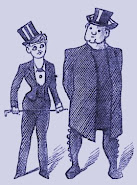
In1950, Rudolph Dirks celebrated the fact that Hans and Fritz were 53 years old. He shows Father Time looking in the ledger of 1897, the year that Dirks created the Katzenjammer Kids; and draws a gag about the comics' cliché (with few exceptions) that characters do not age. This page is relatively ancient itself -- 75 years since its own appearance, more than half the lives of Hans and Fritz. Time flies when...
Father Time and I and Yesterday's Papers wish a Happy New Year to all our friends! Dod gast it!
We have visited, via rare archival material from King Features Syndicate archives, legendary cartoonists from the protean days of comic strips. George Herriman, Tom McNamara, and editor Rudolph Block thus far. Photographs, specialty drawings, data; the only deficiency -- out of our control, as it was "out of control" in 1917 -- is the insipid poetry that serves as promotion. But, that is why the book was produced, so we must endure. (And there are some valuable facts that leak through...)
It is interesting, and a well-known aspect of the Birth of the Comics, that commercialism played a major role. Comics were weapons in circulation wars between publishers. They received boosts -- creative freedom, vast publicity, and cartoonists treated like stars -- to assist in their acceptance by the public.
The "wars" also featured cartoonists themselves as weapons, objectives, prizes, and goals. many of the great early artists of the Funny Pages switched employers and venues, sometimes dissatisfied with their employers (we have documented that Block seriously annoyed numerous of his cartoonists to the point of their quitting Hearst)... but usually having their services bid and outbid by hungry publishers.
There is a story -- if not true it virtually encapsulates the truth of the times -- that T E Powers spent an afternoon in a Park Row bar, not working for Joseph Pulitzer of the New York World nor William Randolph Hearst of the Journal, but receiving reports from office boys how his salary was going up and up as the two publishers bid against each other for his services. (Hearst won out.)
Frederick Burr Opper drew for the New York Herald (and Puck Magazine) until purloined by Hearst. Rudolph Dirks was hired away from Hearst by Pulitzer; so was Bud Fisher with the assistance of syndicate pioneer John Wheeler. Winsor McCay drew for James Gordon Bennett's two newspapers before Hearst hired him away. George Herriman drew for the World but eventually settled in the Hearst stable. R F Outcault, whose Yellow Kid can be cited for inaugurating this crazy transmigration, worked for Pulitzer, then Hearst, then Pulitzer again, then the Herald, then Hearst until his retirement.
In the eyes of the voracious publishers (benign godfathers they were, when all is said and done; or wet-nurses) there was no bigger star in their constellations than George McManus. He had attracted the attention of Pulitzer in their original working environs of St Louis; then McManus drew for Pulitzer's New York World.
McManus the cartoonist had a short gestation as a struggling stylist; soon his artwork was polished, handsome, mannered... and funny. As a creator, he created multiple strips starring in multiple titles. His premises were funny, and his narratives flowed like stage-plays. In fact his several creations did become Broadway musicals. And his characters appeared on the market as toys and in games.
Probably the most popular of his strips was The Newlyweds, a one-premise strip (as most early comics were) about an obstreperous baby. When McManus switched to Hearst he continued the strip but renamed it Their Only Child!, finessing a sticking-point of other mutinies like Mutt and Jeff and The Katzenjammer Kids whose titles became bones of contention.
McManus created another strip for Hearst, a Sunday page called The Whole Bloomin' Family. It is curious to note that Bringing Up Father, which commenced full-term as a Hearst feature in 1913, never was a Sunday page until six years later. After that it became the major strip among Hearst and King Features' properties for years. It owned the front pages of the Hearst chain's Sunday comic sections until supplanted by Blondie in the early 1950s.
In the 1917 promotion book, McManus was allowed to illustrate the stars in his galaxy including characters he had created, and left, at Pulitzer's shop. We see the eponymous star of Let George Do It; Rosie and her Beau; and Panhandle Pete. In addition, Snookums Newlywed and his parents; the Whole Bloomin' Family; and Jiggs and Maggie of Bringing Up Father.
By the way, and speaking of the Newlyweds and their only child (italics aside), we have a reprint book of daily strips from the New York World. It is from 1907. The strips appeared earlier in the year in the newspaper, not to mention the book collection -- which challenges the convention histories citing Mr A Mutt as the medium first daily strip (November 1907). More to follow in Yesterday's Papers and in the revival of nemo magazine...
The history of newspaper syndication -- and specifically the distribution of cartoons and comic strips -- is a story yet to be told, and told well.
There are many misperceptions in the tale(s), some surprising turns, and motivations of various parties. It is a tale that involved creativity on the part of innocent cartoonists having their fun... cigar-chomping businessmen... and casual decisions that set the course of an industry.
Our look at one corner of this world, as it was created by a handful of gods, lifts a curtain or two. And it will provide a look at some of the earliest of cartooning stars in the orbit of William Randolph Hearst. The newspaper mogul was in a real sense one of comic strips' godfathers. Lesser but consequential members of that galaxy are Rudolph Block, who will be represented here; and Moses Koenigsberg, a behind-the-scenes manager of the material we will share.
By the mid-'teens of the 20th century, syndication had become a side-effect of big-city newspapers and the spread of journalistic empires. But its growth was sloppy and disorganized -- or, as some historians might maintain, merely "organic." I will skate through history in generalities, because generalities are collections of truth without being adorned by details and statistics.
Around 1884 the publisher S S McClure introduced the modern concept of syndication by securing agreements from authors like Robert Louis Stevenson to serialize chapters of new books to newspapers. The idea simultaneously promoted new books and attracted newspaper readers, especially if they bought papers to satiate their curiosity about each next episode. Charles Dickens and W M Thackeray had serialized their books in English publications in the same manner, but for weekely and monthly periodicals.
In the United States, small enterprises follow, modestly, McClure's lead, nut major syndication began in earnest almost by accident when newspaper titans Hearst and Joseph Pulitzer distributed their own material, generated by their flagship papers (in, respectively, New York and San Francisco; and New York) to other of their properties in between. The next step: the practice morphed into sales in smaller cities. Rural papers that could not afford their own high-salaried cartooning stars, or print full-color comic supplements, could sign syndication deals that gave them big-city patinas.
Smaller operations were de-facto syndicators: the World Color Printing Company and (ironically) several McClure-owned properties offered pre-printed material and full color sections to rural newspapers.
Another irony, or anomaly, is how the larger concerns of Hearst, Pulitzer, Col McCormack of the Chicago Tribune, and others, long regarded income from syndication as a minor consideration versus publicity, covering their costs of salaries and production, and consolidation of territorial monopolies.
(In a 1952 letter to Al Capp, Harold Gray recalled that long-held priority of syndicates. And in a 1937 King Features Syndicate internal corporate report, it held that even licensing and merchandising income was secondary compared to the publicity that accrued to client newspapers.)
Back to the mid-'teens.
The competition, particularly among their comics and cartoons, between Hearst and his rivals, had become so intense that some services had a surfeit of talent. By 1917 his comics operation filled the daily and Sunday pages of the dozen papers in the Hearst chain. A few years earlier the Hearst organization had spun off Buster Brown, Little Nemo, Polly and Her Pals, and other strips under a purportedly rival umbrella, the Newspaper Feature Service. This enabled Hearst papers to run two comic sections every weekend, perhaps one on Saturday, or to provide Hearst rivals in certain cities with their own comic sections that didn't appear to be generated by Hearst! (In New York City, for instance, Hearst's deadly competitor the New York Tribune was able to run a four-page NFS color comic section that appeared to readers to be the Trib's own.)
By 1917, Hearst's lieutenant Moses Koenigsberg split up the syndicate operations even further. Eventually there was King Features, a sort of holding company or sales agent for all the syndicates; Central Press Association; International Feature Service, Newspaper Feature Service; and others. The material we will be sharing here and over subsequent weeks is from a rare book published for prospective clients by the International Feature Service.
The book in my collection was once the property of the Hearst cartoonist Tom McNamara, whose bio and drawings are featured therein. His name and address (in the Bronx) are featured on the cover, and Tom designed a colophon in colored pencil and affixed it to the cover.
There is also a page devoted to a brief bio and a photograph of one of Hearst's chief lieutenants, an architect of two decades of Hearst comic-strip activities. Rudolph Block was editor of comic sections and cartoons; he suggested many ideas for the cartoonists; and directed promotions and themes. He might be better remembered today if he had not been -- evidently -- a bastard to work with. Some time ago in Yesterday's Papers I wrote about him:
Rudolph Block was a de facto director of the Comic Art departments in the Hearst enterprises. He was talented enough (in his "other life" he was a short-story and Yiddish-theater writer as Bruno Lessing) and Hearst relied on him. But by a lot of evidence in my research I could find no cartoonist who did not bristle under his tutelage. Block was the real reason that Rudolph Dirks took Hans and Fritz, and his Katzenjammer Kids, to Hearst's rival, the Pulitzer chain. I have a letter by Frederick Opper (Happy Hooligan) to Block's successor expressing relief that Block was gone. When I interviewed the daughter of R F Outcault (The Yellow Kid;Buster Brown) the sweet, diminutive, 96-year-old lady responded to my question about whether she knew anything of her father's relations with Block. She leaned forward and said, "My father though he was a son of a bitch."
And a similar story about why Frank Willard did not remain with Hearst as Billy DeBeck did: Ferd Johnson told me that Block interfered and criticized Willard so much that one day "he punched Block in the face." Of course the cartoonist parted from Hearst; returned to Chicago, and, now with the Tribune, he created Moon Mullins.
... and so forth!
So to an extent this book was a panegyric to Block / Lessing. However, after the first spread, the pages were devoted to the cartoonists (and feature writers) of IFS.
Out of deference to Tom McNamara, this installment will feature his page, his bio and photo. McNamara was not the most accomplished of cartoonists, and his several strips through the years were only of moderate success. Us Boys, On Our Block, and other titles for Hearst were minor presences in the daily and Sunday sections. He later drew Teddy, Jack, and Mary for the Chicago Tribune Syndicate with less credit, losing in a famous poll of readers.
But McNamara was accomplished in other fields. He scripted many plots on the Hal Roach lot, most notably many Our Gang comedies. And he was a great friend and frequent companion of cartoonists. I have letters that Hearst Editor Arthur Brisbane wrote him, suggesting gags for his strips; and George Herriman was a particular friend. He addressed his letters to McNamara "Dear Rubber Nose," and this book was acquired from Herriman's daughter among letters, sketches, and photographs in my collection by the creator of Krazy Kat.
One regret about this great book is the space taken up by the awful drivel of text. What could have been valuable documentary information is a minimum of that, and awful poetry carrying promotional foofaraw. We will, however, take what we can get. After all, this represented a "half-million dollar feature service."
The blank spots and the penciled Xs suggest that McNamara was supposed to draw more of his characters, besides Skinny Shaner and Shrimp Flynn. Perhaps he was out on a bender at deadline time,or simply overslept. He was one of Us Boys in the Hearst stable.
I:Political Cartoonists Have Reflected (and Moved) Events, Decisions, and... History
by Rick Marschall
Politics and cartoons have not always been ingredients in an adversarial recipe. This drawing from PUCK is about a politician (publisher William Randolph Hearst) and his own cartoon characters, stars in his chain of newspapers. In 1904 he sought the Democrat Party nomination for President; he would have run against the incumbent Theodore Roosevelt. Around him are the creations of F Opper, Rudolph Dirks, James Swinnerton, and Carl Schultze.
I recently returned from Washington DC, the Inauguration and related events, and while this will be old news to any who read this after it is archived, it will not be a news report. I was inspired, if that is the right word, to share a little history of presidents and cartoons. Campaigns and commentary by comic artists. It will run over several postings.
Editorial
cartooning, specifically politically cartooning, thrives at times of
urgent public debates and vivid personalities.
This
statement sounds trite or self-evident, barely a thesis except that –
in a corollary of the “Great Man” theory of studying
history –
urgent public debates and vivid personalities sometimes are shaped
and propelled by speeches, tracts… and cartoons.
The
timing and the passions of the Revolutionary War, the French
Revolution, the Spanish-American War, the New Deal, and various
anti-war movements all mightily were influenced by cartoons and
cartoonists.
Cartoons not only reflected events but have influenced history. Napoleon said that history was written
by the victors – and
it is just as true that our views of history often have been shaped
by artists, including cartoonists.
The legendary Thomas Nast, a self-caricature, sharpening his most lethal weapon, a pencil. His support of the North in the Civil War, and of President Abraham Lincoln, earned the latter's honorific, "The North's Greatest Recruiting Sergeant." On the other hand, his vicious cartoons against Democrat presidential candidate Horace Greeley helped defeat U S Grant's opponent in 1872. Greeley died only days after the election.
Much
of what we think – and know; or think we know – of kings,
presidents, generals, candidates, and leaders of movements, has been
codified by cartoonists. Oftentimes, major figures in history have
been portrayed to their detriment. Sometimes
unfairly, sometimes falsely, often spot-on. No matter: our general opinions of: say, Andrew Jackson or Williams Jennings
Bryan frequently are what the cartoonists said through their art.
Consider
Theodore Roosevelt and Richard Nixon. Do we “know” them through
their portraits? Speeches? Caricatures?Truth?
Generalizations? Slander? Gossip? Facts? Cartoonists work on the
blank slates of daily journalism in ink, but might as well carve in
stone.
King
Tut: What do we know of how he lived and loved? But his image
endures. We have thousands of hours of Nixon on film, yet we remember
him mostly through the cartoons of Herblock.
… Anyway,
it was once so. Henry Major, a caricaturist of an earlier generation, noted that cartoonists more than occasionally were thrown in jail for what they drew.
He said that later cartoonists should be arrested for what they don’t
draw. If we return to our thesis – that political cartooning
thrives during times of urgent debates and vivid personalities, and
vice-versa – then we might well be entering a new Golden Age of
political cartooning.
Time
will tell, but signs are at hand. The Trump presidency, indeed the
Trump phenomenon, provides an unprecedented opportunity for political
cartoonists to spread their ink-stained wings as seldom before. Stand-up comedians and cable-news wiseguys have stolen a lot of cartoonists' thunder... but, really, only to the extent that artists and newspapers have weakened their platforms and surrendered their turf.
To
appreciate the art form of the political cartoon, as much as to
contextualize the opportunity presented by Trump, it is instructive
to survey the history of political cartooning in America. We will see
that the most powerful and memorable – and prescient – work has
been at times when vivid personalities have predominated. Whether
cartoonists have accurately or satirically recorded, or helped
create, their victims, is an open question. That questions is as
intractable as the chicken-or-egg conundrum.
Our
job – as citizens, commentators, voters – is to appreciate and
learn from this amazing art form of graphic humor, variously called
“Wordless Journalism,” the “Ungentlemanly Art”: the political
cartoon.
At
a conference held by the American Association of Editorial
Cartoonists in the mid-1970s, Meg Greenfield of the Washington
Post
addressed the assembled cartoonists and thanked them for providing
“laughs” and “morning chuckles.” The assembled cartoonists
mostly were outraged. After investing in careers as pictorial
commentators they were being dismissed as court jesters. False News. By the Washington Post of all institutions (surprise, surprise in view of recent events? See the recent travails of cartoonist Ann Telnaes, chronicled in these columns) .
Several times in American history, there were calls to restrict and even censor, political cartoons. Sometimes these calls, by politicians of course, became legislative proposals. These bills never became laws. Spangler, Montgomery Advertiser, in the 1910s. The most serious of these efforts occured in Pennsylvania about the same time, by an aggrieved Senator Pennypacker.
It
was outrageous that someone from the staff of the newspaper home of
Herblock could so totally misunderstand the unique gift – yes, art
form –
of the political cartoon. Maybe cartoonists make their points through
laughs. But that one creative tool among many others, is
not the only special attribute of cartoons – there is the ideal of
truth itself.
Next: The birth of American political cartoons, and the early American cartoonists Benjamin Franklin and Paul Revere.
Comics fans and scholars, and everyone in between, will be happy to learn that the latest production of Sunday Press Books has been released. JIMMY! is the multi-tasking title, referring to one of the Founding Fathers of the American comic strip, Jimmy Swinnerton, and his major creation, Little Jimmy.
There is everything major about this book, as it is a typical production of SPBooks and its genial genius Peter Maresca -- oversized, many pages, in all color, chock full of rare artwork, and chocker full of information, dates, and critical appreciation.
Swinnerton was hired by the young William Randolph Hearst when the latter no-yet newspaper mogul was commencing his empire -- not the least as Godfather of the Comics -- in San Francisco. It was in the '90s, and Swinnerton was to live, himself, into his 90s. In the years in between he created cartoons and strips based on California bears and New York City tigers; animals on the Ark and Mount Ararat; the irrepressible Sam and his laugh; the irascible Mr Batch; the Canyon Kiddies of the Far West (whose adventures took them to color magazine pages and animated cartoons); and even an adventure Western strip, Rocky Mason.
There is more, far more, in Swin's colorful life and career. Sent to the desert in a doctor's attempt to ameliorate his death-sentence of TB, Swin lived there for many decades -- legendarily the sixth White man to settle in Palm Springs -- and became as one with nature and Indian culture. Along the way he became a respected painter of Western landscapes. And he lured his cartooning friends to visit; Rudolph Dirks passed through, George Herriman remained.
I once talked to, but never met, Jimmy Swinnerton (Milt Caniff asked me to help Swin sell his artwork) as I had briefly met Rudolph Dirks. The Sunday Press book JIMMY! fills in the gaps of things we might have talked about. Despite my voluminous collection of Swin's newspaper and magazine work (and paintings my son now owns, and collects), Pete Maresca has characteristically discovered treasures including sketches, photos, and personal drawings. More, his selection from decades of Sunday pages expertly chose the funniest and (yes) visually stunning examples.
Somehow escaping inclusion in JIMMY! is this drawing from almost 130 years ago, 1895. It has been on my wall for years and I take delight in appreciating its youthful and random spirit. Presumably the man with the hat is young Swinnerton -- who ought to have been smiling, as Hearst plastered this poster all around San Francisco, making the young artist a star.
As I say, there is a cornucopia of surprising and excellent artwork and information in this book. Swinnerton's reserved style managed to mask humor and even mayhem whose comic excesses easily rivalled that found in neighboring strips like the Katzenjammer Kids and Happy Hooligan. In addition he quietly made substantial contributions to the nascent art form of the comic strip -- like parallel action ("Meanwhile -->") and flat blacks and areas of colors, likely inspired by poster art and Japonisme, which look was adopted by George McManus.
JIMMY! and other Maresca Masterpieces can be found at www.SundayPressBooks.comAn imprint of Fantagraphics Books.
A Christmas card by C W Kahles, ca 1930, produced for family and fans. Hairbreadth Happy, and probably his fair maiden Belinda, are downstairs, frustrating Santa. But we do see the nasty villain (boo! hiss!) Rudolph Rassendale about to administer his patented form of holiday greeting.
Recently we profiled Thomas Nast, the Father of American Political cartooning; and mentioned the native Bavarian artist's prolific work, and his comic-connection to Santa Claus.
Another American cartoonist was born in Bavaria: Charles William Kahles (1878-1931) was born in Lengfurt, western Bavaria, actually about the center of three cities of Frankfurt, Nuremberg, and Würzburg; across the Main River from Triefenstein. We will see a couple of his Santas in this essay.
The Kahles family settled in Brooklyn, and the cartoonist lived there and in Queens and on Long Island the rest of his life. Kahles did early work for the New York Recorder, a pioneer of color newspaper printing; and then, enormously prolific, cartoons and comic strips for the New York World, Hearst's American and Journal, the Press and Ledger in Philadelphia, the pre-print syndicates of McClure and the World Color Printing Company, the weekly humor magazines Judge and Puck, and many freelance and ghost-artists assignments.
Some day soon we shall profile the career of C W Kahles. Here we will merely visit, and present in best thematic tradition, a Christmas drawing or two.
I can note a melancholy (and personal, I suppose) aspect to Kahles's career. He drew dozens of strips, often simultaneously, even for rival papers or syndicates. His work was much-published when the cartoon weeklies flourished; and he was a pioneer strip cartoonist as the art form was establishing its language and structure. His work was nestled among the greats like George Herriman, Rudolph Dirks, ZIM, Jimmy Swinnerton, and George McManus.
Yet none of his strips prominently survive in memory or the histories, except his eventual claim-to-fame, Hairbreadth Harry. Many of his "hits," like Clarence the Cop, actually were originated by other cartoonists; Kahles probably inherited more strips than any cartoonist in history. He died at the relatively early age of 53, and his successor on Harry, F O Alexander, clearly was a better cartoonist. Kahles seems to have been burdened with two unhappy marriages, and was described as a work-obsessed recluse who ventured out onlt to feed his passion for chess matches.
Kahles was blessed with a daughter, Jessie, who provided the adulation that the critics withheld. Until her death -- I knew her and acquired pieces of original art and documentation from her father's career -- she was an indefatigable booster of C W Kahles. All fathers should have such children! Yet her campaigns were uncritical, historically inaccurate, and perhaps irritating to those historians and publishers she might otherwise have recruited to join her virtual fan club.
I am not damning with faint praise; perhaps the opposite. Kahles pops up, seemingly, with every page you turn in musty bound volumes or early Sunday funnies or humor magazines; the fecundity of his drawings and strips is astonishing; and his awkward figures are discernable, even when unsigned, in ghost-artist work, for instance on several pages of Slim Jim and brochures for Mutt and Jeff animated cartoons.
I present here two Christmas cartoons, interesting in their non-traditional aspects. The first is a rough sketch, a submission, perhaps for Judge Magazine, of Santa Claus delivering presents to soldiers in World War I trenches. A drawing given to me Jessie Straut, who knew no more of its acceptance nor eventual publication.
The other cartoon is a Christmas card that Kahles drew and color-printed near the end of his life. It features characters from his popular strip Hairbreadth Harry -- yes, he finally received deserved success; the parody of cliffhangers ran for years and even inspired motion-picture treatment.
To be continued... as those cliffhangers always promised at the end of each episode!
Rough sketch by C W Kahles for a magazine gag cartoon, probably for Judge, ca 1918 -- "The Kind of Bombing Raid the Boys Would Like."
The current stars of Barney Google and Snuffy Smith, drawn by their current master, John Rose
Recently the 90th birthday of Mr Snuffy Smith was observed. Technically, it was the 90th anniversary of the hillbilly's debut in Billy DeBeck's classic strip Barney Google.
Comic-strip characters are famous for "growing," or aging, at their own speed, or not at all. Snuffy is one character who has changed over then near-century... but somehow is younger-looking, cleaner, more active, and happier then when he was introduced to readers in 1934. Withal, he and his woman Loweezy (her name, appropriately, of inconsistent spelling) attracted the attention, and affection, of America to extent that he took over the strip. Its title is, formally, Barney Google and Snuffy Smith, but Mr Google has become an occasional cast member.
Barney himself had his significant birthday in 2019, marking his strip as one of comics history's longest-lived sagas. Billy DeBeck was a successful political cartoonist in Pennsylvania and Ohio before moving to Chicago and creating strips for the great breeding-gound of talented cartoonists, the Chicago Record-Herald (by then, actually, Hearst-owned as the Herald-American; history and stories for another column). He created an anecdotal strip about about a tall, thin fellow, eponymously and eventually titled Take Barney Google, F'rinstance. The Herald-American was, as I said, a breeding-ground for the already fertile cartoonist community in Chicago. Another cartoonist sharing his creations in the paper's Sunday color section was "Doc" Willard, whose past and future moniker was Frank Willard. In true Hearst fashion, these two talented cartoonists had their work and themselves headquartered in New York City (soon followed by another Chicago cartoonist named E C Segar...) Some day -- yes, here in Yesterday's Papers and in the upcoming revival of NEMO Magazine -- the parallel careers of the two friends Billy DeBeck and Frank Willard will be told.
They were more than friends, and did not hold each other as deadly rivals. Yet their paths were very similar. Both created wildly popular strips, Barney Google and Willard's Moon Mullins. Both strips starred low-life roustabouts. Both artists became, when humorous continuities became the order of the day in the 1920s and '30, absolute masters of the challenging form. Both artists created colorful and memorable casts of peripheral characters -- in DeBeck's case the hillbilly we celebrate here; Barney's horse Spark Plug; et al. (Willard's Moon Mullins lived in a boarding house, which enabled characters to come and go besides the permanent relatives and neighbors).
DeBeck and Willard were smart enough, or busy enough, or distracted enough by the High Life, or possibly lazy enough (naw) to hire assistants. Lightning struck twice in these instances. DeBeck's wing-man was Fred Lasswell; Willard hired (actually in the first months of Moon Mullins) Ferd Johnson. Lasswell was to succeed DeBeck and draw Snuffy's adventures until his own death, upon which his own assistant John Rose assumed the reins and continues (excellently) to depict the goings-on in Hootin' Holler. (More like DeBeck than Lasswell, Rose has introduced some new characters, and has Barney visiting more often).
One possible dissimilarity between DeBeck and Willard might have been the latter's temper. Rudolph Block was a de facto director of the Comic Art departments in the Hearst enterprises. He was talented enough (in his "other life" he was a short-story and Yiddish-theater writer as Bruno Lessing) and Hearst relied on him. But by a lot of evidence in my research I could find no cartoonist who did not bristle under his tutelage. Block was the real reason that Rudolph Dirks took Hans and Fritz, and his Katzenjammer Kids, to Hearst's rival, the Pulitzer chain. I have a letter by Frederick Opper (Happy Hooligan) to Block's successor expressing relief that Block was gone. When I interviewed the daughter of R F Outcault (The Yellow Kid; Buster Brown) the sweet, diminutive, 96-year-old lady responded to my question about whether she knew anything of her father's relations with Block. She leaned forward and said, "My father though he was a son of a bitch."
And a similar story about why Frank Willard did not remain with Hearst as Billy DeBeck did: Ferd Johnson told me that Block interfered and criticized Willard so much that one day "he punched Block in the face." Of course the cartoonist parted from Hearst; returned to Chicago, and, now with the Tribune, he created Moon Mullins.
But we are here to note the 90th anniversary of Snuffy Smith's debut. By this point, Barney had shrunken to the "height" we know; experienced wins and losses with his race horse Spark Plug; starred in magnificent mock-melodramas around the world, encountered colorful heroes and villains; inspired several famous songs; and uttered nonsensical phrases that swept the nation. On one of Barney's journeys he found himself in hillbilly country and... the rest is history.
Billy DeBeck, who was not lazy, quickly was enamored of Appalachian culture and lore. Surviving from library are books of notes and sketches, annotated books of rural mountain humor (Sut Lovingood, et al.) so there sprang verisimilitude if not similitude in the stories he spun and the characters' dialog he wrote. But he did pursue leisure activities, thanks to his assistant Lasswell (Ferd Johnson became a companion, as the two followed their bosses around the country, from golf course to golf course. They sometimes were joined by Zeke Zekely, as his boss George McManus joined the other two cartoonists researching putting greens and bars...)
I will share here some DeBeck sketches from my collection of Barney and the early Snuffy... and a songsheet featuring Snuffy, not to be outdone by the songs that Barney inspired. Think of them as bodacious snapshots from a Fambly Album of a truly remarkable comic-strip.
In the late 'teens Billy DeBeck was barely a professional cartoonist, yet he produced "How-To" cartooning manuals and taught under Carl Werntz of the Chicago Academy of Fine Arts.
Barney and the star of the Sunday page's brilliant top strip Parlor, Bedroom, and Sink, Bunky
You'd have to be pretty famous to have as your address something like "DeBeck, New York City." DeBeck was.
Drawn by DeBeck for an event in St Petersburg Florida, where he eventually settled for its warm weather and golf courses.
A Christmas card drawn for Joe Connolly, president of King Features Syndicate.
There were songs about Barney Google and Spark Plus and other DeBeck inspirations, catch-phrases, and storylines. The legendary Billy Rose wrote the famous "Goo-Goo-Googly Eyes" song... when it was Snuffy's turn the uber-legendary Duke Ellington wrote his song.
Ferd Johnson described Billy DeBeck to me as a "dapper little guy." In this photo he is being shown off on a European cruise, S S Rotterdam, by the infamous Comics Editor of the Hearst syndicates, Rudolph Block.
About to sail on another European cruise are DeBeck and his wife Mary. Back in "the day," when famous cartoonists went on vacations or bought touring automobiles, it was the stuff of newspaper society columns and press releases. For almost a decade the major annual award of the National Cartoonists Society was the DeBeck Award, a silver cigarette case. Mary endowed and helped administer the prize. After her death, the NCS's own "Oscar" became the Reuben Award, a statuette designed by Rube Goldberg.
Fred Lasswell and I sporting neckties with the Yellow Kid at an event marking another anniversary, the 100th "birthday" of the comics, 1995.
Before its run ended in 2000, Bringing Up Father had achieved notable success as an American comic strip. Some "obituary" writers called it the longest-running comic strip, which was not true -- The Katzenjammer Kids had commenced in 1897; Bringing Up Father began in 1913 -- but for a long time it was the jewel in the crown of King Features Syndicate.
Comics sites often have cited BUF as an "instant hit," but in fact it was not until April of 1918 that the strip was deemed popular enough to have life as a Sunday page too. (Ironically it supplanted Rosie's Beau, which eventually became the top-strip in the Sunday funnies.) McManus, as an inventive cartoonist, however, had notable celebrity since leaving St Louis and dominating the New York World's comic section for almost a decade before he switched publishers, from Joseph Pulitzer to William Randolph Hearst. In the last major moves in "syndication roulette," between 1911 and 1914 or so, the New York Herald lost a major star (Winsor McCay and Little Nemo) to Hearst; the New York American of Hearst lost Bud Fisher and his Mutt and Jeff as well as Rudolph Dirks of The Katzenjammer Kids to the World; and George McManus, creator of many popular strips, moved from the World to the American.
Whether it was a daily or a Sunday comic, Jiggs and Maggie, the stars of Bringing Up Father, inspired a plethora of licensing and merchandising items, as well as attracting readers. There were several Broadway musicals; popular songs; toys and figurines; reprint books; and animated cartoons.
The premise of the strip, of course, was the comic tension between Jiggs, an immigrant hod-carrier who won the Irish sweepstakes, and his shrewish wife Maggie, who became an overweening parvenu. Jiggs adopted spats and a top hat, but preferred life in the rough-house eatery of Dinty Moore with his old friends. For decades this premise, laced with slapstick and McManus's impressive Art Deco drawing style, maintained the popularity of Jiggs and Maggie.
King Features President Joe Connolly standing behind his star cartoonists, 1929, l-r: George McManus; Jimmy Murphy; and caricaturist Henry Major, holding the drawings he did of the quartet. From my collection of KFS archives.
The strip was so ubiquitous that a comic reference of McManus's invention -- that Jiggs craved the humble dish of corned beef and cabbage -- cemented its association with the Irish. Grocery stores still market corned beef and cabbage before every St Patrick's Day, thanks to the strip; and American tourists in Ireland frequently are frustrated that the Irish themselves seldom combine or serve the dish.
Jiggs and Maggie, once finding life as a Sunday page, was the invariable front page on all the dozens of newspapers in the Hearst chain, and in other newspapers too. This status held until around 1950, when Blondie became King Features' line-leader.
In future YPs we will document the "other" lives of Jiggs and Maggie -- maybe in several installments or an eventual book, so many were the versions and spin-offs and variations of McManus's strip. We can linger here a moment on the motion picture and stage (not musical) versions, however.
George McManus with various KFS executives (Comics Editor Sylvan Byck, second from left), ca. 1950. McManus was short, but not that short: he is seated at the desk....
In 1946-50 a series of theatrical movies brought Jiggs and Maggie to life, barely. The plots and action were threadbare; McManus himself made one cameo appearance, but the movies are notable because Jiggs was played by the old vaudeville actor Joe Yule... the father of Mickey Rooney. Renie Raino played Maggie, with Tim Ryan as Dinty Moore.
Even earlier, in 1928, MGM released a feature film, silent but in the dawn of the talkies, with the mid-level star Polly Moran as Maggie. J Farrell MacDonald played Jiggs; Jules Cowles was Dinty Moore.
I recently have come across an item that can answer the question that, I would guess, not one in a thousand comics fans can answer. What was the last name of Jiggs and Maggie? Or Was Jiggs his first names or last name? There were different hints through the years, and changing suggestions, but nothing definitive. It is not unusual for fans -- even creators! -- to be ambiguous or even clueless about such things. After all, whether Krazy Kat was male or female... depended on the gag or its exigencies of the day. And John Dirks claimed to me that he did not know which was Hans and who was Fritz. (It takes a detective to discern the answer from his father's years of work.)
A sketcth drawn by George McManus for Mary Joe Connolly, young daughter of King Feature Syndicate's President Joe Connolly.
But a play, officially licensed by King Features in 1936, answers that question. Logically titled Bringing Up Father, the Book (dialogue) was written by Bruce Brandon, who was a playwright with other credits for Samuel French, the licensor and publisher of this play. The bound script includes, for performance assistance, the play's premise; the cast of characters and their descriptions; notes from the creators including suggestions on how to stage the production; suggested publicity and press releases; and a list of costumes and props necessary for a stage presentation.
Official? And -- officially? -- the names of the characters. Perhaps definitive; approved if not dictated by George McManus.
Jiggs Mahoney. And Maggie Mahoney.
A few "dramatic licenses" were taken. There is no Nora; there is a different Rosie; and no mention of the son of Jiggs and Maggie... who only made the briefest of appearances in actual strip...
Here is a sample page from the Book. A synopsis for theatre troupes.
When
the comic strip “The Katzenjammer Kids” debuted in William Randolph Hearst’s
Sunday supplement for the “New York Journal” on 12 December 1897, it is
unlikely that anyone could have predicted that it would still be syndicated in
newspapers and magazines 124 years later in 2021. If you don’t see it in your local newspaper,
go to the Comics Kingdom website and, sure enough, there it is. I checked it today (www.comicskingdom.com/katzenjammer-kids).
Harold
Hering Knerr, who is interred at West Laurel Hill Cemetery, was its artist for
35 years – from 1914 until his death in 1949.When you look at his family history, his becoming a cartoonist is
probably one of the last things you would expect.Harold’s father, Dr. Calphenas Brobst
“Calvin” Knerr, was a physician who at age 92 was the oldest graduate of
Hahnemann Hospital Medical School when he died in 1940.His uncle Levi Knerr was also a physician
trained at Hahnemann.His brother
Bayard, six years his senior, was yet another a physician. Another brother, Horace, became a
metallurgist.
His
mother was Melitta H. Hering, whose father Constantine Hering (1800-1880) was an
early proponent of homeopathic medicine in America and a founder of Hahnemann
Hospital; in 1834, Constantine had caused quite a stir in his neighborhood when
he brought a fir tree from New Jersey into his house at Christmas time and
decorated it with fruits, candies, gifts, and candles, just as he had done
growing up in Germany.It is now
acknowledged as the first Christmas tree in Pennsylvania.You can hear more about him in “All Bones
Considered: Laurel Hill Stories” podcast #017, “American Medical Fathers, Part
1 (HERE)”
Harold
was born in Bryn Mawr in 1882.After a brief
time in public schools, his parents sent him to Episcopal Academy for two years
and then to the Pennsylvania Museum and School of Industrial Art, where he
discovered, as he said, “I was not Michelangelo.”PMSIA, also referred to as the School of Applied
Art opened in the Centennial year of 1876 as both a museum and teaching
institution. Classes began in a building
at 312 North Broad Street, and soon expanded into the old Franklin Institute
(now the closed Philadelphia History Museum), at 15 South 7th Street.In 1893 PMSIA acquired a complex of buildings
at Broad & Pine, vacated by the Pennsylvania Institution for the Deaf and
Dumb.In 1938, the two institutions
split: the museum became the Philadelphia Museum of Art, and the school stayed
the PMSIA. In 1964, it renamed itself
the Philadelphia College of Art. After
further name changes the school is now the University of the Arts.
While
growing up at the end of the 19th century, Harold decided that he
wanted to be an aeronaut – in other words, he wanted to fly before there were
airplanes.When interviewed in 1922, he
related “My first experience as an aerialist was on a roof, a hipped affair …
the roof was next to my father’s home with a galvanized iron gutter at each of
the eaves to catch the rain.It was fun
to sit at the peak of the hip and slide down the slate roof, catching with my
heels on the gutter.I really had two
chances before falling the 30 feet to the ground.If I missed with my heels, as I sometimes did,
I could catch with my hands, which I always did.I never fell.But I was compelled to stop this childish prank by parental
authority.Grown persons are always
interfering with the amusement of children.”
“Then
I transferred my talents to the dumb waiter.I would pull myself up to the top of the house and turn loose, thus
getting a swift ride to the bottom of the shaft, accompanied by a terrific
bump.Again my parents became nervous
and I was forced to desist.Then I got a
glider.It was great.”
He
talked about how he and his friends had some of the first gliders in the
country which they would attach to automobiles by ropes and fly like kites when
the autos speeded up.
“The
gliders were followed by balloons.Those
were days of real sport.Once the crew I
trained with reached a height of 13,000 feet by the simple process of throwing
overboard too much sand by mistake.”He
describes how they shot up from 2000 feet after inadvertently dumping a
40-pound sandbag ballast.Then their descent
was so rapid that they avoided a crash only by heaving everything else out of
the basket as the balloon deflated, and then skidding through a herd of startled
cows before they came to a safe stop.
He
continued working on his drawings and sold several to Philadelphia newspapers,
including realistic sketches of gravestones “from the city’s oldest graveyard”
(Christ Church?) for $3 each.By 1901,
when he was 19 years old, he was drawing color comic strips for three of
Philadelphia’s newspapers, many of them “one-shot” features.
The
art of cartooning was in its very early days, and many of the early strips
featured artists who were fine illustrators.The initial drawings were black on white, and the colors were added by
the publishers.
While
the origins of comic strips can be traced to the 1820s, it was not until the
great newspaper wars between William Randolph Hearst and Joseph Pulitzer during
the 1890s that they started to flourish in America.I talked about an earlier American cartoonist
A.B. Frost in a video podcast on YouTube called “A.B. Frost and His
Family.”The first acknowledged newspaper
comic strip was “The Yellow Kid,” which appeared in Pulitzer’s “New York World”
and then Hearst’s “New York Journal” from 1895 to 1898.The comic gave its name to the pejorative
phrase “yellow journalism,” stories that were sensationalized for the sake of
selling papers.
In
1897, German immigrant Rudolph Dirks introduced a strip starring two German
American boys, Hans and Fritz, and their Mamma.He called it “The Katzenjammer Kids.”It was based on an 1865 German strip called “Max and Moritz.”Katzenjammer is a German term meaning “the
yowling of cats,” but is also a euphemism for a hangover.Dirks’ early illustrations were rather crude
– even the word balloon had not yet evolved.In 1902 Dirks introduced “Der Captain,” a boarder, or perhaps live-in companion,
for Mamma.In 1905, he introduced “The Inspector,”
an officer of the school system.It was
wildly popular.Some modern art scholars
even claim that Pablo Picasso’s love of “The Katzenjammers” led to his early
breakthroughs in cubism on “Portrait of Gertrude Stein” (1905-1906) and “Les
Demoiselles d'Avignon” (1907).
Meanwhile
in Philadelphia, Knerr was contributing comics to five different newspapers,
including “Mr. George and Wifey.” “Scary Williams,” “Wooly Willie and Little
Chief Rain-in-the-Face,” and “Zoo-Illogical Snapshots.”One of his characters followed Scott Joplin’s
introduction of ragtime at the 1904 St. Louis Fair.The strip was called “The Irresistible Rag –
They Must Dance” and featured a grossly caricatured African American musician
who delighted in playing catchy ragtime music on his flute and forcing people
to dance.
His
biggest success was “The Fineheimer Twins,” which was a blatant rip-off of the
Katzenjammer Kids, bad German dialect and all, featuring the mischievous Johann
and Jakey.Knerr penned this one for
more than ten years until 1914.
In
1914, Rudolph Dirks left William Randolph Hearst for the promise of a better
salary under Joseph Pulitzer.This was
an unusual move, since cartoonists usually went the other way, leaving Pulitzer
for Hearst. Hearst sued and in a highly
unusual court decision, he retained the rights to the name “Katzenjammer Kids,”
while Dirks retained the rights to the characters. Hearst promptly hired Philadelphian Harold
Knerr to draw his own version of the strip. Dirks initially renamed his version “Hans and
Fritz.” Anti-German sentiment during the
Great War forced him to change his title to “The Captain and the Kids.” And for the next six decades, two versions of effectively
the same comic strip were distributed by rival syndicates in US newspapers. Dirks’ version ran until 1979.This would be the equivalent of two similar
comic strips called “Doonesbury” and “B.D. and Boopsie” running in competing
newspapers for more than half a century with exactly the same premise, the same
characters, and similar artwork.
Harold Knerr, Chicago Examiner, July 4, 1915
Hans
and Fritz – one blonde, one brunette – were not mischievous like Dennis the
Menace or Calvin; they were downright malevolent, and their audience loved them
that way.Mamma, a plump Fräulein with
her dark hair in a triple-bun, was constantly flustered.The pipe smoking Der Captain, dressed in cartoon
sea togs, had a full-face beard and a short temper.He often had his foot propped on a stool to
sooth his aching gout; naturally, his throbbing toe became the target of the
boys.Other characters were added
through the years – Rollo Rhubarb, Lena, Miss Twiddle, and Der Captain’s shifty
friends “The Herring Boys,” with a name echoing Harold’s own middle name.
The
Katzenjammer Kids were such a cultural phenomenon that they became a traveling
stage show for children, playing across the United States and Canada for many
years; there were Katzenjammer animated cartoons, Katzenjammer dolls, and jigsaw
puzzles and cereal box cut-outs and comic books.They even made it onto US postage stamps and,
as satire, into everything from Tijuana Bible eight-pagers to “National
Lampoon.”In the late 1970s and early
1980s, “Playboy” magazine published a satirical comic called “The Krautzenbummer
Kids.”
Knerr
took advantage of another feature of early cartoons.Many Sunday comics were permitted to take up
the entire page.A number of artists
produced what were called “toppers” – cartoons that would run on the top third
of a page so the main feature could have the bottom two-thirds.Staying with his German roots, Knerr started publishing
“Dinglehoofer and His Dog” in 1926, showing the adventures of a kindly German
American bachelor – much like Knerr, who never married – and his curious little
pup, Adolph.Eight years into the strip,
an orphan boy named Tadpole Doogan joined them, calling the lead character “Mr.
Dingy.”In 1936, events in Germany again
affected America’s comic pages and the name Adolph was no longer considered
appropriate.So dog Adolph got “adopted”
by a farm family, and a new dachshund puppy named Schnappsy joined the
cast.There was also a family cook and
maid named Lilly.This strip also ran
until Knerr’s death in 1949.
Knerr’s
private life was a quiet one. He had
moved to New York City and lived in a hotel apartment for the last few decades
of his life. His name was rarely, if
ever, in the newspapers other than on his comic strips. Now and then he answered fan mail including a
letter from a woman reader who asked him to send one of the six fictional pups
born to Schnappsy. Along the way he
developed some unnamed heart problems.
On 8 July 1949, a hotel maid using a pass key found him dead on the
floor of his bedroom in his pajamas. He
was 66 years old and his only surviving relatives were his brother Horace and
sister Mildred. His remains were
interred in the Hering family plot, West Laurel Hill Cemetery, Washington
section, Lot 330. Many artists later, his
comic strip lives on, 72 years after his death.
It is the longest running comic in the history of the United
States.
–00–
Bibliography:
“Katzenjammer Kids’ Secret Is That All Grownups Have,” The News-Democrat, Paducah, Ky. Sunday, 5 November 1922, page 28
“Harold H. Knerr – of the “Katzenjammers” Tells Times-Dispatch Readers something About Himself,” The Times Dispatch, Richmond, Virginia. Sunday, 2 Mar 1930, p. 74
“Dr. Calvin B. Knerr Dies at Age of 93,” The Philadelphia Inquirer, Philadelphia, Pennsylvania. Monday, 30 September 1940, page 5.
“Harold Knerr, Cartoonist, Dies,” The Philadelphia Inquirer, Philadelphia, Pennsylvania. Saturday, 9 July 1949, page 5.
“What Do You Want to Know? Who originated the Katzenjammer Kids?” The Philadelphia Inquirer, Philadelphia, Pennsylvania, Friday, 19 July 1968, page 21.


 Posts
Posts