Saturday, May 16, 2009

A. D. Condo (1872-1956)


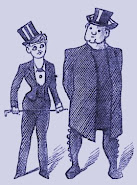
Facts about A. D. Condo, the man behind the “Everett True” comic strip, have been scarce until now, which is strange because Condo’s popularity and fame was immense during the entire period of his long career. A. D. Condo may just have been the most popular cartoonist on the entire continent of North America. One contemporary reviewer of Martin Sheridan’s “Comics and their Creators” decided Sheridan's history was not complete, because it neglected to mention A. D. Condo and Clare Victor “Dwig” Dwiggins, famed for the “Tom Sawyer and Huck Finn” comic strip.

“Everett True” began in 1902 as one of a series of different characters alternating weekly in Condo’s comics. The last comic strip under the Condo name was printed in 1946, forty-four years later. Even then “Everett True” continued as a pale version of its former self well into the sixties under the title “Uncle Ev,” featuring Everett True. Condo’s comic characters were ideal for the stage.


In March 1913 a group of Condo’s characters from the strips, “Oscar and Adolph,” “Diana Dillpickles” and “Mr. Skygack,” the man from Mars were brought to the stage in a musical variety show put on by Joseph Weimer. Fred Schaefer, A. D. Condo’s writer, or “hunch man,” produced a book giveaway for the show which was titled “Oscar and Adolph.” Viewers of a parade in Indiana, in 1913, were delighted to see “Everett True” and “Skygack” among the marchers. The American Bioscope Company produced a movie in early 1916 which starred a frighteningly realistic doppelganger of the original king of Swat in the person of comedy star Bobby Bolder, a native of London, England.


The following article appeared November 18, 1923 in the Montana Daily Independent.

CONDO’S REFORMER ‘EVERETT TRUE’ HAS NOW SWATTED 6,000 PESTS

By A. H. FREDERICK.

Six thousand pests, or thereabouts, have been swatted -- a good many of them, I hope, into oblivion -- by the iron fist of “Everett True,” militant reformer.

It was way back in ‘04 that A. D. Condo created “Everett True.” This places “Everett” in the pioneer class of comickers appearing daily. Yet he still holds his own with the best of them, growing ever more popular.

Condo preceded “Everett” into the world by thirty years.

He was born (meaning Condo) at Freeport, Ill., in 1872. Shortly afterwards the Condos moved to Missouri, where the father, a Methodist preacher, lost his life in a cyclone.

“Ministers,” says Condo, “were paid little in those days. We hadn’t much. After the cyclone we had less.”

In 1882 the family settled at Findlay, O., where Mrs. Condo taught school.


BORN AN ARTIST

A fondness for picture-making was born in condo. Even at four years old he was happiest with pencil or crayon, and throughout his childhood his mother often had to shoo him out to play, so apt was he to linger indoors at the game of draughtsmanship.

It was for newspaper art that the boy had a preference from the time when he first began his work seriously, and it was into a newspaper office that he gravitated naturally even before completing the customary course in the Findlay grammar school.

In the 80’s, however, there was no such demand for daily paper illustration as developed a little later, so it was as a printer’s devil that Condo made his start and not until ‘96 did the opportunity come that he had been waiting for.

That was the year of William Jennings Bryan’s first and most spectacular run for the presidency.

With his sensational campaign practically overnight a cartoonist became an essential member of the staff of every up-to-date newspaper.


CHALK PLATE WORK

Accordingly Condo went to work as a chalk plate artist for the Toledo (O.) News.

In 1902 after consolidation of the Toledo News and Bee, he joined NEA at Cleveland, making general comics.

A. M. Hopkins was editor-in-chief at the time. He suggested a series of strips, each series to run a week and then give way to a new one on a fresh subject and with a fresh group of characters.

Condo went to it in co-operation with Jack Raper, now of the Cleveland Press as “hunch man.”

One day Editor Hopkins proposed a weekly series picturing the adventures of an individual of the “Truthful James” type -- a man who always told the truth, regardless of consequences or any consideration of policy, circumstance or convenience.

Out went the series and made such a hit that it was decided to continue it.


JACK CHOSE THE NAME

Raper, however, didn’t like the name “Truthful James,” and it was on his motion that “Everett True” was adopted.

The “Everett” of those days hadn’t quite the amplitude of girth that distinguishes him at present. That he’s gained more or less weight isn’t surprising. He’s going on twenty years older. But the spirit of the crusader burned as brightly in him in him in 1904 as at this time of writing.

Alternating with “Everett” when he first made his appearance were two other strips, “Oscar and Adolph” and “Diana Dillpickles.” Later they were dropped and “Everett became a daily. Also Condo became his own “hunch man.” He’s remained so ever since.

By the way, he doesn’t consider “Everett” a comic.

“Rather,” he says, “it’s a corrective dose, in sweetened capsule form. It may go down pleasantly, while the patient laughs. But after its down it has a purpose.”


CONDO NO CRUSADER

“Also you might say that “Everett’s” no picturization of myself. I never have been a gratuitous pest-swatter, though sometimes I’ve longed to be. I’ve answered that question by mail so often that Id be glad to leave it generally known the answer in the negative.”

Personally Condo’s a person of much gravity, but behind this gravity lurks an ever-ready smile and many a lightning quick-flash of humor.

He has a daughter, now of high school age, who’ll tell you “daddy’s” the greatest man in the world, with “Everett” a close second.

Back in 1910, NEA sent Condo to California to “get art” on the Johnson-Jeffries fight scheduled originally to be held there. Later he returned to Cleveland, but, the opportunity presenting itself, he went back to the Pacific coast and lives in Berkeley this minute.


A. D. Condo (NEA)

*Update: Steven Rowe commented that based on census records "Armando D. Condo (19 Sep 1872 -24 Aug 1956) died in Albany, California."

Friday, May 15, 2009

Irving “Knick” Knickerbocker (1898-1930)


Irving “Knick” Knickerbocker was only active for a very short period, from 1925 to his early death in 1930. If he had survived he may have been numbered among the great cartoonists. After his tragic early death he was quickly forgotten. His obituary follows.


‘Tinymites’ and ‘Little Joe’ Mourn as “Knick” Passes On.

Noted Cartoonist will be Buried at Auburn, Washington.

Cleveland, Feb. 3 1930 (NEA).--

Irving S. Knickerbocker, known as “Knick” to thousands of newspaper readers through his comic drawings and sketches, which appeared daily in newspapers throughout the country, is dead as the result of injuries received in an automobile accident here.

Knickerbocker, who at 32 had established himself as one of the leading comic artists in the country, was killed when the automobile in which he was riding was struck by another car.

With a group of friends, Knickerbocker was on his way home from a dance. The force of the collision drove the car in which he was riding into a telephone pole, and Knickerbocker died of a fractured skull and punctured lung.

Funeral services will be held at Auburn, Wash., the home of Knickerbocker’s parents.

Three feature drawings gined “Knick” a wide following. These were “The Tinymites,” an imaginative daily story for children by Hal Cochran with illustrations by “Knick;” “Dizzy Dugan,” a popular sports feature, and “Little Joe,” a humorous daily sketch of general appeal. In addition “Knick” drew illustrations for feature stories on the news and sports pages.

Knickerbocker was born in Auburn, Wash., and roved over the country in search of adventure while he was still in his teens. He worked on a farm, in a lumber camp and on a railroad, enlisted in the army the day the United States entered the world war, and served in France with the A. E. F. After the war he spent some time as a sailor on an ocean liner, and then came ashore and studied art.

His knack of putting humor into his drawings quickly gained him recognition, and NEA Service, an organisation supplying more than 700 daily newspapers with feature stories and pictures, secured his services.

He is survived by his father and mother, a brother and two sisters, all of whom live in Auburn.

Two coincidences, striking in the light of the tragedy that befell him, marked his last day of life.

Just before leaving his office for the last time, “Knick” dropped five “Tinymite” drawings on the desk of Hal Cochran, NEA art director, and remarked, “Well that’s ‘30’ for me.” “Thirty” is the newspaper expression for “the end.”

The last sports cartoon Knickerbocker drew appeared on the day of his death. Over it “Knick” had written the heading “It was fun while it lasted.”


*Directly above: the opening of the baseball season.


Wednesday, May 13, 2009

Them Were the Days


Here’s another treat for boxing fans, Wood Cowan’s great comic strip Them Were the Days, which began November 29, 1927 with the story of the first British Heavyweight champ James Figg. The last I could find was on Jan 27, 1927, “The Nelson-Gans Fight.” The comic did have some Canadian syndication in the Halifax Herald. As you can see they practised a strange form of boxing in ‘them days,’ with the fights lasting until one or another fighter was bloodied and oblivious.

Wood Cowan (1896-1977) drew a variety of strips although this is my favourite, He drew ‘Vivian the Vamp,’ ‘Carrie,’ ’Mom ’n Pop,’ ’Oh Diana’, ‘Our Boarding House’ (in 1946), and ’Sissy.’ Barnacle Press has generous sampling of Cowan's ‘Carrie’ comic strips HERE. I don’t know much about Cowan except that he was a resident of Bridgeport, Connecticut.


Tuesday, May 12, 2009

Walter R. Allman (1882-1924)


Walter R. Allman, creator of “The Doings of the Duffs” comic strip was born in Toledo Ohio and began his career on a Toledo newspaper while in his twenties. His first strip was in 1912, six-panels titled “They All Fall For It.” This was followed by a single-panel, “The Great American (Canadian in Canada) Home.” The Duffs was about as popular with the public as Mutt and Jeff. He died in Cleveland, Ohio on July 8, 1924 aged 42, survived by his widow.


The strip was extremely popular in the US and Canada and was the subject of a 2 reel movie debuting in in June 1917 which was filmed in Decatur, Illinois by the local Rembrandt Studios. The cast included Charles French as Tom Duff , Denise Newcomb Johnson as Helen Duff, and Aubrey Miller as Olivia.

Saturday, May 9, 2009

Hype Igoe Cartoons


Herbert Anthony Aloysius (‘Hype‘) Igoe, “probably the best informed writer on boxing that ever lived,” according to Damon Runyon, and a swell cartoonist, was born 13 June 1877 in Santa Cruz, California. He and his best friend’s Rube Goldberg and Thomas Aloysius “TAD” Dorgan, (1877 -1929), attended Polytechnic High School where they were taught art.

San Francisco was the birthplace of the daily comic strip, with Bud Fisher’s Mutt and Jeff. The city was full of sports cartoonists and supplement illustrators. There were Charley Arcanne, Charlie Edwards, Jimmy Swinnerton, Homer Davenport, Tad Dorgan, Hype Igoe, Rube Goldberg, Merle “Bug” Johnson, Jules Pages, Bob Carter, Haydon Jones, Harrison Fisher, Bob Edgren and Dan Smith.

Hype Igoe started his newspaper career at 15 as an office boy (along with Tad,) for Jimmy Swinnerton and Homer Davenport on Hearst’s San Francisco Examiner. It's been said that he got Bud Fisher his first job, on the San Francisco Chronicle. In 1905 Swinnerton, famous for the “Little Bears” cartoons , brought the inseparable pair to New York. Brisbane only wanted Tad, who refused to make the move without Hype Igoe. Both were hired and moved to the Hearst newspaper building at 238 William Street. Hearst was publishing two newspapers from the plant, the Morning American and the Evening Journal.

One of Igoe’s best friends was Damon Runyon, sports writer on the Morning American, who had a deep admiration for the older, legendary writer. They were introduced by Tad, who drew cartoons for the American. Hype Igoe was the boxing writer for the other paper, the Evening Journal. Damon Runyon kept a trunk load of new shoes, which Igoe broke in for him with the result that he never had to buy new footwear for himself. Hype’s ukelele was confiscated by the proprietor of Jack’s busy restaurant because the resulting sing-a-longs slowed down the trade.

Igoe was a confidant of boxing champions from the times of Gentleman Jim Corbett. He covered every boxing match from the Fitzimmons/Corbett fight down to Joe Louis’s battle with Abe Simon in 1942, and with the exception of Gene Tunney he predicted every winning heavyweight champion. He was a pallbearer at the funeral of Bat Masterson, knew Wyatt Earp, Tex Rickard and Jack Dempsey. He had once managed the brutal middleweight boxer Stanley Ketchel, who was murdered by a jealous husband in Conway, Missouri. Runyon compared Igoe’s boxing writings to those of Pierce Egan, the London historian of pugilism.

There were a lot of stories as to the origin of the name “Hype,” Here’s one of them from a previous post:

“It was Dorgan who helped popularize the label “Hype”, which Igoe had hung on him by a 300 pound Negro elevator operator. The operator took one look at the slender 15 year old copy-boy back in the days when he was working for the San Francisco Examiner and observed: “Mr. Igoe, yo ain’t no bigger than a hypodermic needle.””

Hype himself originated the phrase "to hype," as in standing behind his fighters "hyping" them up for the slugout.

Hype Igoe, 67 year old fight expert for the New York Journal American, died of a heart ailment 11 February 1945, leaving a widow and four children.

*Cartoons courtesy of Kevin Igoe.


Tuesday, May 5, 2009

Virgil Partch (1916-1984)


Virgil Partch (VIP) was born in Alaska on October 17 1916. The 1946 Current Biography Yearbook described Partch as “since 1942 the creator of a form of “maniacal humor.”” In 1942 he sold his first cartoon, to the venerable Collier’s, followed by contributions to The New Yorker, Look, and Saturday Evening Post. In the sixties Partch was the top “sick” comic on True, the Man’s Magazine, which often had little VIP illustrated extras like calendars, and detachable books on mixing drinks. (True published a similar “Bar Guide” in paperback). I was too young (at eleven or twelve) for martinis but had a substantial collection of True, the Man’s Magazine, and the work of Virgil Partch, who I considered some sort of genius of the pen.

Partch was all over True Magazine, in the letters column headers, gag cartoons, giveaways and advertisements. It was the age of sick comics like Mort Sahl and Lenny Bruce, and the black humor of authors like Bruce Jay Freidman, who was an editor on sex and sadism magazines like Men, Male, and Man’s World. In 1960 VIP syndicated a gorgeous Sunday page called Big George which I believe was also printed as a single-panel. Virgil Partch perished in an automobile accident, along with his wife, on August 12 1984.


Monday, May 4, 2009

Juniper Junction by Doug Wright

Juniper Junction was a long running Canadian institution. It begun running in the twenties in the Toronto Star as a one-panel gag titled Life's Little Comedies. The artist, Jimmy Frise, moved the strip from the Star Weekly to the Montreal Standard in 1947 where it ran in full color (as Juniper Junction) and was even syndicated in the U.S. market. Frise died of a heart attack June 13 1948 and Doug Wright inherited the strip. When the Montreal Standard canceled the color comic Doug Wright was offered a new berth at the Family Herald, a farm magazine which had been running the Standard's Juniper Junction in b&w atop Fred Harmon's Red Ryder Sundays.
I only have one sample of the Family Herald strip by Doug Wright, but below are a couple of brilliant strips by Frise featuring Archie Weaver's pet moose Foghorn from his strip Birdseye Center

A word to the wise: The first print edition of Sequential, featuring articles on Jimmy Frise by Bryan Munn, and Doug Wright by Brad Mackay will be available in a free pdf version around May 9 or 10. Details will be found HERE

 The Collected Doug Wright Canada's Master Cartoonist Volume I is available HERE.

Doug Wright Editorial Cartoons


Doug Wright Editorial Cartoons from the Hamilton, Ontario Spectator 1973.

The Collected Doug Wright Canada's Master Cartoonist Volume I is available HERE.