

 Posts
Posts


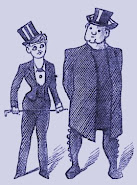


In the late fifties William Gaines received a letter on
Buckingham Palace stationary concerning the resemblance between Alfred E.
Neuman and young Prince Charles of England that had been published in MAD
magazine.
Gaines recalled publishing something about the resemblance
between Neuman and the Prince and receiving the letter saying “I bloody well
don’t look like him” and signed “Charles Printemps or something like that and
it was mailed from a post office box near the palace. We never did find out if
it was legitimate or not.”
Gaines also remembered MAD was sued several times over the
ownership of Alfred E. Neuman. “His face has been around at least a hundred
years. When I was a kid I used to see it on post cards saying “What, me worry?”
We found it as early as the 1890’s. He was an advertisement for a dentist in
Topeka, Kansas, whose name was Painless Romaine. He was used for a million
things, even for anti-Roosevelt ads in the 1930’s.”
 |
| [1909] Winnipeg Free Press, October 30 |
Harvey Kurtzman said that the publishers became curious
about the origin of Alfred E. Neuman, sometimes referred to as Melvin
Cowznofski, and pleaded with its readers for information. “The answers were
astonishing. The face dated back to the 19th century. It was supposed to have
been used for selling patent medicine, shoes, and soft drinks. The kid was
depicted as a salesman, a cowboy, a doughboy, and was rendered in dozens of
slight to gross altered variations.”
“But the answer I have always liked to believe was that the
face came from an old high school biology text -- an example of a person who
lacked iodine.”
Carl Djerassi of Stanford recalled an anti-Semitic
wall-poster featuring ‘the face’ as a Jewish street-pedlar. He saw it in Nazi
Germany in 1938 under the message “Death to the Jews.” Craig Yoe said Alfred
“probably started as a cartoonist's stereotype of an Irish idiot boy.”
 |
| [1928] Winnipeg Free Press, March 26 |
Alfredo Castelli found a character from Pittsburgh circa
1903 named Pickle Neary (see Pickle Neary pin-button) who had an uncanny
resemblance to the Kid and also noted a close resemblance to Rube Goldberg’s
brother Walter in an old photograph. The face has also been used in Australia
to sell dairy products in the 1920’s. Recently I turned up some examples from
New Zealand.
M. Reidelbach’s Completely Mad (1991) reported the finding
of a precursor to Alfred Neuman in the “It Didn’t Hurt A Bit,” Kid found in an
advertisement in the Illustrated London News, printed in New York City in 1895.
He also showed up in ads for Cherry Sparkle Soda and Puck Magazine. The
Christens write in ““It Didn’t Hurt a Bit” Kid: Dental Precursor to Mad
Magazine’s Alfred E. Neuman:”
“In the late 1890’s, the Ritter Painless Dental Company,
located at the corner of Third Avenue and Schermerhorn Street in Brooklyn, New
York, used a large picture of “The Kid” on their second floor outdoor display.
An accompanying label stated, “It didn’t hurt a bit.” In this large painting,
the boy’s facial features were exaggerated to make him look like a mentally
defective “pinhead.”
 |
| [189?] New York |
In 1908 Antikamnia calendar cards were supplied to dentists.
In 1886 two German doctors discovered a coal-tar derivative called acetanilide
which was supposed to reduce fever and numb pain. The patent medicine makers
took it up for the North American market. One popular remedy was punningly
called Cuforhedake Branefude, another was Antikamnia. Allegedly these medicines
killed 28 people and one dog. Samuel Hopkins Adams exposed them in a series of
articles in Colliers magazine between October 1905 and September 22, 1906,
entitled The Great American Fraud. Antikamnia was still being sold in the
1930’s.
In 1909 the first Winnipeg Tribune “It Didn’t Hurt A Bit”
Kid ads for the Winnipeg Dental Parlours appeared and ads were still shilling
for Dr. Glasgow, Dentist in 1928. Apparently ads were published periodically in
Manitoba until at least 1936. The Trib also published the cartoons of Grue
[Johnny Gruelle] throughout 1909 which were published through the early NEA
while Gruelle was working in Indianapolis. Painless Romaine “It Didn’t Hurt A
Bit” Kid ads from Kansas survive dated 1910, and King Dental Parlours was
another source of Kid ads. He even appeared in Gruelle’s June 17, 1911 Sunday
page of Mr. Twee Deedle, in close-up with the gap-tooth in the right place, a
dead-ringer for ‘The Kid.’
 |
| [1910] Antikamnia |
One person has suggested that the Kid first appeared in 2
illustrations by Henry Holiday to Lewis Carroll’s 1876 Hunting of the Snark,
“The Butcher and the Beaver” and “The Beaver’s Lesson.” It’s true it looks
quite a bit like Alfred E. Neuman but the character is a boy about 6 to 9 years
old while Alfred is at least beginning puberty in the dental ads. The book I
studied showed the preliminary pencil drawings as well as the engraved finish
work and they look nothing like Alfred. The first shows the boy with a soft and
gentle face with mouth closed. The second is a bit more sinister, the boy looks
like some fairy character from the Bedlam asylum art of Richard Dadd, who
returned from a trip to the Holy Land and stabbed his father to death. The boy
is biting on a quill pen and seems to have a full set of teeth. Maybe - but I’m
not very convinced.
Going back further we find the Kid character in "The
Crowded Grandstand," from July 9, 1896 Toronto Evening Star, signed
Archer. He shows up again in the work of cartoonist W. M. Goodes in a book called
Comic History of Greece by Charles M. Snyder, 1897, J. B. Lippincott Company.
 |
| Jock McCulla |
Curiosity led me to think that perhaps he had come from one
of the early travelling medicine shows, perhaps as a label on the bottles of
patented painkiller. I recalled reading an article years ago in the Weekend
magazine, sent all over Canada with the comic sections. I looked it up.
I don't claim this is the true story of Alfred E., merely a
possible origin;
The King of Canadian medicine men was Thomas Patrick
"Doc" Kelley (1865-1931), who, starting in 1886, travelled Canada and
the U.S. selling patent medicine like East India Tiger Fat and Passion Flower
tablets. He was so well known that druggists in Toronto and Winnipeg stocked
his wares in their drugstores. His favoured stomping grounds were Illinois,
Michigan and Ohio. Other medicine shows travelled the circuit, including the
Kickapoo Company, but they never seemed to make it outside of Toronto.
Amongst the banjo players, wrassling bears etc., the most
popular member of Kelley's troupe was a comedian, Jock McCulla, born in
Scotland, whose pratfalls and slapstick, often of a very painful- looking
nature, made him one of the most popular comedians in North America, pre-movies
and vaudeville. I can imagine him saying after a particularly nasty fall;
"It didn't hurt a bit," followed by sales of bottles of some type of
pain-killer, stocked by drugstores all along the route for boys with teeth
knocked out by hockey puck or baseball.
Jock McCulla bore an uncanny resemblance to Alfred E., with
carrot-top hair and a gap-toothed grin -- well, judge for yourselves -- here's
Jock McCulla in the flesh, possible forerunner of the What-me-worry kid
sometime between 1890 and 1896.
Researching the subject I found that one of the mainstays of
the medicine shows in pre-painless dentistry days was the pulling of teeth with
pliers as well as providing the pain-killer for relief. The painkiller was
quite effective since it was often mixed with opium or cocaine. Violet McNeal
wrote a vivid outlaw memoir of the medicine-show days in 1947, Four White
Horses and a Brass Band, which details the lives, cons and crimes of the
travelling performers and quack doctors. Many of the men and women involved in
the medicine shows supplied (and used) illicit drugs like cocaine and opium to
the whole continent, from Manitoba to the Inland Empire, the American South,
Midwest and the East Coast. Medicine shows were amongst the earliest of
advertisers in newspapers, almanacs, bottle labels, illustrated cards, fences, farmhouses,
rocks, even one joker who painted on the side of the Rockies.
 |
| Jock McCulla |
The first comics I have found where some of the characters
bear strong resemblance to “the Kid” were by Frederick Burr Opper in Puck and
they go back as early as 1888. Cartoonist F. M. Howarth was using similar faces
in both Puck and Golden Days in the same time period. Opper used the
look-a-like so many times that you have to believe that either he invented the
character or he knew that the audience would recognize the Kid because the character
was already well-known to the public in North America.
 |
| [1900] C. A. David in Toronto Saturday Night, December 1 |
 |
| [1911] Mr. Twee Deedle, by John Gruelle, June 17 |
Further Reading:
“Publisher says MAD still going strong after 32 years.”
Pacific Stars and Stripes 20 Jan, 1985.
“Once and for all the story about Alfred Neuman,” by Harvey
Kurtzman, Winnipeg Free Press, 6 Feb 1975.
“That Way Lies MAD-ness: Carl Djerassi Confronts his Past”
Current Comments No. 24, 12 June 1989.
““It Didn’t Hurt A Bit” Kid: Dental Precursor to Mad
Magazine’s Alfred E. Neuman” by Arden G. Christen, DDS, MSD, MA, and Joan A.
Christen, BGS, MS Journal of the History of Dentistry, Vol. 48, No. 2, July
2000 p.53-55.
“Behaving Madly,” by Craig Yoe, Modern Arf, Fantagraphics
2005.

 |
| [1948] Maclean's Magazine |
 |
| [1876] Hunting of the Snark by Henry Holiday |
 |
| [1940] Hooey (reprints from a Canadian newspaper column) |


 |
| [1903] Pickle Neary pinback |
 |
| [1895] Wizard Oil pamphlet cover |

[1908] John Gruelle, The Spokane Press, Dec 16, 1908


