Tuesday, June 14, 2011

Ace O'Hara


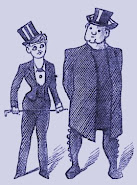
Ace O'Hara was an interesting British strip which appeared originally in the Daily Dispatch. Ace O'Hara was a nicely scripted science-fiction feature appearing in the Melbourne Australian Age from 8 Nov 1954 to 3 Aug 1964. The long-running Mercury Features strip was bylined Basil Blackaller until his death in 1958 when Tony Speer took over the illustration. The writer was Conrad Frost. First strip is directly below >


April 1 1961


Aug 3 1961


April 16-April 20 1963 >


June 3 1964


Aug 3 1964

*Tip o' the hat to Steve Holland for the updates.


Monday, June 13, 2011

Frederick Gleason (c. 1817-1896)

Frederick Gleason, born in Germany c. 1817, is regarded as the founder of illustrated journalism in the United States. The Congregationalist had a different opinion. “The first illustrated newspapers in this country were The Illustrated New York News, which appeared on June 8, 1851, and Gleason's Pictorial Drawing-room Companion, which was started on July 2, 1851, by Frederick Gleason.” This turns out to be wrong since Volume I No. 1 of Gleason’s Pictorial was published on 3 May 1851.

“I commenced the publication business in 1842, in the old Solly Building, Boston, issuing from there a number of novelettes and other cheap works.” These cheap romances of pirates, knights, and smugglers were written by Sylvanus Cobb Jr., Ned Buntline, Osgood Bradbury, A. J. H. Duganne, Dr. J. H. Robinson, Lieutenant Murray, and Harry Halyard.

“In 1843 I established the Flag of Our Union, the first really literary publication of its class, which soon brought hosts of imitators. Among these were the True Flag and the American Union… About 1850 the Flag of Our Union had a large circulation from which my income was $25,000 per annum.”

Inspired by the Illustrated London News Gleason issued 25,000 copies of Gleason’s Pictorial in 1851. One of his early employees was Henry Carter, known as Frank Leslie, who joined him in 1851 in the engraving department and remained two years. He later sold the newspaper to Maturin Murray Ballou in 1854 with circulation at 110,000 copies. Four years later the renamed Ballou’s Pictorial failed and Gleason took over publication once again.

In 1892 Gleason was publishing The Home Circle and Gleason’s Monthly Companion from 47 Franklin Street.

“When I commenced the publication of the Pictorial I published a paper of facts and not of fancy, as most of the illustrated journals of today do. If there was a disaster in mid-ocean I did not have my artists on the spot. In 1853 the artists of the United States presented me with a solid silver service valued at several thousand dollars.”

Gleason died 6 Nov 1896, the inmate of a home for the aged in Boston.

* “He was the Pioneer. Gleason Founder of Illustrated Journalism.” Weekly Argus News 3 Dec 1892.

**Images courtesy E. M. Sanchez Saavedra


Friday, June 10, 2011

American Highwaymen


At least half-a-dozen American publishers issued British highwaymen penny dreadfuls in series but there were very few American highwaymen. Edward L. Wheeler, author of Wild Ivan, had much greater success with Deadwood Dick, road-agent, which was published by Aldine in London and sent to all the colonies. Dr. John Hovey Robinson went back to the early days of American romances of the fifties. His serials appeared in Gleason's Pictorial and were kept in print by Beadle until the 1880's. The Nation described his works as 'unnatural backwoods romances.' Oll Coomes wrote Red Rob, the Road-Agent and Lady Jaguar was from the pen of William H. Manning writing under the pseudonym "Captain Mark Wilton."


*Images courtesy E. M. Sanchez Saavedra

Thursday, June 9, 2011

Introducing Moon Mullins


Advertisement introducing Moon Mullins 26 Jan 1927 and comic strip from 2 April 1935. The stereotypical character Mushmouth Jackson went from Jack Dempsey's sparring partner to Moon's chauffeur but was phased out circa 1953 along with others like Joe Palooka's sidekick. See "What's not so Funny about the Funnies HERE.


Wednesday, June 8, 2011

A Slap at Slop


Mathew Crowther has found an extraordinary broadsheet format version of William Hone's 'Slap at Slop' which I have posted in 4 high-res images HERE.

Mathew explains "I already own a copy of the 1822 re-issue which was re-worked by Hone into a standard octavio-sized pamphlet but this original version is something else. It was published as a full-sized replica of a broadsheet newspaper running to 4 pages in total and containing a plethora of absolutely amazing woodcuts by Cruikshank. These early broadside editions are really rare and most of the copies of Slap at Slop you tend to see for sale today are re-issues which have been disbound from the bound volume of reproductions which Hone published in the 1820s."

Tuesday, June 7, 2011

The Game of Death


“Every other year or so, when the new crop of youngsters comes along, we can repeat many of these things again. Generation after generation, as sure as the kites and skipping ropes that blossom in the spring.” These were the words of a “premium specialist” recorded in a newspaper article, in October 1948, titled

CEREAL LURES BIG BUSINESS

Millions spent to get Junior to eat through Premiums

According to the article “the No. 1 headliner for the kids was that atom bomb ring. When you put your eye close to the plastic bomb you could see a radiant substance inside that sparkled as if alive. More than 3,500,000 children sent 15 cents and a box top for that one.”

On September 4, 1950 there was a science-fiction convention (Dianetics was a popular discussion) in Portland, Oregon. Attending was a famous fan turned science fiction author, E. E. “Doc” Smith. Smith was a chemist, and general manager of a Chicago manufacturer of doughnut mix. In 1914 he wrote a story about an atom bomb used to destroy a planet. The story was not published until 1928.

“I blew that planet completely to hellangone. I made a nova out of it. It was roughly comparable to what the hydrogen bomb would be if they used a ton of lithium hydride. I got $75 for it.”

Those were the good old days; between 1954 and the Cuban Missile Crisis of 1962, every kid born in Canada after1940 went through yearly air raid drills -- heading for the basement to lie in a fetal position and await the Commie bombs and oblivion. We may have been irradiated already since we lived over the border north of the Hanford nuclear plant at Richland, Washington which leaked and sent airborne radiation ‘downwind’ between 1944 and 1949. No doubt much of it went upwind to British Columbia as well. We lived in Trail, B.C. by 1956, a five hour drive from Richland. The smelter where heavy water for the bombs was manufactured (my mother worked there during the war) poisoned the Columbia at Trail with zinc and lead while Hanford was poisoning the Columbia with radioactive cooling water at its confluence. The present owners have cleaned the Columbia river considerably since then.


Government pamphlets available at libraries were a hoot -- one image that stuck in my head was of a nondescript-looking man caught outside during a nuclear attack. The artist depicted the flash in the sky which was a signal to lie down in a shallow ditch -- supposedly radiation would float over top of you and be dispersed in minutes. Then you could get back on your feet and continue with your morning walk.

By 1962 Dr. James Van Allen, who had discovered the radiation belt named after him, said that a “huge new radiation belt in the lower reaches of the Van Allen belt has been formed around the earth as a result of the July 9 high-altitude nuclear test conducted by the United States over the Pacific.”

*Top: Bert the Turtle (April 25) reassures the kiddies in one of seven comic strips published in 1952. Bottom: American Bomb pamphlet.

**Selection from Albert E. Kahn's 1953 Game of Death HERE.


Friday, June 3, 2011

George M. Woodward and the Comic Strip


by John Adcock

“A caricaturist in a country town, like a mad bull in a china-shop, cannot step without noise; so, having made a little noise in my native place, I persuaded my father to let me seek my fortune in town.” -- G. M. Woodward related by Henry Angelo.

Henry Angelo, author and fencing master, included a sketch of Woodward in his Reminiscences;

“It appears that the caricaturist came not to London, like many another wit, pennyless; his father allowed him an annuity of first fifty, and augmented the sum to a hundred pounds. With this income, and what he obtained by working for the publishers, he was enabled to enjoy life in his own way; and might be met, with a tankard of Burton ale before him, seated behind his pipe, nightly at Offley’s; or, if not there, smoking the fragrant weed at the cider-cellar, the Blue Posts, or the Hole in the Wall. Latterly, his rendezvous was transferred to the Brown Bear at Bow-street, where he studied those peculiar species of low characters, the inhabitants of the round-house, and the myrmidons of the police.* Enamoured with the society of these able physiognomists, he ultimately took up his quarters at the Brown Bear, and there, to the lively grief of those tender-hearted associates, one night died, in character, suddenly, with a glass of brandy in his hand.” (*Bow-street runners)
Very little notice has been taken of the caricaturist and illustrator George Moutard Woodward in contemporary or modern histories of caricature, yet, following the example of Hogarth, he was one of the earliest practitioners of the comic strip form in England. There is confusion about his middle name which is spelled ‘Murgatroyd’ by some and ‘Moutard’ by others. He was known to his contemporary’s as ‘Moutard.’

Henry Angelo said of Woodward that ‘The inventive genius of one burlesque designer was exhaustless….” And then goes on to say he was “commonly designated by his merry associates ‘Mustard George.’” Angelo dabbled in caricature as well. He recalled exhibiting his own caricature of the dandy Soubise, titled the ‘Mungo Macaroni,’ in Darley’s shop-window…

Woodward’s exact date of birth is unknown but most sources give it as the year 1760. The Derbyshire Record Office, which has a collection of 500 or so of his drawings and prints (they call him ‘Murgatroyd’ by the way) states he was born ‘in around 1865’ and grew up in Stanton by Dale. Thomas Wright wrote in History of Caricature and Grotesque in Literature and Art;

“There was much of Bunbury’s style in that of Woodward, who had a taste for the same broad caricatures on society, which he executed with a similar spirit. Some of the suites of subjects of this description that he published, such as the series of the Symptoms of the Shop, those of Everybody out of Town, and Everybody in Town, and the specimens of Domestic Phrensy, are extremely clever and amusing. Woodward’s designs were also not infrequently engraved by Rowlandson, who, as usual, imprinted his own style upon them.”
Woodward was not an engraver, he drew in pencil only and his work was finished by many engravers including Isaac Cruikshank, Richard Newton, Thomas Rowlandson and Isaac’s son George Cruikshank. Woodward began his career ‘in around’ 1790 and published popular prints for most of the major publishers; Allen, Holland, Fores, Ackermann and Tegg.

One Tegg print ‘The Art of Walking the Streets of London -- Plate 1st’(1818) was engraved by George Cruikshank from Woodward’s design and 4 rectangular boxes, or panels, with vignettes of the passing crowd seen from a fixed point as though from a moving carriage, even as the background changes. You can look this plate up in Vic Gatrell’s indispensable densely illustrated book City of Laughter (2006) Fig. 13, page 49. It could be argued that ‘The Art of Walking’ is not a comic strip, nonetheless it is a ‘strip’ by design, and has many of the elements of the modern comic strip.

Even closer to a comic strip is the print ‘SIX of the most approved methods of appearing ridiculous on the Ice!!’ from 1797, published by Allen & Co., and reprinted in Woodward’s book ‘Eccentric Excursions’ in 1798 from the same publisher. This print, seen above in a poor copy, follows one figure in six vignettes as he skates to a disastrous fall on his head. It anticipates the photographic studies of motion carried out by Eadweard Muybridge in 1878 and foreshadows stock slapstick comic strip situations of the future. The only thing different from today’s strips is the absence of the speech ‘bubble.’ Woodward was very familiar with balloons but this example was judged perfect without.

Woodward may not have been the only caricaturist, or even the first, drawing sequential prints but he seems to have acted as a gag-man and designer for others. The Richard Newton prints HERE all seem to have been done by Newton to Woodward’s design. Woodward drew many popular prints featuring ghosts. It seems likely that comic strips of the 1820's and 1830's by C. J. Grant, John Leech and George Cruikshank were all influenced by the earlier example of G. M. Woodward.

*Update: This cartoon from this page is provided by Leonardo De Sá


George Moutard Woodward (1760?-1809)


by Mathew Crowther

George Moutard Woodward was born sometime around 1760 to a family who were in service at Stanton Hall in Derbyshire. The young Woodward grew up in the nearby market town of Stanton-by-Dale and, judging by the evidence of his later writings, received a relatively sound education. Woodward took to caricature in his youth as a means of ridicule his neighbours and local dignitaries. A folio of his earliest drawings, dated to 1781, is in the Derby Local Studies Library, among a sizeable collection of his prints, drawings, and book illustrations.

His caricatures having caused something of a local stir, he persuaded his father to let him seek his fortune in London. Apart from two caricature prints dated 1785 designed by Woodward and published by him from 28 Cary Street Lincoln's Inn, it was not until 1790 that he made an impact on the London scene. Thereafter his output was copious. The British Museum catalogues list 525 examples of his work from the next twenty years, published by Holland, Fores, Ackermann, and latterly Tegg, all leading print sellers. These prints, designed by Woodward, are etched by others - Rowlandson, who was his friend and drinking companion, Isaac Cruikshank, Roberts, and Williams.

Woodward's original drawings are vigorous but crude, marked by heavy outlines and coarse colouring; his value lay in his humorous ideas. Woodward's political prints and broadsides are orthodox in outlook, generally supporting the government and always ready to lambast the French. His forte was social humour, and in this area his reputation between 1807 and 1809 surpassed even that of Rowlandson. Lacking the serious purpose of a satirist and going beyond the ritual mockery of hypocrisy and affectation, he concentrated on jokes, which were often ribald. For his contemporaries, much of the attraction of his work lay in the captions, which relied heavily on wordplay and were sometimes couched in doggerel verse. He tended to choose his subjects from the middle and lower classes rather than high society and had a partiality for sailors.

Woodward was a pioneer of the strip cartoon. Elaborating a method of Bunbury and F. G. Byron, he produced between 1794 and 1800 a number of single-sheet caricatures, with titles like ‘The Effects of Flattery’, that were variations on a theme arranged in rows, a device that was much exploited. He showed versatility too in designing book illustrations, borders, and screen decorations. Of Woodward's books, the first and most celebrated was Eccentric Excursions, published in 1796 with 100 plates engraved by Isaac Cruikshank after his designs. Woodward's text describes an idiosyncratic ramble round the country and reveals an engaging personality. At least seven other books followed, all broadly humorous and witty.

After 1805 there is a notable tailing off in his works as an artist and an engraver and most of the prints which carry his name after this date will usually be followed by the abbreviation 'Del.', meaning 'delineated by' and indicated that the print came from an original concept by Woodward but which was drawn and engraved by another artist. From 1805 until his death Woodward seems to have worked in closely with Thomas Rowlandson and may have been jointly employed with him to produce satires for the publisher Thomas Tegg. Although I'm not sure why Woodward went into decline as an independent artist in these years I would speculate that it may have had something to do with his drinking which, even by the dissipated standards of the day, was considered to be excessive.

The first image is a rare example of an etching in Woodward's own hand entitled A New Phantasmagoria for John Bull!!In this print, John Bull is seen as a sailor wearing striped trousers, a sword in his right hand. He looks towards two figures poised on the beams, which radiate from a magic lantern worked by Napoleon. Other beams reach a bear standing on a rocky island on the horizon behind John. Napoleon says: “Begar de brave Galanté Shew - for Jonny Bull.” The two lantern-figures include a French officer, holding a tricolour flag in the left hand, and young woman. He says: “Here we come Johnny - A Flag of Truce Johnny - something like a Piece! all deckd out in Bees, and stars and a crawn [sic] on her head - Not such a patch’d up piece as the last.” John answers with a distrustful stare: “You may be d——-d and your piece too! - I suppose you thought I was off the watch - I tell you Ill say nothing to you till I have consulted Brother Bruin and I hear him grouling terribly in the offing.”


The second is a print which was published just a couple of weeks before Woodward's death in 1809 and was drawn and etched by Rowlandson from an original idea by Woodward. The Head of the Family in Good Humour is a relatively pugnacious reflection on Britain's isolation at this stage in the Napoleonic Wars. John Bull is surrounded by scowling and grotesquely caricatured foreigners who issue various warnings such as; "Austria will never pardon him" and "let him tremble at the name of America" but appears utterly unconcerned and responds by saying "Don't make such a riot you noisy little brats, all your bustle to me is no more than a storm in a chamber pot."

Third is an image from a series he produced with Rowlandson in 1799. Grotesque Borders for Screens, Billiard Rooms, Dressing Rooms, &c., &c., Forming a Caricature Assemblage of Oddities, Whimsicalities & Extravaganzas!! was an early form of the 'scrap sheets' which were to become popular in the 1820s and 30s. The prints were issued as one large series of images which were meant to be cut up and pasted around the borders of albums of caricatures and prints.


Thursday, June 2, 2011

John Doyle (1797-1868)


By Mathew Crowther


Doyle, like many satirists of the period, began his career with aspirations of becoming a serious artist. He was schooled at the Royal Dublin Society and had even worked as the official artist to the Lord Lieutenant of Ireland, before he decided to emigrate to London in 1825. However, after an initially promising start which included an exhibition at the Royal Academy, his career as a serious artist began to founder in England and within two years of his arrival he had begun working as a jobbing satirist and illustrator for Thomas McLean's publishing house.

His most famous work is probably the long-running 'The Political Sketches of HB" series which was published without interruption from 1822 until 1849. The nom de plume HB (an essentially meaningless moniker which was constructed by Doyle writing his initial over each other twice), was perhaps concocted by Doyle in the hopes that his attempts to build a career in the world of 'high art' would not be tainted by his association with the 'low' world of caricature and the print shop. He need not have worried however because his 'Political Sketches' were wildly popular and by the early 1840s the income Doyle accrued from publishing the series was sufficient to buy him a house in the well-to-do Hyde Park area and allow him to move in the same fashionable circles as Dickens, Thackeray and Scott.


Today Doyle's work as a satirist is often looked upon as being distinctly mediocre in comparison with the great names of late eighteenth and early nineteenth century English satire and even with contemporary satirists, such as C.J. Grant, who achieved far less success than Doyle in their own life time. In particular Doyle's critics tend to argue that his work 'sanitized' political satire by removing much of the caricature and humour which had typified the works of earlier satirists. However we should remember that Doyle was a commercial artist who was merely reflecting the changing tastes of his audiences. If Doyle's work was a little more staid in its style than that of Gillray or Rowlandson this is in part because the Victorian audiences of the 1830s and 40s were far less inclined to laugh at the grotesque and rather base humour which had excited their parents and grandparents generations.


These are all relatively early examples from "The Political Sketches of HB" and date from the years 1829 and 1830. They all relate to events which took place during the Duke of Wellington's first government and two them; The Prophecy and Political Harmonics are particularly focused upon the Catholic Emancipation Act. Wellington's determination to remove legislation which was prejudicial to Irish Catholics evidently struck a chord with Doyle as by 1830, when the Iron Duke was being pilloried by a large section of the Liberal and Radical presses, Doyle was still willing to publish a pro-Wellington print like The Nocturnal Reverie.


Wednesday, June 1, 2011

A Word with Punch


A Word with Punch (to be continued if necessary). As mentioned in my previous post "Literature of the Lower Orders" HERE. Alfred Bunn, tired of being the butt of Punch's columns, put together a Punch facsimile designed by George Augustus Sala (not well-known as a caricaturist but he did have quite a talent for it) which pushed Punch into an uneasy silence. Just about everyone connected with Punch at the time is depicted in the cover illustration. This image is from The History of "Punch" by M. H. Spielmann, 1895.