

 Posts
Posts


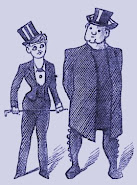


The founder of The Graphic and The Daily Graphic was William Luson Thomas (1830-1900), engraver and brother of George Thomas, a well-known painter. He started an engraving factory with a large staff supplying engraved illustrations for books and periodicals, among them the Illustrated London News.


Queen Victoria’s reign is limping to an end, her death in 1901 flashed round the world by telegraph. Each issue of The Daily Graphic has a nicely drawn weather girl which looks like the artist had studied illustrator Frederick Walker’s black and white poster for The Woman in White, the first “Sensation Novel,” serialized in 1859. The weather on December 7, 1896 is “Squally, Showery, Colder,” and a violent gale was ripping up the South Coast of England.


About eight of the twenty pages were taken up with advertising columns and illustrated ads. There is a small column of police reports, two or three per issue; stories from the Niger Campaign; and a massacre of Italians in Somalia.
Henry Irving and Miss Ellen Terry star in Cymbaline, to be followed by The Bells and Richard III. The Mikado is playing at the Savoy, managed by D’Oyly Carte. The Moore and Burgess Minstrels are playing nightly at St. James’s Hall, and the newest type of imported American popular song, the “coon song,” is being sung by Eugene Stratton in the Music Halls.


At the Royal variety show Professor Jolly’s New and Improved Colourted Animated Photographs are on view along with the pantomimists and trick bicyclists. “Animated photographs” are also a feature at the Egyptian Hall, home to magician J.N. Maskelyne. George Meliès, Emile and Vincent Isola, Felicien Trewey, David Devant, Carl Hertz, Professor Anderson, Leopoldo Fregoli, Alexander the Great, Walter R. Booth and G.W. Bitzer (Griffith’s cameraman, who wrote his own great book, highly recommended), Albert E. Smith, J. Stuart Blackton (who billed himself the ‘Komical Kartoonist’), and Harry Houdini were all magicians who became involved in the burgeoning film industry (See: The Magician and the Cinema by Erik Barnouw, Oxford University Press, 1981).


Historic Newspapers holdings include newspapers from all over the world but the bulk of their archive consist of papers from the US and UK, including regional titles. Historic Newspapers supplies free of charge educational support packs for schools and has a dedicated research team available. They have a stock of over six million original newspapers going back 200 years which are sold as research items, collectibles and gifts.
Historic Newspapers also passed along this discount code to share with Yesterday’s Papers visitors
Code: 15TODAY
This code can be redeemed against any of the original newspapers and if a Victorian newspaper is added at the basket (from just £5) it will also be applied to this.
Historic Newspapers also passed along this discount code to share with Yesterday’s Papers visitors
Code: 15TODAY
This code can be redeemed against any of the original newspapers and if a Victorian newspaper is added at the basket (from just £5) it will also be applied to this.


