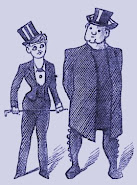
All hail! another year has now begun;
But in the past, behold! what deeds were done.
For who like me has sternly watched the times,
Exposing follies, and detecting crimes?
The highest ne’er escaped my piercing ken,
And all were made to tremble at my pen.
My aid was ready for the poorest cause,
Where rogues would strain, or wealth corrupt the laws.
But, hark! I’ll quickly summon to my sight,
Those whom I serve, and those who fear my might.
Each shall a tale unfold, with looks aghast;
Then learn my future actions by the past.
Keen satire’s pen and lash I still shall wield,
‘Till rascals vanish, and ‘till tyrants yield.
All then, who dare, and vainly will resist
The scourge of knaves and fools, the SATIRIST,
To grace my pages on this new-born year,
Now at my instant bidding, rise! appear!
*
The Satirist, 4 January 1835
The costermongers of the Seven Dials had a keen interest in penny literature, and the literate among them gave public readings in the courts. One of Henry Mayhew’s informants said “What they love to listen to - and indeed, what they are most eager for- are Reynolds’s periodicals, especially “The Mysteries of the Court.” “They’ve got tired of Lloyd’s bloodstained stories,” said one man, who was in the habit of reading to them, “and I’m satisfied that, of all London, Reynolds is the most popular man among them. They stuck to him in Trafalgar-square, and would again. They all say he’s a ‘trump‘, and Feargus O’Connor’s another trump with them.”
Reynolds had said in public to great applause that “the people of England were seeking their rights by moral means; he was happy to find that the people of England were so determinedly bent on possessing their rights; in all the novels and romances he had written, he had never failed to push forward the great rights of humanity.” His working class readers enjoyed his spicy stories because they made buffoons of the police and the aristocracy. Scenes were set in places they knew well, in the familiar boozing kens of the Seven Dials and the notorious rookeries of Jacob’s Island. They believed the aristocrats capable of monstrous crimes. Mayhew was informed that the following extract from The Mysteries of the Courts of London “took their fancy wonderfully.”
“With glowing cheeks, flashing eyes, and palpitating bosom, Venetia Trelawney rushed back into the refreshment-room, where she threw herself into one of the arm-chairs already noticed. But scarcely had she thus sunk down upon the flocculent cushion, when a sharp click, as of some mechanism giving way, met her ears ; and at the same instant her wrists were caught in manacles which sprang out of the arms of the treacherous chair, while two steel bands started from the richly carved back and grasped her shoulders. A shriek burst from her lips - she struggled violently, but all to no purpose : for she was a captive - and powerless !
We should observe that the manacles and the steel bands which had thus fastened upon her, were covered with velvet, so that they inflicted no positive injury upon her, nor even produced the slightest abrasion of her fair and polished skin.”
Reynolds tales of ruling-class vice and corruption was following in the footsteps of much earlier works based on the real and imagined crimes of royalty;
The Spirit of “The Book,” The Secret History of the Court of England , and
The Murdered Queen ! In 1829 Thomas Ashe revived the theory that Ernest Augustus, Duke of Cumberland (fifth son of George III.,) murdered his valet, Sellis, in a book titled
Osphia, or the Victim of Unlawful Oppression. Ashe was hoping his blackmailing libel would pay off, instead he was jailed for threatening to murder the Duke.
G. W. M. Reynolds picked up the story of the murder of Sellis in the eighth volume of
The Mysteries of the Court of London. Reynolds added a novel twist to the melodrama, Sellis discovered Neale, another of Cumberland’s servants, in bed with Cumberland’s sister, Princess Augusta and “fled along the passage.” Neale then murdered the Duke’s valet to keep his seduction a secret. Frank Jay suggests that Reynolds Mysteries of the Court of London was inspired by a suppressed 1832 work,
The Secret History of the Court of England.
“Well penned, they present to the reader, artistically wrought up in the form of a mysterious narrative, extending over from one to two hundred weekly numbers, all the disgusting facts which have, from time to time, during the last fifty years, been brought to light, and exposed in the public journals, as reports from police courts, criminal trials, and cases of seduction, and adultery, from our ecclesiastical courts, and courts of common law. They are artfully and cleverly dressed up and aided by the depraved pencil of an artist skilled in depicting the sensual and horrible; and while they interest the tale-devourer, they, at the same time, fearfully stimulate the animal propensities of the young, the ardent, and the sensual.”
The most audacious attack on Cumberland appeared in an extraordinary weekly serialized fiction, masquerading as fact, begun in Barnard Gregory’s
The Satirist on July 12, 1840, titled
Prince Ernest of Saxe Coburg, purported to be the memoirs of a Frenchwoman, Mademoiselle Pauline Adelaide Alexandre Panam, who, in 1809, was seduced at age 14, abandoned with child, starved, drugged, and near-poisoned by “this vampire Prince,” In addition to her slavery to “this monster’s tyranny, lust, meanness, and bloodthirsty cowardice,” Pauline had to deal with his horrific mother, the Duchess of Coburg who says ; “Give us the child that we may thrust it into a foundling hospital, where it’s identity may be lost forever, and go you yourself and turn wh-e. Take to the streets and let us, thus be rid of you both.”
There was no crime done in London that Gregory and others did not lay at the door of Ernest Augustus, from the murder of his valet Sellis to an attempt to take over the throne of England by sponsoring the attempted regicide of Queen Victoria, by Oxford, a crime for which “no-one would have been benefited but King Ernest and the Tories.” Gregory possibly had a hand in two other scurrilous works,
Authentic Records of the Court of England, and
Secret Life and Extraordinary Amours of Ernest, King of Hanover.
The Satirist; or, Censor of The Times ran from 10 April, 1831 to 15 December 1849. Barnard Gregory and Hewson Clarke were the main contributors. Robert Cruikshank, brother of George Cruikshank and engraver G. Armstrong contributed a political cartoon series called
Our Portrait Gallery beginning January 4, 1835 which continued for approximately one year. Gregory was the registered proprietor, printer and publisher at no. 334, strand, Middlesex.
The Satirist’s masthead read : “SATIRE’S MY WEAPON --” “I was born a Critic and a Satirist, and my Nurse remarked that I hissed as soon as I saw light.” The newspaper was Liberal, pro-Reform and Anti-Chartist.
Patricia Hollis wrote that “..a closer study of the unstamped shows that there were two radical rhetorics, not one. The older was shaped in the years around 1819, and denounced aristocracy, monopoly, taxes and corruption; the newer was that of Hetherington, Carpenter and Bronterre O’Brien, and it denounced exploitation, poverty, and power.” Gregory’s politics were likely based on the older radical rhetoric with its hatred of aristocracy and “Old Corruption.”
Barnard Gregory (1796-1852), proprietor of the extraordinary
Satirist, was the son of a Goswell-street green-grocer born in the County of Hampshire. He worked as a schoolmaster, itinerant preacher, druggist, and head clerk in a Brighton bank before founding
The Satirist; or, Censor of The Times in 1831. St. Margaret’s Chapel in Brighton was built by Gregory as a financial speculation when he was the editor of the
Brighton Gazette, and was named after Gregory’s first wife, Margaret. Mrs. Gregory laid the foundation stone on May 15, 1824. They had a son, Charles Barnard, who died in 1843, and a daughter, Margaret Gregory, who was born in 1825.
Gregory made a profitable sideline from extortion and blackmail. It must have been lucrative considering the law-suits, fines and prison sentences Gregory and his printers were willing to put up with. Pocket money was extorted in the front-page
‘To Correspondents’ columns. A quick payment would quash any further revelations about the gossip alluded to.
We have certainly heard of GEORGE SAMUEL FORD -- we may allude to him again.
The case in which SYLVESTER and WALKER, of Furnivall’s Inn, figure, is under consideration.
ARNOLD, the Lessee of the late English Opera House, the father of the “last man” appointed a Commissioner of Bankrupts, was a member of the Beefsteak Club.
We have unfortunately no room for the communication from “a friend of Captain SUTHERLAND’S” respecting the mysterious death of his games-keeper.
Gregory’s main rival and political opposite was fellow blackmailer Charles Molloy Westmacott, the illegitimate son of Richard Westmacott and a widowed innkeeper named Susan Molloy. His father had him trained at the Royal Academy of Arts but he was more interested in the indolent life. On his father’s death Charles was disinherited by his half-brother, Sir Richard Westmacott. Sir Richard may have been justified as Westmacott had already begun his blackmailing career through publishing the
Gazette of Fashion (1822,) devoted to gossip, which lasted 13 numbers. He took over
The Age (1827-1843) from Richard Richards, who often edited the paper “in the seclusion of the Fleet prison,” and grew wealthy by extorting money through its columns.
“The modus operandi (as given by Mr. William Bates, from whom we derive our information respecting this man) appears to have been as follows : ‘Sometimes a vague rumour or hint of scandal, accompanied perchance by a suggestive newspaper paragraph, was conveyed to one or more of the parties implicated, with a threat of further inquiry into its truth, and a full exposure of the circumstances which excited the sender’s virtuous indignation. This, if the selected victim was a man of nervous, timid temperament, often produced the desired affect; and although possibly entirely innocent of the allegation, he preferred to purchase silence, and escape the suspicion which publicity does not fail to attach to a name. If, on the other hand, no notice was taken of the communication, the screw received some further turns. A narrative was drawn up, and printed off, in the form of a newspaper paragraph, and was transmitted to the parties concerned, with a letter, intimating that it had been ‘received from a correspondent,’ and that the publisher thought fit, prior to publication, to ascertain whether those whose names were mentioned desired to correct, modify, or cancel any part of the statement. There is no doubt that very large sums have been extorted by these scoundrelly means, and a vast amount of anxiety and misery occasioned.” this was “the sort of man” that Charles Molloy Westmacott appears to have been; and I learn on the same authority that by these means he was enabled in one instance alone to net not much less than a sum of £ 5,000. “Pulls” of this kind enabled this fellow to live at his ease in a suburban retreat situated somewhere between Barnes and Richmond, which he fitted up (for he considered himself , as some others of his more modern class appear to do, a “man of letters”) with books and pictures.”

In August 1831 Gregory began a regular series entitled
The Hells, which attacked the proprietors of the gambling houses of London in which they promised to “publish the names of the various parties connected with these establishments, their histories, and such particulars as may lead to a full exposure of their characters and nefarious proceedings.” It was claimed that this was done for “the public good” but it was merely another lucrative source of blackmail money for the
Satirist.
The proprietors of the Hells fought back with intimidation and violence. Near the end of August 1834, “the Thurtell’s of the day,” Ephraim Bond (“alias Cohen,”) a man named Bliss, and four others, viciously attacked the acting editor in the office of the Satirist. Bond and Bliss were the proprietors of a gambling hell on St. James’s-street.
“In this case three gentlemen entered the Satirist office… while three others remained outside the door to prevent interruption. These individuals made some inquiries as to the responsibility of the individuals present for an article which appeared in the paper of the previous day; and on an answer being given, commenced a furious attack on Mr. Steele. The other gentleman retreated into an inner room, the door of which he shut. This door was instantly broken open, and an attack equally ferocious commenced upon him. The weapon used was a whip loaded with iron. He was covered with blood and contusions, and knocked almost senseless to the ground; after which, the intruders thought proper to retire, having declared, in the course of their outrage, their intention to murder their victims.”
Gregory was not intimidated although he most certainly must have taken defensive measures to prevent further altercations in the Strand office. Charles Westmacott, Barnard Gregory and other blackguard editors used differing methods to guard against the wrath of their victims. Theodore Hook, editor of
John Bull, kept a “coarse, half-brutal, but tall and powerfully built Irishman, of the grade of a day-labourer” on the premises who would identify himself as the editor to unwelcome visitors.
“I have heard it said, and believe it to be true, that in Westmacott’s editorial room he had a small basket suspended near the ceiling, that a spring, when touched, brought close to his hand. It contained a pistol. Westmacott was a poor creature physically, and had received several thrashings. Gregory was, on the contrary, a very powerful man, and aided by a huge loaded bludgeon, which he always carried, would not easily have met his match.”
Gregory was sentenced to 3 months imprisonment on Feb. 14, 1839 for libel against the wife of James Hogg. It was his first gaol term but not his last.
One morning in February of 1843 a placard concocted by the staff of
Punch advertised:
GENTLEMEN OF LONDON ! Mr. Barnard Gregory, the editor of the Satirist, will appear to-night at Covent-Garden Theatre, in the character of HAMLET.
The
Morning Chronicle reported the ensuing incident at the Covent Garden Theatre when Gregory had been advertised to make “his first, and no doubt his last” appearance on the stage as Hamlet. The show was discontinued after the uproar accompanying the first act:
“The curtain rose and the tragedy commenced. For some time, until Hamlet made his appearance, all were quiet and attentive as usual. No sooner, however, did “Hamlet” come forward, than there arose a storm of hisses, groans and yells, such as we never before heard in a theatre. For awhile Mr. Gregory bore the brunt of it, expecting that with the first burst its fury would be expended…Finding that the uproar did not abate, he commenced in the very midst of it his part of the performance. The first opening of his mouth seemed to call forth fresh elements of confusion. The play was, however, continued; Hamlet saw the troubled spirit of his father, and obeyed its mandate to follow him. Everything was seen, but nothing was heard, except the mingled hisses and groans of the assembled audience; and the first act of Hamlet was, perhaps for the first time, performed in dumb show.”
The Duke of Brunswick egged on the audience, many of whom were his friends. Gregory had earned his enmity for charging on November 14, 1841 in the
Satirist that Charles, Duke of Brunswick- Lüneburg, murdered the prostitute Eliza Grimwood in her room in the Waterloo Road. The fracas at the Covent-Garden Theatre could have turned ugly. W. H. Linton uneasily noted that “a lot of rough fellows,” probably hirelings of Gregory’s, were in the crowd ; while the Duke had on his payroll none other than Jem Mace, the celebrated pugilist turned publican. In 1843, as a result of libeling the Duke of Brunswick by charging him with the murder of Eliza Grimwood, Gregory was jailed twelve months for libel.
In August 1843 a wanted placard was posted offering a five pound reward (afterwards increased to ten) for the apprehension of Gregory, who was hiding in his house in Southend under an assumed name. Gregory was trying to avoid an indictment for publishing a libel against His Highness the Duke of Brunswick and Lunenburg in the
Satirist newspaper. The bill-posted description was quite precise; right down to his “habitual satirical sneer.” The placard’s insulting tone implies that it may have been another persecution by the staff of the comic journal
Punch.
“The said Barnard Gregory is about five feet two inches high, sallow complexion, about fifty-five years of age, generally without whiskers, his natural hair grey and scanty, wears wigs of different colours, has a projecting forehead, giving a lowering expression to the face, eyes darkish colour, nose short and ill-shaped, face round, has an habitual satirical sneer, is high-shouldered and slightly knock-knee’d, dresses shabbily in black; voice powerful, with a fawning style of speech; if not disguised, is in mourning; manner pompous and vulgar; walk embarrassed and uncertain.”
The police, under the supervision of Constable Low, watched the house throughout the night. An officer hidden in the shrubbery at the rear of the house noticed Gregory peeking his head out of the window shortly before retiring to bed. Low, in disguise, entered the house through a window and began searching the house. A servant alerted Gregory who escaped to the top of the house.
“Miss Gregory, who it appears accompanied her father, met the officer on the stairs, and was astonished to find herself accosted as Miss Gregory, where she had been known only as Miss King.”
It took five or six hours to find Gregory who was taking refuge in a small press in the garret. Gregory was secured and lodged in the Ship Hotel at Southend, where he was visited by his daughter and his solicitor. He was given a prison sentence. On 30 Nov 1844 Gregory quitted Newgate between one and two o’clock in the afternoon, in company with his daughter Margaret and several friends.
In 1846 Gregory returned to the stage, subsequently acted at the Haymarket, Victoria and Strand theatres, wrote four dramas, and is said to have edited the
Penny Satirist for Benjamin Cousins. There is no evidence for this assumption however, the editor in 1838 was a man named "Shepherd" Smith, the Universalist. On May 6, 1846 Gregory was sentenced to 8 months imprisonment in the Queen’s bench once again; for 4 libels (again involving Eliza Grimwood) on his nemesis, the Duke of Brunswick.
Gregory married Margaret Thompson in March 1847. Gregory retired soon after when he contracted a lung disease and the
Satirist’s proprietorship went to Alexander Carrol, Jun., who was soon facing bankruptcy. On 30 September 1847 there was a “riot” in the
Satirist office when Gregory, the landlord, sent a group of eight hired rowdy’s to evict the brothers W. A. Ghislin and G. Ghislin, who sent for re-enforcements and after a brawl regained possession and drove the Gregory camp out of the office. The
Satirist came to an end on 15 December, 1849 at number 924. On June 13, 1850 an unrepentant Gregory was
again gaoled for 6 Months for libels against Brunswick.
Gregory, whose address was now The Priory Frognal, Hampstead, died on or about the 17th day of November, 1852. He was buried at Kensal-Green, “last home of the Londoners … Within its fifty three acres lie lord and leveller, priest and actor, poet and clown.” The cemetery was consecrated on All Souls’ Day in 1832 and Gregory’s first wife Margaret’s was the first body deposited there. Gregory’s ashes found a home under “a massive marble monument with two carved figures in niches” inscribed “Barnard Gregory, the Satirist.”
“His royal highness, the Duke of Sussex and half the late British peerage rest within a few yards of Feargus O’Connor. Thomas Barnes, the editor of the Times, sleeps his last sleep by “Barnard Gregory, the Satirist.””

*
Illustration by Robert Cruikshank, brother of George Cruikshank, engraved by G. Armstrong.


 Posts
Posts