Tuesday, January 19, 2010

Mystery Editor Revisited


Sometimes it pays to think out loud. In a previous post, “Mystery Editor,” I pondered long and hard on the identity of the anonymous lead author, and possible editor of Famous Fights.

A kind reader, Christopher Moughton, wrote to tell me of a book by E. V. Lucas, “The Phantom Journal,” published in 1919. Lucas relates how the editor of a weekly sporting paper, “The Mirror of Life and Boxing,” knew Borrow well, and had visited him in the Isle of Man. My mystery editor, you will recall had said that he and Borrow had “shared” a trip to the Isle of Man. Lucas names his subject only as Mr. Bradley.

I found a little about Mr. Bradley without even leaving the house. He was J. Frank Bradley, mostly referred to as Frank Bradley, editor of “The Mirror of Life and Boxing World” which began publishing in 1894. Bradley was still alive and corresponding in 1918. Just a tantalizing co-incidence, or is this the Cambridge man born in 1834? It needs more investigation but he does look like a good fit.

The British Library gives the following title changes and dates for the paper. First it was “The Mirror of Life” from 1894 to 1907, “The Mirror of Life and Sport” from 1907 to 1912, “The Mirror of Life and Boxing World” from 1912 to 1919, and “Boxing World and the Mirror of Life” from 1919 to 1924.

George Borrow (1803-1881) wrote books based on his adventures in Europe as an itinerant Bible salesman and newspaper correspondent. He was the author of “The Bible in Spain,” “Lavengro” and “The Romany Rye.” Borrow once said that his favorite books were the Bible and the Newgate Calendar, and he himself was hired by a bookseller to compile (with the aid of scissors some critics complained), six volumes of “Celebrated Trials.” I have a beat up copy of “Lavengo” round the house which I have read with pleasure more than once, usually when the snow is piled up against the door and the mercury is showing thirty below zero.

The following article is for my informative reader, who expressed an interest in George Borrow. This is only Part One, and I have no more. The elusive author says that he first met Borrow in the Isle of Man “five-and-forty years ago,” or 1856, while Lucas dates it to “the eighteen seventies.” However the discrepancy in dating the shared trip to the Isle of Man could have been due to E. V. Lucas relying on second hand testimony because in the following article the author says “neither raging tempest nor bitter cold could keep him from his morning plunge among the billows, where he rolled and disported himself like a porpoise. He was, of course a magnificent swimmer, but he swam in a fashion of his own -- pawing the water like a dog.”

Lucas, in “Phantom Journal,” (page 43) quotes Bradley on the same subject: “when Borrow swam, says Mr. Bradley… he “rolled and disported himself like a porpoise,” and at another “pawed the water like a dog.” Mystery solved, the anonymous author of Famous Fights was J. Frank Bradley, editor of “The Mirror of Life.” One mystery remains though, was he also editor of Famous Fights, and possibly Famous Crimes, or was that, as the masthead claims, Harold Furniss?

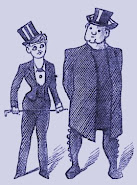
The illustration at top, of the pugilists, is by “Pugnis.” From Famous Fights Volume III, no. 38:


Monday, January 18, 2010

A Tale of Two Roberts


A TALE OF TWO ROBERTS

By Steve Holland

Robert Prowse (1826-1886 ) and Robert Prowse Junr. (1858- )
Born in Liverpool in 1826, the son of Richard (a lapidary) and his wife Elizabeth, Robert Prowse was a prolific artist for penny dreadfuls, rated amongst the best of the woodcut artists working in the field. His illustrations accompanied some of the most famous of the ‘dreadfuls’, including many of Edward Harrison's publications (The Blue Dwarf, Black Bess, Blueskin, etc.), Charley Wag, Fanny White and many of the novels from the Emmett family.


His earliest known artwork appeared in The Weekly Magazine (1860) and his illustrations accompanied a number of long-running serials in the London Herald including Percy B. St. John's ‘The Sailor Crusoe’ (Nov 1861-Jun 1862) and ‘Lealliwah, or the Valley of Cedars’ (from May 1862), engraved by Walter Gorway. Around the same time he was also illustrating ‘Ethel Grey, or Alone in the World’ by W. Stephens Hayward (Halfpenny Journal, 1861).


Prowse became one of the leading contributors to boys' adventure weeklies in the 1860s, contributing to Vicker's Boys' Journal, The Young Englishman's Journal (approx. 1867-73) where he illustrated many of George Emmett's famous stories, including the famous ‘Shot and Shell’ series and ‘Charity Joe’ -- and The Boys' Standard (1878).

Robert Prowse's brother Henry Prowse, born c.1821, was an engraver, who, I believe, died in 1873. His son, Henry (born 1851), was also an engraver.


Robert Prowse was married to Jane Anne Smith in Clerkenwell in 1858 and had seven children: Robert (1858), Jessy Jane (1860), Arthur (1862), Jane Adelaide (1864), Maud Elizabeth (1873), Grace Ethel (1876) and Frederick Ernest (1879). Jane Prowse was ten years his junior, and during his early artistic career the family lived in Clerkenwell, London EC, where four of their children were born (the last registered in Islington). The Prowses later moved to Battersea where a further three children were born. In the 1881 census the family was living at 80 Freke Road, Battersea, Surrey. The senior Robert Prowse died in 1886.


There has been some confusion over the years about Robert Prowse's long career, which seemed to extend into the 20th century. His work was usually signed “R.P.” which has led to some confusion over the years. There was a second Robert Prowse, the son of the penny dreadful artist, born in Clerkenwell in 1858. Prowse junior married Josephine Veillard in Wandsworth in 1878 and had thirteen children: Josephine (1880), Beatrice (1881), Robert (1883), Jessie J. (1884), Kate E. (1887), Richard M. (1889), Charles G. (1891), Tom (1894), Rene (1896), Albert E. (1898), Mildred A. (1899), Dorothy M. (1901) and Marjorie Adelaide (1903).


His earliest known work appeared under the byline R. Prowse Junr. In 1877 when he provided illustrations for The Vacant Throne! by Oswald Allan (London, E. Head, 1877) and Everybody's Christmas Annual whilst still in his late teens. He provided covers for a number of E. Harcourt Burrage's novels when they were published in the “Best for Boys” series in 1892-93.


It was around 1893 that Robert Prowse junior began his association with the Aldine Publishing Co., producing illustrations for their partwork publications of Burrage's The Lambs of Littlecote and The Island School amongst many other contributions. His illustrations appeared in Aldine's Garfield Boys' Journal (1894-95) and Aldine Cheerful Library (1894-95), and he worked for most of Aldine's library titles, becoming their main cover artist from the mid-1890s. His work can be found on Boys' First-Rate Pocket Library, Aldine Detective Tales, and Aldine Romance of Invention, Travel and Adventure Library in the 1890s. Probably his most famous covers were for the Aldine Robin Hood Library, and he continued to provide cover art for years to come, his last known work appearing on the Aldine Invention Library (1913) and Aldine Cinema Novels (1915).


Robert Prowse Junr. was living in Tottenham, Middlesex, in 1901 with his wife Josephine (born in Paris) and two children, Josephine and Beatrice, both born in Battersea. I'm still not sure when Robert Prowse Jr. died but my best suspect died in Romford, Essex, in 1934 aged 76. Unfortunately, there's no way of confirming this without a copy of the death certificate.


Illustrations by Robert Prowse Sr.

The Double Man; or, The Revelations of an Old Jailer. London, John Lofts, 1860?

Charley Wag, the New Jack Sheppard. London, United Kingdom Press, 1860.

The Blue Dwarf, by Lady Esther Hope. London, E. Harrison, 1861[1860-61].

Jessie, the Mormon's Daughter. A tale of English and American life. London, E. Harrison, 1861.

The Mysterious Man; or, The Three in One. London, Webbe, 1861.

Black Bess; or, The Knight of the Road [by Edward Viles?]. London, E. Harrison, 1863.

Blueskin. A romance of the last century [by Edward Viles?]. London, E. Harrison, 1863.

The Women of London. Disclosing the trials and temptations of awoman's life in London, with occasional glimpses of a fast career [by Bracebridge Hemyng?]. London, George Vickers, 1863.

Fanny White and Her Friend Jack Rawlings. A romance of a young lady thief and a boy burglar. London, George Vickers, 1863.

The Boy Brigand; or, The Dark King of the Mountains. London, Henry Lea, 1864.

The Boy Rover; or, The Smuggler of the South Seas, by Lieutenant Parker. London, Henry Lea, 1864.

Gentleman Clifford, and his white mare Brilliant; or, The Ladies' Highwayman. London, E. Harrison, 1864.

The Life and Career of a London Errand Boy, by John Bennett. London, Henry Vickers, 1865.
Rose Mortimer; or, The Ballet-girl's Revenge. London, London Romance Co. [Newsagents' Publishing Co.], 1864.

Red Ralph; or, The Daughter of the Night, by Percival Wolfe. London, London Romance Co. [Newsagents Publishing Co.], 1865.

Wild Will; or The Pirates of the Thames, by Percival Wolfe. London, London Romance Co. [Newsagents Publishing Co.], 1865.

Hounslow Heath and its Moonlight Riders, by Julian St. George. London, London Romance Co., 1866.

The Mystery of Marlborough House. A tale of trial and temptation. London, E. Harrison, 1866.

The Sailor Crusoe, by Percy B. St. John. London, "London Herald", 1866.

The Black Highwayman [by Edward Viles?]. London, E. Harrison, 1869.

Robin Hood and the Outlaws of Sherwood Forest, [by George Emmett].London, Temple Publishing Co., 1869.

Dick the Diver; or, The London Treasure-seeker. London, T. Roberts,1870?

Union Jack. The British boy sailor, by Charlton. London, A. Ritchie, 1870?

Captain Tom Drake; or, England's Hearts of Oak. London, A. Ritchie,1870?

The Gipsy Boy; or, The Green Woods and Battle Fields. London, Edwin J. Brett, 1870 [1869-70].

Tom King and Jonathan Wild; or, The Days of Young Jack Sheppard. London, A. Ritchie, 1884.

Charity Joe; or, From Street Boy to Lord Mayor, by George Emmett. London, Hogarth House, 1885?

The War Cruise of the Mosca, by George Emmett. London, Hogarth House, 1885?


Illustrations by Robert Prowse Junr.

Ching-Ching’s Own, by E. Harcourt Burrage. London: W. Lucas, 1888 [covers].

Dashing Duval; or, The Ladies' Highwayman. London, Palmer & Co., 1889? [**].

Hal o' the Heath, the Wandering Heir, by E. H. Burrage. London, "Best for Boys" Publishing Co., 1892. [cover].

Lionel the Bold; or, The Circus Rider's Revenge, by E. H. Burrage. London, "Best for Boys" Publishing Co., 1892. [cover].

Jack Jaunty; or, Friend and Foe, by E. H. Burrage. London, "Best for Boys" Publishing Co., 1893. [cover].

The School of the Regiment; or, Life at Bangfire Barracks. London, Aldine Publishing Co., 1893.

The Lambs of Littlecote. A thrilling school story. London, Aldine Publishing Co., 1894-95. The first 13 numbers were illustrated by Harry Maguire, the rest by Prowse.

The Island School. A story of school life and adventure. London, Aldine Publishing Co., 3 vols. 1895-96.

Happy Jack, the Rover. London, Aldine Publishing Co., 1895.

Broad-Arrow Jack, by E. Harcourt Burrage. London, [Hogarth House?], 1897?

Dick Strongbow, the Diamond King, by E. Harcourt Burrage. London, [Hogarth House?], 1897?

Buffalo Bill Library. London: London: Aldine Publishing Co. [1st series] 1897-1909, [2nd series] 1909-1913, [3rd series] 1912-1918, [4th series] 1918-1932. All covers were by Prowse.

Buffalo Bill Novels. London: London: Aldine Publishing Co., 1901?

The Robin Hood Library. London: Aldine Publishing Co., 1901-1906.

The Dick Turpin Library. London: Aldine Publishing Co., 1902-1909.

The Claude Duval Library. London: Aldine Publishing Co., 1902-1906.

The Spring Heeled Jack Library. London: Aldine Publishing Co., March to September 1904, 12 numbers.

The Jack Sheppard Library. London: Aldine Publishing Co., 1904.

The Black Bess Library. London: Aldine Publishing Co., 1909-1910.


NOTES

[**] Dashing Duval is dated by James/Smith as ca 1875 but describes itself as the “most interesting and thrilling story ever presented to the boys of Albion.” The short-lived magazine, Boys of Albion was launched by Palmer in 1888, hence the likely date for Dashing Duval in 1889.


Saturday, January 16, 2010

The Pirate's Isle


This is about my eighth post on George Emmett, who wrote boys school stories, westerns, and war yarns. He also wrote a series of nautical tales. The Pirate’s Isle was serialized in 1871 in the Young Briton. The pictures here, cover and interior, are from the Hogarth House edition circa 1881 and the illustrator is Harry Maguire. George Emmett wrote All’s Well and Black Eyed Susan as well. The cover artist on All’s Well may be by John Proctor, the other I think maybe -- Harry Maguire again.


Owlet the Robber Prince


Owlet the Robber Prince; or, the Unknown Highwayman by Septimus R. Urban (real name James Malcolm Rymer), The New York Dime Library, no. 1068, Jan. 1903, J. M. Ivers & Co., James Sullivan, proprietor. The original American printing of this tale was in Beadle’s American Tales number 77 back in 1871. Next Beadle & Adams published it in The New York Dime Library number 166 in 1881. The only other known title under the pseudonym Septimus R. Urban was The Little Middy; or, Picked up Adrift published in New York in the Camp-Fire Library number 26 in 1888.

Owlet is described after a highway robbery as “not human but bore an exact resemblance to an owl.”

“An owl your majesty - a green- a sickly green sort of colour was over it. And the feathers, and beak, and eyes, were perfectly and exactly, those of an owl of very large size …”

Owlet is a mysterious work by Rymer which I have been unable to trace in a British penny dreadful. It may have originally been serialized in some weekly story paper. I’m sure the artist is British artist Robert Prowse Senior, which is also strange because Beadle and crew never used British artists as far as I know.

A similar owl-masked villain appears in Blueskin as a minor character named Captain Howlet, and the owl illustration is also the work of Prowse, although not one of his best (see below). Blueskin: A Romance of the Last Century was by the author of Black Bess; or, The Knight of the Road &c., illustrated by Robert Prowse and others, London: Edward Harrison, according to an advertisement published on 2 Aug 1863. Blueskin has been attributed to Edward Viles, but, based on a close reading, my theory is that the author of Blueskin was James Malcolm Rymer.

The Elizabethan era highwayman Gamaliell Ratsey was also said to wear the headdress of an owl or bird when robbing coaches. Ratsey’s tale probably influenced Rymer’s Owlet, who, at the end of the thrilling romance, turns out to be the rightful heir to the throne of England.


Friday, January 15, 2010

Surprising Adventures of a Clumsy Boy Crusoe


The Surprising Adventures of a Clumsy Boy Crusoe, written and illustrated by Chas. H. Ross (Charles Henry Ross.) In 1859 the publishers imprint read > Griffith and Farran, Late Grant and Griffith, Successors to Newbery and Harris.


*Thanks to Alfredo Castelli

Tuesday, January 12, 2010

Ferdinand Fissi (1872-1954)


Ferdinand Fermo Fissi was born in Greenwich, London, on 11 June 1872 at 484 New Cross Road. He married Alice Maud Giles (1887-1951) in Rochford, Essex in September 1907 and they had two children, Sophie Maud, born 1908 in Rochford, who died in 1994 in Honiton, and Dorothea Alice, born 1914, who died in 2002 in North Wales. Sophie apparently had two daughters.


Fissi may have had his first professional experience with illustrations for ‘The Illustrated Police Budget the Leading Illustrated Police Journal in England,’ which ran from 1893 to 1910, and was edited by Harold Furniss. He definitely had a hand in ‘Famous Fights Past and Present’ (1901) and ‘Famous Crimes Past and Present’ (c. 1903), both edited and eventually published by Harold Furniss. Another likely source of work was probably the publisher Charles Shurey, who was also connected with Famous Crimes and had numerous penny publications to his name.

In 1909 Fissi executed 22 drawings of Beaulieau Abbey which were engraved and published in book form under the title ‘A History of Beaulieu Abbey,’ by Sir James Kingston Fowler. Fissi was a contributor of motoring illustrations to a magazine called ‘The Car’ in 1912. In 1913 he illustrated ‘Dervorgilla, Lady of Galloway and Her Abbey of the Sweet Heart,’ by Wentworth Huyshe, for the Chiswick Press in Edinburgh.


Alice Maud petitioned for divorce in 1917. Fissi was remarried to Mary Rebecca (Rita) Morgans on 22 Feb 1919. In 1922 Fissi was working at London's Cricklewood studios for J. Stuart Blackton, the British-born founder of American Vitagraph Company and producer of the first animated cartoon, "Humorous Phases of Funny Faces," in 1906. The 1922 film was titled "The Gipsy Cavalier" and starred famous French light heavyweight boxing champion Georges Carpentier. In 1923 Blackton and Fissi worked together in London on "The Virgin Queen."*

Ferdinand and Rita sailed to New York on the SS Aquitania in 1924. They lived in New York at 1585 East 14 Street from 1925 to 1930. A surviving photograph shows Fissi at work as a scenic artist in an unidentified film studio, possibly at Cricklewood, possibly in New York. On 3 may, 1925 Fissi authored an article in the New York Herald Tribune titled “How Tricks of the Motion Picture Trade are done. Feats of Photography and Illusion explained and Illustrated by Ferdinand Fissi.”


The US census showed them living in North Tarrytown, New York in 1930, which is probably the year they moved to Toronto, Ontario, Canada, where they resided at 204 Indian Valley Trail in the suburb of Port Credit. The couple had no children. Fissi was appointed Chief Artistic Director for the city of Toronto and spent his later days designing ceramics and furniture in Port Credit.


Fissi was quite a good artist and his sensational drawings had a grim, lively, even humorous quality about them. His most famous work will probably end up to be the illustrations to the account of ‘Jack the Ripper’ which appeared in ‘Famous Crimes’ about 1903. The series is famous amongst Ripperologists in both original and facsimile reproductions. I myself am quite fond of the covers to the serialized ‘Burke and Hare,’ the bloody-minded pair of Scottish body-snatchers, also published in ‘Famous Crimes.’


It’s not known if Fissi carried on as an illustrator in New York and Toronto. Likely he did and his contributions might be eventually dug up in old newspapers and magazines. His sketches and paintings, if they survived, may still be hidden in some basement library archive in Ontario, awaiting rediscovery.


Ferdinand Fissi died of coronary thrombosis 18 October 1954 at 11:30 pm in the Oakville Hospital at Port Credit. Rita Fissi died 22 May 1963 aged 68. She is buried at Spring Creek Cemetery, Spring Creek Cemetery in Mississauga, Ontario.


*Many thanks to Tony Morgans (Rita Fissi’s nephew) and Nick McBride for most of the illustrations. Thanks to Clare Lendrem, grand-daughter of Dorothea Alice Fissi, for The J. Stuart Blackton references.


Monday, January 11, 2010

Mystery Editor


What follows is a minor literary and pugilistic mystery which, so far, has me stumped. The anonymous author in question, with the “sober eye of the historian,” wrote of the great international contest between Tom Sayers and John Camel Heenan in the very first issue of Famous Fights Past and Present, and seems to have written most articles, if not all, in every issue of that penny periodical that I have had the pleasure of reading I had always assumed that the editor Harold Furniss, whose name appeared on the masthead, was probably the author of all the main articles, but as it turns out he may not have contributed anything but his name and his illustrations.

Ripperologist Robin O’Dell, in his book Ripperology said a curious thing about Furniss who is assumed to have written the article on the Whitechapel murders in Famous Fights sister publication Famous Crimes. The Whitechapel article “was told in four parts and written in the first person, possibly by Harold Furniss, who only claimed to be the editor.” I would love to know what O’Dell meant by that “only claimed,” and on what evidence he was basing his bald assertion; unfortunately he has nothing else to say on the subject. In the old days scurrilous penny publications often used a beard to pose as editor in order to prevent reprisals from the law or the libeled. Was Furniss a beard for the real editor? If so who was the ‘real’ editor? I don’t have enough of Famous Crimes to make a judgment but I do have 27 of the first 53 issues of the companion Famous Fights, also attributed to editor Furniss.

My mystery man has something to do with the above query; my mystery man was a boxing historian, journalist, collector of boxing memorabilia, and probably a pioneer photographer. Judging by the clues left in his writings he must have been a “celebrated” chronicler of the ring, well-known to his readers, since he seems to have known everyone involved in the pugilistic community; editors, journalists, publicans, bankers, bettors and boxers. He was intimately familiar with gentlemen’s clubs like the National Sporting Club, “one of the best clubs in London,” knew all the watering-holes frequented by the pugilistic fraternity, and counted such boxers as Jem Mace, Nat Langham, Jem Ward, Harry Broome, and Owen Swift among his personal friendships. He also spoke fondly of George Borrow, author of “Lavengro,” and “my old friend ‘Harkaway,’” the penny dreadful author Bracebridge Hemyng.

He wrote under no byline, not even a pseudonym like his acquaintances “Augur” of the Sporting Life (Harry Feist) or “Hotspur” of the Daily Telegraph. He did offer various personal clues to his identity in various asides contained in his articles. In the first issue of Famous Fights for 4 March 1901 the first autobiographical clues are presented in the cover article on the Sayers and Heenan brawl.

“The present writer has some advantages not possessed by others who have told the story. For not only did he witness the fight himself, but there have been placed at his disposal the letters and memoranda of many old sportsmen who also witnessed the contest, and were intimate with both the combatants.”

He “had the pleasure of knowing Miss (Adah Isaacs) Menken personally, and I retain a lively and agreeable recollection of a supper on the stage of the Marleybone Theatre, after she had been playing William in “Black-Eyed Susan,” for the actor named Booth, who had taken the theatre for a few weeks -- no connection to the great Edwin Booth, or his brother who shot Abraham Lincoln. She sat beside me in the sailor’s costume which she had worn on the stage as William, and most fetching and bewitching she looked, with her crisp crop of curly dark hair, her expressive features, and snow-white neck. It was not surprising that such a charming creature should have captivated John Camel Heenan, or any other man over whom she chose to throw the spell of her witchery. She died in Paris in the August of 1868.”

This was my first inkling that the author was not the supposed editor Harold Furniss, since Furniss was only twelve years old in 1868 and presumably living in Birkenhead, opposite Liverpool at the time. Our author dropped more personal information in the second issue of Famous Fights. He writes of the capable editors of Bell’s Life in London, Vincent Dowling and his son and successor Frank Dowling. He knew Frank Dowling well, and, judging by the many glowing mentions of that editor in Famous Fights, may even have had a connection with that penny paper, perhaps as a reporter.

“Occasionally, indeed, savage assaults were made upon the editor of Bell’s Life, and I remember Frank Dowling’s showing me how he had planned his sanctum so that he could command the fire-place and the fire-irons, and keep any number of assailants at bay from behind his desk. But then the editor, if so assailed, had terrible powers of retribution. He could bar from the columns of Bell’s Life the challenges and advertisements of all who came under his ban and the professional pug who was thus excommunicated found himself practically deprived of his livelihood.”

Part 3 of the Sayers-Heenan match was covered in Volume I No. 3, which featured an engraving of a ‘bewitching’ Adah Isaacs Menken on the cover, as well as the most revealing autobiographical information our mystery historian has revealed thus far in the narrative.

“Nine months later, on the 18th of October, 1853, Tom’s (Sayers) career of conquest was rudely checked by Nat Langham. This was the first prize fight I ever witnessed, and as I hope to tell the story from my own point of view in a future number, I shall not dwell on it minutely here.

I was then an undergraduate at Cambridge, and Nat had for some months been in residence there as the landlord of the Ram Inn, Bridge Street. He very soon had his hands full of pupils, who looked upon him as a hero. Indeed, I think we all regarded Nat as the greatest master of the noble art the world had ever seen.”

“Imagine then, our surprise when just before we “went down” for the Long Vacation of 1853 we learned that Tom Sayers had sent our hero a challenge to fight for £100 a-side and the Championship of the Middle Weights. I recollect how we laughed at Tom’s cheek as we discussed the challenge in the bar parlour of the Ram Inn, and how we generally set it down as mere bounce destined to die away in a fizzle.”

After describing how, on 18 October 1853 the “sporting undergrads” at Cambridge sneaked out in twos and threes and “got off to the traps which were waiting for us at various points along the Ely Road,” to carry them to the London special for Ely where they would learn the final destination for the prizefight, our hero gives away his age, nineteen, which gives him a birth-year of 1834. At this point I knew that our scribbler was not Harold Furniss, who was born in 1856 and thus a babe of three when the Cambridge youth set off on their exciting adventure. Our author was 67 when he penned the Sayers-Heenan articles for Famous Fights in 1901.

Now I got excited and began looking up various people, hoping to identify the elusive historian. Who could he be? Unfortunately not many British boxing historians are known to us these days other than possibly Pierce Egan, John Bee and Henry Downes Miles, author of Pugilistica. I thought Miles might be a suitable suspect; he had edited a book about Tom Sayers with articles and clippings from the Times, Punch, All the Year Round, and the Saturday Review in 1866. But Miles had authored The Life of Richard Palmer, Better Known as Dick Turpin as early as 1839. Clearly he was not our man.

It was definitely not Harold Furniss, could it have been the printer and publisher of Famous Fights, Frank Shaw? Here I’m stymied again -- I could find nothing about Frank Shaw except that he was the printer publisher of The Illustrated Police Budget in 1893, as well as serving the same function for Famous Fights in 1901. By the time of the publishing of Famous Fights Volume II no. 22 Shaw is replaced by printer/publisher Harold Furniss. The Fleet Street address is the same for both publishers; Caxton House, 11 Gough Square.

Our Cambridge man seems to have been a gentleman in his own right; a powerful writer and a meticulous historian of the ring. He took great pleasure in correcting the authors of boxing bibles like Fistiana and Pugilistica, and closely interviewed numerous elderly ‘informants’ who had witnessed contests that took place before his own time.

In Volume I No. 10 in the cover article on the early fights of Jem Mace the historian gives vent to his belief that the Prize Ring gradually died in England after the second fight between Jem Mace and Joe Goss on 6 August 1866. “It was his (Mace) misfortune to appear in the ring when its fortunes were at a low ebb -- when the patronage of pugilists had fallen from noblemen and gentlemen, and admirers of courage and fair play, into the hands of flash publicans, hell-keepers, night-house keepers, and gangs of robbers, whose sole object was to fleece the fast and foolish toffs who frequented their dens of debauchery and villainy.”

That fight between Mace and Goss was the last our chronicler witnessed in person, for “although the actual mill was as stirring as any ring-goer could desire, the ramping robbery and rowdyism which one had to put up with on the way back were enough to sicken anyone of a sport which had become so degraded, and no decent sportsman cared again to face such an ordeal.”

The same issue let slip another piece of the puzzle. In ‘Tom Sayers and the Toll-Keeper’ he continues with the life Tom Sayers led after the Sayers-Heenan fight. The article is illustrated by an illustration of ‘Tom Sayer’s Circus, From a Photo by the Editor’s Father.’ Now the editor is given as Harold Furniss on the masthead, which leads me to wonder: Could our anonymous historian have been the father of Harold Furniss, the editor of Famous Fights, born in 1856? It could be, but it seems more likely to me that the real editor of Famous Crimes was the anonymous author born in 1834, and the photograph was taken by his father.

On the subject of photographs the Anecdotes section of Famous Fights in the second issue mentions that when Pedlar Palmer was training for a fight with Dave Sullivan circa 1890 the author spent a pleasant day with him at his training camp in Brighton. “I had my camera with me, and invited the little fellow to pose for a few pictures. He willingly complied…How he was beaten will be told in an early number of this paper; and we will also publish some snap-shots of the fight.” Unfortunately I don’t have the number referred to, and it’s not clear if this is the subject of our investigation speaking, or some other person on the staff of Famous Fights. It occurs to me the photographer may even have been Harold Furniss who was an accomplished lithographer and illustrator.

Judging from the article Sayer’s Circus was touring England in the year 1862. Our historian visited George Borrow at his home in Oulton, in Suffolk, and they shared a visit to the Isle of Man. Elsewhere he writes that in 1860 he was residing at Stone, in Staffordshire, which is in the Midlands and closer to Birkenhead, near Liverpool, where Harold Furniss was born, than to London. It was the age of the telegraph and the railroad, and our man, from 1853 until 1866 seems to have been constantly on the tramp, never staying in one place too long. He had an intimate knowledge of every public house in London and environs, and weaves the publicans history into his articles.

In 1902 the 4th volume, 52nd number of Famous Fights under the heading Editorial Notes we find the following address:

“With this number our little paper completes the first year of its existence. It was started as a hobby and to oblige a number of personal friends who were interested in the Records of the Prize Ring, and who yearned for a full, true, and unbiased account of the Historic Fight between Tom Sayers and John C. Heenan. The story of that contest as told in the first numbers of our paper has been pronounced by all who have given their opinion to be the best ever written -- perhaps the best that ever can be written.”

This sounds more like the voice of our mystery author than that of the supposed editor, Harold Furniss. It was the mystery author who wrote the majority of tales in Famous Fights, both main and secondary stories, his style was unmistakable. When starting a new serial he often referred to his previous articles, and repeated details; how he was a Cambridge man, how he witnessed his first fight in 1853, and how he witnessed his last in 1866. Many articles repeated accounts of his friendship with George Borrow. Famous Fights began with a serialization of the Sayers-Heenan fight, and the old man, at 67 years old, was still writing articles about his favourite period 52 weekly numbers later.

The only articles he did not write were those dealing with modern boxers like John L. Sullivan and John Corbett, if he is to be believed when he repeats that he witnessed his last match in 1866. It could be that Robin O’Dell was right about Harold Furniss and that he did “only claim to be the editor,” of Famous Crimes. The same claim could be made about his editorship on Famous Fights. It looks like the editor, who started the paper as a ‘hobby’ to record his reminiscences of the pugilists, was someone else, an unknown. It may also be that the editor’s father, the photographer, was not Furniss’s father after all, but the mystery author’s father, who, the old man informs us, was a fan of the ring long before 1853.

Who was the mystery author-editor? Was Harold Furniss a beard for Frank Shaw? And was Frank Shaw the printer’s real name or a pseudonym? I could find no printer or publisher under that name in the 1901 census. As I noted in a previous post Harold Furniss appeared in a court case in 1894 over the Illustrated Police Budget which was also printed and published by Frank Shaw. He was described not as the editor but as “an artist, named Harold Furniss, employed upon the paper.”

I have too many questions, with as no answers. Could he have been Furniss’s father? I did look through the 1901census records for someone named Furniss born in 1834 and found quite a few under that name, male and female. Of the four men born in 1834 there were Arthur G. Furniss, an Electro-Plate manufacturer in Sheffield; Mark Furniss, a farm laborer in Nottinghamshire; Thomas Furniss, a book-binder publican residing in Essex; and Thomas S. Furniss, ‘living on his own means’ in Sussex. The two Thomas’s are possibilities, as well as Frank Shaw, if that was his real name. Even more likely is that the editor had no relation to Furniss at all, a talented historian whose identity still waits for rediscovery.

NOTE: Some new information has come to light about the career of Harold Furniss since I first posted on ‘Harry and Harold Furniss.” See HERE.


Friday, January 8, 2010

Mary Tourtel (1874-1948)


The originator and first illustrator of Rupert was Mary Tourtel, who created him in November 1920 in the Daily Express and retired in 1935. Punch cartoonist Alfred Bestall followed and drew it throughout the sixties. Here is a rare glimpse at the artwork of Mary Tourtel.