Monday, May 27, 2019
Friday, May 24, 2019
A Crowded Life in Comics –
Cartoonists’ Love Notes, Good-Byes, and Get-Wells
Rick Marschall
May 24 was the anniversary of me and my late wife Nancy. She died
six and a half years ago, a great wife and mother to our three children. She
endured a lifetime of ailments – diabetes, heart attacks, strokes, cancer,
celiac disease, amputations, dialysis, heart and kidney transplants, and, at
the end, creeping dementia. She was strong; complained little; and kept her
faith. The transplants were forecast to buy her three extra years, but she
survived 16 years.
She was a saint to endure my comics and cartoon collecting; but
after all I knew someday I would be writing this column for Yesterday’s
Papers. She was also the star of our team, socially. The only people who
did not love her were those who had not yet met her. A favorite of cartoonists
and their wives; there were many dinners and parties in Connecticut especially,
when we lived in Westport and Weston; and she loved throwing parties herself,
especially surprise parties for us all.
Among the cartoonists and wives at our wedding were Dik Browne, Jerry
Dumas, Jack Tippit, Bill Brown, Mel Casson, Mort Walker. Comics historians
Maurice Horn and Bill Crouch were also there.
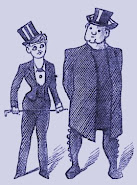
I will share some drawings here to illustrate the memories. The
first is a Little Nemo take-off. When I left the Connecticut Herald
political-cartooning job to join United Feature Syndicate, Dik and Joan Browne
threw a little farewell party, and son Chris – the best amateur cartoonist of
the day – drew me (Ouch! Yes, I looked like that, then) having fever dreams…
with a cameo of Nancy, looking like, well, Nancy.
When we moved, years later, to Bucks County PA, a bunch of
cartoonists had a BBQ where we were farewelled. Ron Goulart joined Bob Weber, Leonard
Starr, Stan Drake, Ray Burns, Jack Berrill, Herb Green, and others. Orlando
Busino engineered a scrapbook of everybody’s farewell drawings, some of which I
have shared in Crowded Life columns. Here is the title page Orlando drew
(yes, characters are his versions, including Moose Miller, which he
occasionally ghosted). Also here, the Jerry Marcus vision of visitors at our
old house’s door. I used this as a change-of-address card!
About a decade after we moved to Pennsylvania, Nancy’s health problems spiked, and she was
listed for transplants. More than four months, waiting for organs. Was her
hospital room cheery? There was hardly room for flowers, so many cartoonists
having sent get-well drawings for the walls. I shared some of these earlier;
here are others – by Bob (Chance) Browne, with Hi & Lois and Hagar’s
family; and by Dick Hodgins, who ghosted Hagar magnificently for years,
followed by his son Richard III.
Nancy’s life was “crowded” in her own way – with challenges and
faith, but also with cartoonist friends and their families.
💕
39
Labels:
A Crowded Life in Comics,
Nancy,
Rick Marschall
Friday, May 17, 2019
Sunday, May 12, 2019
A Crowded Life in Comics –
The World’s Greatest Comics Festival, Lucca
[1] Sergio Aragones prepares his morning cappuccino
by Rick Marschall
I have been to Europe more than 60 times, a good percentage of those trips centered around comics festivals, salons, and symposiums. That I often planned trips to coincide, or, more often, I was an invited guest as speaker, juror, or exhibitor (not exhibitionist) made for very nice icing on the cake. I often took a week or two extra, since I was given freedom to choose the dates for the flights they booked… and this Intentional Tourist checked many boxes in cultural, musical, and sight-seeing categories.
It started somewhere, besides connecting dots of interest in comics and a Wanderlust. The major American cons, of course. But I have attended many international comics festivals including Angoulême; ExpoCartoon in Rome; Erlangen in Germany; and in Prague, London, and Brussels. A speaking tour for the US Information Service of the State Department. At many I was the American representative of festivals, sharing presentations or exhibitions; bringing American cartoonists and fans (more than 125 to Angoulême one year – whoosh!); and waving the flag at roundtables.
[2] Bonvi and Victor de la Fuente greet each other
The Festival began in the Ligurian Italian town of Bordighera, beautifully nestled on the French Mediterranean border. It was the convention to which Al Capp was invited, and ultimately made a LIFE Magazine cover story out of the challenge of finding it. It moved the next year to Lucca, a Medieval Tuscan town situated roughly equidistant from Florence and Pisa. It has remained there ever since, surviving budget crises and politics; a biennial schedule; an osmosis-like split with ExpoCartoon in Rome; revival as Lucca Cartoons and Games.
[3] Moebius – Jean Giraud –
on a chill October morning
Of those days I can share much that will be interest to readers (maybe decade-by-decade here in A Crowded Life sometime) about those guests and those awards (plucking a couple myself) and those debates and those lectures and those side-trips and those restaurants… and those friends. It got so that I anticipated every Lucca largely because the cartoonists, the “experts” from all over the world, and special fans, formed the core of a true family reunion for me.
[4] John Prentice, Mordillo, and de la Fuente looking over a Rip Kirby reprint book.
For this column I will share some photographs from the first couple of Luccas I attended, and some sketches that were drawn… often late at night, at the bar of the Hotel Napoleon (built as the Hotel Mussolini in the 1930s) or the lobby of the Universo. Talking (as best we could), sketching, laughing, drinking, Hugo Pratt playing the guitar and singing… but there I go. More stories later. Here, visual memories.
[SKETCHES]
The first Lucca I attended was 1978. I was still editor at Marvel (I convinced Stan Lee to send me and scout for talent for EPIC). Harry North, the British cartoonist for MAD, said he would do a sketch if he could take my book to his room overnight. Here is what met me at breakfast –
Wednesday, May 8, 2019
Comic Science Investigation #1
OLD DOC YAK TAKES HIS SPACE
COMIC EXPERIMENT. American comics of the early 1900s were rich with experimenters and experimentation. Within a decade or so, and certainly by the close of World War I, if not before, this experimentation had given way to a formula, based on strong characters and what-came-to-be-called sequentialism.
Here’s how Sidney Smith began Old Doc Yak in The Chicago Tribune in February 1912, with Yak’s kicking his way through a miniaturized front page:
In my recollection of my first encounter with this strip, it
was somewhat different: A single panel on the paper’s actual front page. The
historical record does not seem to bear out this memory; this first installment
seems to have been on an interior page.
Chicago Examiner, August 9, 1908
The Buck Nix dailies in Blackbeard’s
Smithsonian newspaper comics collection remain a highlight of that book. On my
one visit to Blackbeard’s San Francisco Academy of Comic Art, seeing more Buck
Nix was a top request: the Smithsonian seems to have presented the most
interesting episodes, however.
Smith’s goat predated his Examiner run: The goat had been a comic commentator in Smith’s editorial work for The Toledo News-Bee as early as 1907, some of which are collected in Yankee Boodle Army [HERE], published in that year and reprinted in 1928. Like so many other comic characters, Nix/Yak just grew.
The Toledo News-Bee, September 30, 1907
In the 1912 Chicago Tribune, during his first week, Old Doc Yak used the tools and plans that Smith had drawn for him to expand his space, but an even more powerful tool, one specific to comics, balloons, enabled Yak to act seemingly independently of creator Smith. Balloons opened the words and thoughts of comics characters to direct reader observation, free of a creator’s traditional literary tools, like narration or explanation; balloons freed comic characters, at least seemingly , of a creator’s control. [Read HERE at Barnacle Press]
Chicago Tribune, April 24, 1912
![]() |
| Chicago Tribune, unknown month and day, 1918 |
.
Chicago Tribune, April 13, 1918
Film Daily, Nov 26, 1923
Chicago Tribune, April 9, 1933
Bud Fisher had begun the first daily comic strip, A. Mutt, in 1907, only five years before Smith’s inaugural Old Doc Yak stunt. Smith’s stunt might have seemed incomprehensible to that earlier audience. That Smith dared, and apparently gathered and kept his audience, shows how quickly those 1912 comics readers had developed expectations of what a comic is (or can or should be): One or more recurring characters performing in a series of panels, separated by borders, and “speaking” through balloons.Strong characters had been instrumental in popularizing and sustaining comics features since the Yellow Kid, a diminutive waif who addressed the audience through “speech” scrawled on his nightshirt, made the overcrowded Hogan’s Alley, a full-page single panel, a popular weekly destination, and his creator, Richard F. Outcault, thanks largely to merchandising the Kid’s image outside the Alley, wealthy.
Audience expectations about a comics’ content and form, already in 1912, were also understood by publishers and creators, eager to attract the most readers and fans and perhaps partake in the success that Outcault and his papers had enjoyed. In the 1910s, daily strips would depend on the popularity of such recurring, recognizable figures. Daily features in the 1920s and 1930s would develop more insistent hooks: continuing stories that required a reader’s daily attention.
Smith’s 1912 self-conscious playfulness about his medium, equating a physical space on a newspaper page with a comic character’s home, was revisited in 1917, five years later: Yak’s bear landlord evicts Yak and son Yutch to ready the space for The Gumps.
The editor, of course, ruled every space on every page, though he was seemingly invisible (or hiding?) and, unlike a paper’s comic characters, faceless
Chicago Tribune, Mar 9, 1912
With Old Doc Yak’s 1912 debut in The Chicago Tribune, Smith plays off his readers’ expectations of sequentiality, then a novelty, but rapidly establishing its dominance within the American comics medium. Hogan’s Alley had debuted only 17 years before and the regular use of balloons, begun by Opper or Dirks, was only a decade or so old. Captions under comics panels had persisted for much of the 20th century’s first decade; The New Yorker sophisticates have still not given up this holdover from 19th century illustrated humor.
Chicago Tribune, June 6, 1912
This formula yielded the formulaic, a bad enough outcome, but, worse, as comics became equated with sequentialism, the understanding of comics, past and present, became hobbled, let us hope not permanently.
Today’s lesson: Comics take up space
UNDERSTANDING COMIC SCIENCE:
A BRIEF INTRODUCTION
Non-sequential tendencies, despite being ignored, unnamed, or glossed over, persist within comics. Some early American comics more boldly exhibit such non-sequential tendencies and a few comics from this experimental era seem wholly non-sequential.
Comic Science considers the visible, not the invisible. These early American non-sequential comics will be examined in subsequent essays: They will not be dismissed as “non-comics.”
Comic Science asserts that the better comics of tomorrow will be built upon non-sequential principles, and with non-sequential practices. Subsequent Comic Science investigations into early American comic strips and pages will elucidate these principles and practices.
፩
Sunday, May 5, 2019
A Crowded Life in Comics –
Art from Crowded Sketchbooks
by Rick Marschall
by Rick Marschall
I have been text-heavy in this space over the past several installments, so I will be merciful and be art-heavy today; or whatever its polar opposite is.
In a “crowded life” in the comics and cartoon worlds, I have been blessed to meet many cartoonists beginning in second grade of school (mine, not theirs). Some blossomed into lifelong friendships; some were one-time visits, especially with pioneers who were active in the 1890s.
I was a “fanboy” just enough to ask for sketches or inscriptions on original art. Often I was not, however – when I chose not to appear to be the fanboy I was – and regrets, I’ve had some.
However, I will share some here, and sporadically, providing a taste of the behind-the-scenes world when cartoonists wanted to strut their graphic stuff… or hastily reduced their characters to the simplest lines… or might have wondered if something like the internet would be invented, and share their sketches!
Enjoy!
♮
37
Saturday, May 4, 2019
Tuesday, April 30, 2019
A Crowded Life in Comics –
Al Capp’s Own Crowded Life and Family
by Rick Marschall
I knew Al Capp better through the conservative movement, in the late 1960s and early ’70s, than through cartooning. Nevertheless this Crowded Life I chronicle led me to interact in several ways and various times with him.
I also knew his brother Elliot Caplin, about whom not enough has
been written in comics histories. Elliot was quiet, taciturn to the extreme;
seldom registering emotion, forever with a pipe clenched between his teeth. He
let his writing do the talking – Elliot, always anonymously, scripted a dozen
or so strips through the decades.
… maybe more; some he co-created; some he scripted; some (like Broom-Hilda)
he lived in a zone between plating a seed and “packaging” a syndicate
presentation. Among the strips with his plots and dialog, or with various
aspects of his fingerprints: Dr. Bobbs; Peter Scratch; Adam
Ames; The Heart of Juliet Jones; Big Ben Bolt; Abbie an’
Slats; Long Sam; On Stage; Encyclopedia Brown; Best
Seller Showcase; Dark Shadows; Buz Sawyer; post-Gray Little
Orphan Annie; and others. More than Allen Saunders and Nick Dallis
combined.
There was a third Capp brother, Jerry. For a while he handled
business affairs for Al, but the L’il Abner creator largely considered
Jerry a hanger-on, and for most of his career he hung around Elliot. Elliot
himself was the quiet center of an active business career beyond his writing.
He was on the staff of Judge magazine (“I put them to bed for good,” he
dead-panned) and then was an editor of Parent’s Magazine. He parlayed
his experience and Al’s success into Toby Press, named for his third child. It
was a comic-book publisher mostly handling Li’l Abner titles.
A fourth Capp I knew, also. When I joined the staff of the Connecticut
Herald out of college, as cartoonist and editor, there was an old fellow
who shuffled through all the rooms every morning, dispensing lollipops to every
desk. He had been with the paper since forever, I was told; probably since the 1930s
in its glory days as The Bridgeport Herald. He was a pleasant old relic
of the sales staff, and when, after a week or two, I became a recipient of
Harry Resnick’s morning lollipops, I knew I had arrived.
Hesch Resnick had served as Al Capp’s agent when, as Alfred G
Caplin, he proposed the L’il Abner strip to syndicates. It was Resnick’s
advice to reject King Features’ meddling in the strip’s premise, and accept an
offer from the smaller United Feature Syndicate.
It is not generally known that Elliot’s birth name was Elia Abner
Caplin; so Li’l Abner was an in-joke from its inception. Al would refer
to Eliot – never without his trademark wheezy laugh – as “that lovable idiot
Elliot,” but affectionately. The pair had supreme admiration for each other. (Jerry
became a Capp, legally.)
As I said, I knew Al Capp during the period when he multi-tasked,
diverting attention from his strip to politics. Claiming he never changed his
famously liberal stances that infused Abner for years, it was the
leftward stampede in American politics that made him seem like a conservative.
Whatever. Almost overnight, as he lampooned hippies and limousine liberals in his strip, he found himself a favorite of William F Buckley; a guest on Firing Line and late-night talk shows; a newspaper columnist; and a speaker on the college circuit. Like Ann Coulter and Ben Shapiro of our day, he was picketed and the object of protests. Allegations that he propositioned “co-eds,” as female students were then called, severely damaged his celebrity.
The recent issue of Hogan’s Alley has a first-person
account of Capp’s lecherous advances (“amorous” is finally an inappropriate
term in these cases); and there were other similar claims, most famously by
Goldie Hawn from days before her own celebrity. Capp’s celebrity, but more
importantly his credibility, was damaged.
The article has a sidebar reproducing a column by Jack Anderson, a
prominent political writer of the day, about Capp’s peccadillo described by the
writer. Another serendipitous connection (a "Crowded life,"
after all). I was Anderson’s editor for a while, believe it or not. Personal
and political animosity fueled many of his “scoops.” His former boss, then
partner, on the “Washington Merry-Go-Round” column was Drew Pearson, who observed,
and skewered, everything from his far-left perch.
Capp mercilessly lambasted Pearson (for many years a fellow
liberal) in Li’l Abner. One
time I asked Pearson about the bad feelings, and he would not confirm that when
Pearson himself created (and thereafter "edited," but credited as a
writer) the newspaper-reporter strip Hap Hooper for Capp's own
syndicate, United, its hero was spoken of internally as a serious-world Li'l
Abner type. A hillbilly who stumbled into situations. Capp was livid, even
after the premise was somewhat revised – and the incident became one on a list
of grievances Capp held against his syndicate for years.
It would not have been above, or beneath, Jack Anderson to be
joyful in “exposing” the claims against Capp for his own “exposing” events. By
the way, one of Anderson’s legmen in those days was Brit Hume, before ABC News’
White House beat, and as Fox News Channel’s Senior Analyst. Times have
changed.
[Speaking of exposing, I have received many inquiries about me and
Hogan’s Alley, prompted by my essays for Yesterday’s Papers and
the announcement of Nemo Magazine’s imminent revival. Formally, I have
not left Hogan’s Alley and in fact am on track to deliver an article for
publication. I founded, or co-founded, the magazine, named it, invited the Art
Director David Folkman to join the team; and I retain an equal-ownership
position with Editor Tom Heintjes. Nevertheless this latest issue sees my name
dropped from every category in the staff boxes. When Dorothy McGreal invited me
to write for her excellent World of Comic Art, she specified that I
should feel free to write elsewhere. After writing several articles for Cartoonist
PROfiles, Editor Jud Hurd kindly blessed my writing elsewhere, and said his
door was always open. The foregoing might answer the questions of some people,
even if not mine.]
Back to Capp: Previous to the assault allegations, he had been
discussed as a candidate against Massachusetts Senator Edward Kennedy… but all
that collapsed.
So did his health and his leg. As a boy in New Haven, Al Capp was
run over by a street car, and forever limped noticeably and bravely, and a bit
awkwardly, on a wooden prosthesis for the rest of his life. In rare appearances
toward the end, even at cartoonists’ events, he was “handled” by Eliot, helping
Al walk and deflecting conversations, even from well-wishers.
Back in cartooning’s turf, I acquired items from his crowded
studio (organizational chaos must have run in the family: Elliot’s office in
Manhattan was smaller than most people’s utility closets – but he never could
lay his hands on proof sheets of his collaborations with, say, Lou Fine, Ken
Bald, and Neal Adams – he knew how to pick ‘em!) and I conducted Al Capp’s last
interview.
Some day, here, I will tell more of my interview, conducted after
he very publicly retired Li’l Abner (“It simply is time for a fresh, new
talent, to take my space”). Al was miserable. He had difficultly reaching the
living room and settling in an easy chair; he complained of his emphysema – but
chain-smoked (“It’s simple; I can give these up or stop breathing,” between
drags). He complained, I tentatively recall, of diabetes. A joy for him, during
that afternoon, was the presence of his granddaughter, a reporter for the Newark
(NJ) Star-Ledger. Tragically the following week she was killed by a
car when she crossed a street.
He shared a lot with me that day. As I said, we’ll dive deeper in A
Crowded Life, but I remember that he disputed the length of time Frank
Frazetta assisted on Abner. And the wonderful answer to my question
about the greatest humorists: he said the great American comic writers were all
named Sol and Nat, representative of the anonymous radio-show staffers of the
1930s. He drew a terrific self-caricature for me that afternoon in Cambridge,
looking as jolly as, sadly, he was not.
Al and Elliot liked the interview I conducted (published first in Cartoonist
PROfiles) and wanted me to ghost-write Al Capp’s autobiography. So did Don
Hudder, a friend who was Editor of Simon and Schuster. Tony Gardner, Al’s
nephew and then agent, got involved, and eventually my modest fee was too high,
and the book was published, “by” Al Capp. It was, frankly, a pastiche of my
annotated interview in many places; and four-fifths strip reprints… from the
recent past. The Best of Li’l Abner, which it was not; and scarcely
claiming to be an autobiography. I still have Hudder’s letter apologizing for
the slight and affirming that I could have made a good treatment even better.
I the meantime, it was, of course, a privilege to know and work
with Al Capp – in two spheres of Crowded Lives, his and mine.
👀
36
Subscribe to:
Posts (Atom)