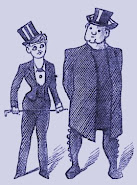
“It all began two score years ago. When the editor of the New York Journal turned to a young staff artist and said:
“Hey, Dirks! Draw me some pictures of kids. And make ‘em funny.”
From: “Und So Dey Iss in Der Moofies Now! “The Captain and the Kids,” Rudolph Dirks’ Forty-Year Comic Favorite, Is Making Its Screen Debut.” Corpus Christ Times, January 14, 1938.
Rudolph Dirks (1877-1968) was born in Germany, and moved to the US when he was seven, with his parents. The family lived in Duluth then Chicago where the elder Dirks practiced trade as wood-carver.
“I intended to follow my father’s footsteps but one week in the shop settled that. I almost cut off one hand.”
His brother Gus, author of the popular “Bugville” cartoons, inspired him to emulate him by moving to New York. He freelanced for a year or so, doing covers for Street and Smith “thrillers,” then got a job on the Journal.
In the early nineties the New York World adopted color printing for its revolutionary Sunday supplements and introduced the first color comic pages. The Journal took note and obtained the services of Rudolph Dirks, and asked to submit something along the line of Wilhelm Busch’s German comic max and Moritz, created the Katzenjammer Kids in 1897.
Pulitzer’s World warred with Hearst’s Journal and lured Dirks away. Hearst owned the title “The Katzenjammer Kids” so Pulitzer’s version became “Hans and Fritz.” With anti-German feeling s high during WWI the title was changed once again to “The Captain and the Kids,” and a daily appeared under the title “The Shenanigan Kids” with art by John Campbell Cory.
For the record, the kids, Hans and Fritz are Mamma’s kids, the Captain was not her husband but a boarder, and the Inspector was a mere truant officer, and no relation to any other character. Rudolph served with the American army in Cuba throughout the Spanish American War as a corporal. But he managed to send his drawings for the Sunday page regularly.
Rudolph Dirks brother Gustavus “Gus” Dirks, was born in Schleswig-Holstein, on the Danish border and shot himself in the head on June 10, 1902. He used a 38 revolver and did not survive. The suicide occurred in a studio on West Fourteenth Street, which was shared by three artists, Gus Dirks, Charles Sarka, and John Tarrant. Many of the headlines mis-reported the tragedy with news that the “Katzenjammer Artist” was dead. Dirks parents were living in Phillips, Wisconsin at the time.
Dirks was a good friend of the eccentric artist “Old Pop” Hart in the thirties. “Pop” was George Obery Hart, a sign painter, who was discovered by art critics when he was in his sixties and was lauded as the “American Gaughin.” It was claimed that he could mix colors in the dark. His popular canvases featured “cockfights, ravishing damsels in tropical courtyards and South Sea Islanders.” He lived for a quarter of a century in a 3 room shack in the woods atop the Palisades where “Walt Kuhn, the comic artist, and Rudolph Dirks repaired regularly to the Jersey shore, climbed to the hilltop and soaked their sorrows away in the beer of a nearby German restaurant with the then unknown eccentric who was “Old Pop”.”
Once Dirks and a group of American painters were sitting in a café in Munich when Pop’s name came up. One member of the party expressed the wish that “Pop” were with them. Dirks immediately sent a check to Hart in America and they were soon joined by “Pop” Hart. He had a little money left over which he spent on a top hat and a walking stick.
“At night, after “Pop” had gone to sleep, they would get the cane, remove the ferrule, saw off an inch of the stick and put the ferrule back. The stick grew shorter and shorter. One day in the midst of a walk, “Pop” stopped in his tracks.
“Fellows,” he said, “this is a wonderful climate over here. Do you know, I believe I’ve grown six inches since I came to this town!”
Dirks was a member of the famous Kit Kat Club and played golf with a group of cartoonists residing in Ogunquit. Each year the winner of the golf matches was given the title “Big Boy.” The winner in 1938 was Robert Laurent, a sculptor. Rudy’s son John Dirks won the cup in 1939 and artist Richard Leahy in 1940. In 1941 it was the turn of Cliff Sterrett, cartoonist for “Polly and Her Pals,” while runner-up Rudy Dirks was given the consolation prize of a necktie.
Dirks was 91 when he died one Saturday night in 1968 at his Manhattan home. His son John Dirks, who had been helping out on the strip for 15 years said he would carry on with the “Kids.”
*Again the original sketch and the letter are from the Don Kurtz collection. The Dirks letter would appear to be in answer to a query by Martin Sheridan, author of the seminal 1942 book on comics, Comics and Their Creators.
In these installments of memoirs I will return more than once to Rudolph Dirks, the father of the comic strip. He was the primal source of sequential panels, a cast of characters, and the signs and symbols of cartoonists – motion lines, stars of pain, dotted vision lines, etc. – originating, or at least codifying, these elements as essential components of strips. I will also refer more than occasionally to his son John Dirks. From Rudy I had the briefest personal encounter, in his nonage (he was born in 1877; d. 1968). I was born in 1949 (still kicking when last I checked), but we did correspond. His son John I knew much better, and visited him frequently at his homes in Ossining NY; later Old Lyme CT; and at his vacation home – Rudy’s old studio – in Ogunquit ME. For a while I was John’s editor on Captain and the Kids, and he arranged to have me be Guest Curator of an exhibition at the Ogunquit Museum of Art. Finally, I likely will return to the landmark set of 20 commemorative stamps, “Comic Strip Classics” for the United States Postal Service, a project for which I was hired to provide artwork, consult on choices, write info and the book that was published.
–Rudolph Dirks stamp post office document–
So, having shared what I will tell, I scarcely have room to tell what I am telling. Anyway, I want to explain a couple of surface-skimming episodes in my precious friendship with Dirks vater und sohn, and honoring Hans and Fritz on stamps. Rudy was still alive and still producing Captain and the Kids when I was young. I wrote a fan letter around 1962, and eventually received a nice answer, with an original Sunday page original. I thanked him and asked if I could visit – from the return address I saw that he lived on East 86th Street in Manhattan. My family lived in the New Jersey suburbs then, having moved from the German section of Queens, Ridgewood; and several relatives lived the German section of Manhattan – Yorkville, whose center thoroughfare was 86th Street. My father’s aunt lived in an apartment two blocks from Rudolph Dirks.
–Rudolph Dirks letter 1962–
So I didn’t wait for a possibly slow reply this time. Taking a chance, I took a bus to New York City (armed with drawings to be critiqued), but my real goal was to meet the Master and extract information about the “Old Testament” days of comics history. The Yellow Kid coalesced in his definitive personality and showcase in 1895-96. But the Katzenjammer Kids were born, as a pair of male Athenas, their mischievous personas set from the start. Likely inspired by Wilhelm Busch’s Max and Moritz in Germany (and in their first week, never again to be seen, was a third brother), there they were… and are. Never have their personalities or even costumes changed since then. (A length interview I conducted with John Dirks, digging into matters as minute as whether Rudy retained a German accent from his youth in Schleswig-Holstein, appeared in Hogan’s Alley number 20.)
–John Dirks rough for stamp–
In any event, I realize that I was on quest to encounter Living History. Rudy was ill on that first call, and as his wife held the door we exchanged some conversation – not enough! – from his room where he sat. He was merely elderly, with a shock of white hair; I suppose I expected him to have a foot wrapped in a bandage for the gout; a heating pad on his head; and other accouterments of… well, his own comic-strip world. I will fast-forward here past the visits and friendship with John and Mary Dirks. A wonderful, warm, creative couple. Some day here I will tell the story of his syndicate rudely ending his strip, and how I fomented a minor public protest campaign. The syndicate was embarrassed… apologized to John… and since “The End” was ordained, took satisfaction in their humiliation. As I say, later.
–John Dirks pen and ink for stamp–
In 1994 I was invited to consult with the US Postal Service as they prepared a set of comic-strip stamps for their “American Classics” series. The designer said that he was getting desperate to find someone could provide decent images of the 20 famous comic characters (the first consultant provided almost laughably inappropriate, almost irrelevant images). So… I was hired, and had a year of interesting and often absurd adventures. But one of the things I determined to do was have John Dirks draw the image for the Katzenjammer Kids. Every other cartoonist represented was deceased, except for Dale Messick (Brenda Starr) who was included mostly because they wanted least one woman cartoonist represented. I lobbied for Edwina, Rose O’Neill, and Grace Drayton to no avail.
–John Dirks color guide for stamp–
They accepted the idea that John, son of the creator of Hans and Fritz, and their decades-long papa, would do the art, or least submit same for approval. You will see here, in steps, an original panel done by his father (in 1917) that I thought would be a good image, displaying Captain, Kids, Inspector, and mischief. Then John’s rough; then his pen-and-ink drawing; then his color guide; then the stamp as it appeared in a Postal Service internal approval document. Pure nostalgia! – I don’t mean the Dirks team, or comics history, or the back-story of the postage stamp. I mean… when a stamp cost only 32 cents! Dod gast it.
“Hearst took on Rudolph Dirks in 1897 to do the Katzenjammer Kids (German slang for ‘hangover’ kids), and thereby headed toward the first big legal battle of the comics. The World, not forgetting Hearst’s capture of Outcault, enticed Dirks into its camp. The bitter legal controversy which followed finally resulted in Hearst’s obtaining the rights to the Katzenjammer Kids, but not to its creator. Dirks continued the characters in the World under the title Hans and Fritz, which during the World War was changed to The Captain and the Kids to purge it of its ancestry. Hearst’s Katzenjammer Kids (drawn by H.H. Knerr) and United Features Captain and the Kids (obtained from the World upon its death in 1931) remain as the sole survivors of all the strips started in the 90s.” — Men of Comics, by William E. Berchtold, in New Outlook, April 1935
—
[2]Ach. Those Katzenjammer Kids Once More! Already Again They Make Troo-o-o-oble!
[3]Dec 19, 1897
[4] Dec 11, 1898
[5]Dec 26, 1897
[6] Nov 27, 1898
[7]His brother Gus Dirks, photo 1901
[8]Gus Dirks draws Hans and Fritz, Nov 6, 1898
[9]Gus Dirks draws Hans and Fritz, Oct 9, 1898
•¡)¡.• •¡.(¡•
[NOTE] There are two biographies of the brothers Dirks, in German only, the latest is Gus Dirks; Käfer, Kunst & Kummer (Gus Dirks; Bugs, Art & Distress) by Tim Eckhorst, published by Ch. A. Bachmann Verlag in 2016.
TIM ECKHORSTstudied communication design and editorial design at the Muthesius Kunsthochschule Kiel. He is a graphic designer in Kiel and Blumenthal. In 2012 he published a biography of Rudolph Dirks. He now has prepared a biography of Rudolph’s brother, Gus Dirks, who drew the comic strip Bugville Life, and died very young.The biography is titled Gus Dirks; Käfer, Kunst & Kummer — which translates into Gus Dirks — Bugs, Art & Sorrow. It will be released by Ch. A. Bachmann Verlag.
[2] Gus Dirks; Käfer, Kunst & Kummer
TRIBUTE COMICS. In addition, Eckhorst has started a Gus Dirks tribute comic. Comic-artists from Germany, Belgium and the Netherlands drew their homage to Gus Dirks and his creations. The result is the comic book Pure Fruit #11; Gus Dirks Remixed. A book of which 10,000 copies were printed, and those will be distributed for free in German comic book shops. All made possible because the publication contains some ads.
[3] Bugville comic by Jens Rassmus
The comic-book will also be published online on May 14th. It can be found HERE. A comic-release-event will be held in Heide (Schleswig-Holstein), the small German town where the Dirks brothers were born, next week.
A few months back a book was published on a classic strip maker that may have escaped the notice of most English language readers. The book is written by young Tim Eckhorst and published by Deich Verlag in Germany.
The word ‘Kauderwelsch’ in its title – ‘Rudolph Dirks; Katzenjammer, Kids & Kauderwelsch’ – translates to ‘bafflegab’.
Tim Eckhorst was born in the same small town as Rudolph Dirks in Heide, Germany. The house where Gus and Rudolph Dirks were born is still standing and a street is named in his memory. Brother John Dirks passed his entire collection on to the town of Heide.
The Dirks ‘Katzenjammer Kids’ strip
At the moment the book Rudolph Dirks; Katzenjammer, Kids & Kauderwelsch is only available in the original German language edition. You can look inside the book HERE, see a trailer (with wonderful vintage film footage) HERE or order a copy HERE.
Why and how “Gus” Dirks
is credited is a mystery. Rudolph’s brother, creator of the Bugville cartoons,
had died, a suicide, in 1903, more than a decade before this promo card was
sent out.
By Rick Marschall
I have recalled in previous “Crowded Life”
installments for Yesterday’s Paper my encounters with those rascally
kids Hans and Fritz… I mean Rudy and John Dirks. How early my crowded life in comics began, how
young I was when I contracted Cartoonvirus; and how long Rudolph Dirks lived.
It still amazes me in 2020 that I have letters
from the man who drew the very first newspaper strips in 1897. Other
cartoonists, including legends, I met through recommendations. In a different
age, a lot of celebrities were comfortable with their names and addresses and
phone numbers being listed in phone books. Rudy lived on 86th Street
in Manhattan, in the old German neighborhood of Yorkville. A phone call, a
knock on the door…
Today, some people don’t even know what a phone
book is.
Anyway, no “old codger” (me) game here. Later,
in the corporate comics world, I became the editor of John Dirks, who inherited
Hans and Fritz from his father. You all know the story of how the Katzenjammer
Kids became the Captain and the Kids, different syndicates, rival
strips, same characters… But maybe you haven’t seen some of the weapons in that
famous journalistic war.
The back story – only told, so far, in my own
writings (cf. America’s Great Comic Strip Artists, Abbeville 1989; and
Stewart, Tabori & Chang, 1997) – is that publisher William Randolph Hearst,
godfather of the comics supplement if not the comic strip, was loyal to some of
his army of editorial assistants, like the famous Arthur Brisbane. Like the
infamous Rudolph Block.
Block wore several hats in the Hearst empire. Under
the name Bruno Lessing he wrote fiction, often for the Hearst papers’ Sunday
feature sections. He also wrote plays for the Yiddish theater, then a thriving
business. As Block, at the turn of the century, he “directed” the Sunday color
comic supplements: hiring cartoonists, suggesting gags, and for a while quite
actively assigning themes on certain weeks, so cartoonists could deal with the
same subjects or (in brilliant fun) jamming on pages together. Blended families
of characters.
But John Dirks told me that the legend of Rudy
wanting a European vacation and jumping ship to the rival Pulitzer chain when
it was denied… was bunk. Or “piffle,” as Rudy called BS.
Rudolph Dirks could not stand Rudolph Block, his
editor.
I asked the daughter of the creator of the
Yellow Kid and Buster Brown, the delightful and frail Mary Jane Outcault
Pershing, in her 96th year, what her father thought of Rudolph
Block. She leaned forward and whispered, “He said he was a son of a bitch.”
Hmmm. Frederick Burr Opper didn’t get along,
either. And – how oblique but how dispositive – I once asked Moon Mullins’s
Ferd Johnson if he knew why his predecessor Frank Willard left the Hearst
Chicago paper and switched to the Chicago Tribune and its syndicate.
“Rudolph Block,” Ferd said. “Doc [Willard’s
nickname] got so sore at him one day, he punched him in the face and quit.”
Nevertheless, Hearst kept Rudolph Block on the
staff, with major duties. I do not know if Dirks tested the waters, or whether
the pioneer of newspaper syndication, John Wheeler, fished in troubled waters,
but Dirks took Hans, Fritz, Mama, and the Captain to the Pulitzer chain led by the
New York World. The enterprising Wheeler had managed a similar shift,
same papers, a couple years earlier, with Bud Fisher and Mutt and Jeff.
Early comics history is replete with cartoonists
and their creations migrating between papers. There were lawsuits, and
threatened lawsuits. These remarkably little-documented altercations will be
limned in my revival of Nemo Magazine, upcoming, yes. But the Yellow
Kid, Buster Brown, the Katzenjammer Kids, Mutt and Jeff, and The Newlyweds were
all characters who switched sides, and had other artists draw rival versions
while the originals continued. Foxy Grandpa, Lady Bountiful, and S’Matter
Pop? were strips that switched sides but did not inspire imitators.
Usually the result of dust-ups about ownership
and rights, legal decisions or not, was that creators retained rights to their
characters; and the newspaper of origin maintained the title and trademarks.
The Katzenjammer Kids, despite the success and celebrity of Buster Brown and Happy
Hooligan, surely was a “line leader” for the Hearst papers. They continued as
stars with Hearst, drawn by Harold Hering Knerr – who had been earning his
living at The Philadephia Inquirer, drawing a carbon-copy of the
characters and premise, The Fineheimer Twins.
Hearst’s loss of the Katzies was a big deal; and
so, logically, was the acquisition of the characters at the World the
papers served by the Pulitzer syndicate, Press Publishing. At first the weekly
pages were entitled Here Dey Iss! and later Hans and Fritz. And
for several tears each page bore the legend, “By the Originator of the
Katzenjammer Kids,” a natural statement of fact.
For weeks those papers ballyhooed the new strip
as much as they could. In this column our illustrations display how big the
game was played… and how small, if not little. Posters and full-page newspaper
ads left no reader in doubt! Mayhem was warned… fun was coming… favorites
planned their return!
In contrast to the posters and full-page
advertisements were post cards, mailed to millions of readers in each of the
cities. Here dey iss! You can see by the newspaper page, Rudolph Dirks himself,
in stylish cap, finally reached the celebrity status of those dod-gasted kids,
Hans und Fritz and Fritz und Hans...
When
the comic strip “The Katzenjammer Kids” debuted in William Randolph Hearst’s
Sunday supplement for the “New York Journal” on 12 December 1897, it is
unlikely that anyone could have predicted that it would still be syndicated in
newspapers and magazines 124 years later in 2021. If you don’t see it in your local newspaper,
go to the Comics Kingdom website and, sure enough, there it is. I checked it today (www.comicskingdom.com/katzenjammer-kids).
Harold
Hering Knerr, who is interred at West Laurel Hill Cemetery, was its artist for
35 years – from 1914 until his death in 1949.When you look at his family history, his becoming a cartoonist is
probably one of the last things you would expect.Harold’s father, Dr. Calphenas Brobst
“Calvin” Knerr, was a physician who at age 92 was the oldest graduate of
Hahnemann Hospital Medical School when he died in 1940.His uncle Levi Knerr was also a physician
trained at Hahnemann.His brother
Bayard, six years his senior, was yet another a physician. Another brother, Horace, became a
metallurgist.
His
mother was Melitta H. Hering, whose father Constantine Hering (1800-1880) was an
early proponent of homeopathic medicine in America and a founder of Hahnemann
Hospital; in 1834, Constantine had caused quite a stir in his neighborhood when
he brought a fir tree from New Jersey into his house at Christmas time and
decorated it with fruits, candies, gifts, and candles, just as he had done
growing up in Germany.It is now
acknowledged as the first Christmas tree in Pennsylvania.You can hear more about him in “All Bones
Considered: Laurel Hill Stories” podcast #017, “American Medical Fathers, Part
1 (HERE)”
Harold
was born in Bryn Mawr in 1882.After a brief
time in public schools, his parents sent him to Episcopal Academy for two years
and then to the Pennsylvania Museum and School of Industrial Art, where he
discovered, as he said, “I was not Michelangelo.”PMSIA, also referred to as the School of Applied
Art opened in the Centennial year of 1876 as both a museum and teaching
institution. Classes began in a building
at 312 North Broad Street, and soon expanded into the old Franklin Institute
(now the closed Philadelphia History Museum), at 15 South 7th Street.In 1893 PMSIA acquired a complex of buildings
at Broad & Pine, vacated by the Pennsylvania Institution for the Deaf and
Dumb.In 1938, the two institutions
split: the museum became the Philadelphia Museum of Art, and the school stayed
the PMSIA. In 1964, it renamed itself
the Philadelphia College of Art. After
further name changes the school is now the University of the Arts.
While
growing up at the end of the 19th century, Harold decided that he
wanted to be an aeronaut – in other words, he wanted to fly before there were
airplanes.When interviewed in 1922, he
related “My first experience as an aerialist was on a roof, a hipped affair …
the roof was next to my father’s home with a galvanized iron gutter at each of
the eaves to catch the rain.It was fun
to sit at the peak of the hip and slide down the slate roof, catching with my
heels on the gutter.I really had two
chances before falling the 30 feet to the ground.If I missed with my heels, as I sometimes did,
I could catch with my hands, which I always did.I never fell.But I was compelled to stop this childish prank by parental
authority.Grown persons are always
interfering with the amusement of children.”
“Then
I transferred my talents to the dumb waiter.I would pull myself up to the top of the house and turn loose, thus
getting a swift ride to the bottom of the shaft, accompanied by a terrific
bump.Again my parents became nervous
and I was forced to desist.Then I got a
glider.It was great.”
He
talked about how he and his friends had some of the first gliders in the
country which they would attach to automobiles by ropes and fly like kites when
the autos speeded up.
“The
gliders were followed by balloons.Those
were days of real sport.Once the crew I
trained with reached a height of 13,000 feet by the simple process of throwing
overboard too much sand by mistake.”He
describes how they shot up from 2000 feet after inadvertently dumping a
40-pound sandbag ballast.Then their descent
was so rapid that they avoided a crash only by heaving everything else out of
the basket as the balloon deflated, and then skidding through a herd of startled
cows before they came to a safe stop.
He
continued working on his drawings and sold several to Philadelphia newspapers,
including realistic sketches of gravestones “from the city’s oldest graveyard”
(Christ Church?) for $3 each.By 1901,
when he was 19 years old, he was drawing color comic strips for three of
Philadelphia’s newspapers, many of them “one-shot” features.
The
art of cartooning was in its very early days, and many of the early strips
featured artists who were fine illustrators.The initial drawings were black on white, and the colors were added by
the publishers.
While
the origins of comic strips can be traced to the 1820s, it was not until the
great newspaper wars between William Randolph Hearst and Joseph Pulitzer during
the 1890s that they started to flourish in America.I talked about an earlier American cartoonist
A.B. Frost in a video podcast on YouTube called “A.B. Frost and His
Family.”The first acknowledged newspaper
comic strip was “The Yellow Kid,” which appeared in Pulitzer’s “New York World”
and then Hearst’s “New York Journal” from 1895 to 1898.The comic gave its name to the pejorative
phrase “yellow journalism,” stories that were sensationalized for the sake of
selling papers.
In
1897, German immigrant Rudolph Dirks introduced a strip starring two German
American boys, Hans and Fritz, and their Mamma.He called it “The Katzenjammer Kids.”It was based on an 1865 German strip called “Max and Moritz.”Katzenjammer is a German term meaning “the
yowling of cats,” but is also a euphemism for a hangover.Dirks’ early illustrations were rather crude
– even the word balloon had not yet evolved.In 1902 Dirks introduced “Der Captain,” a boarder, or perhaps live-in companion,
for Mamma.In 1905, he introduced “The Inspector,”
an officer of the school system.It was
wildly popular.Some modern art scholars
even claim that Pablo Picasso’s love of “The Katzenjammers” led to his early
breakthroughs in cubism on “Portrait of Gertrude Stein” (1905-1906) and “Les
Demoiselles d'Avignon” (1907).
Meanwhile
in Philadelphia, Knerr was contributing comics to five different newspapers,
including “Mr. George and Wifey.” “Scary Williams,” “Wooly Willie and Little
Chief Rain-in-the-Face,” and “Zoo-Illogical Snapshots.”One of his characters followed Scott Joplin’s
introduction of ragtime at the 1904 St. Louis Fair.The strip was called “The Irresistible Rag –
They Must Dance” and featured a grossly caricatured African American musician
who delighted in playing catchy ragtime music on his flute and forcing people
to dance.
His
biggest success was “The Fineheimer Twins,” which was a blatant rip-off of the
Katzenjammer Kids, bad German dialect and all, featuring the mischievous Johann
and Jakey.Knerr penned this one for
more than ten years until 1914.
In
1914, Rudolph Dirks left William Randolph Hearst for the promise of a better
salary under Joseph Pulitzer.This was
an unusual move, since cartoonists usually went the other way, leaving Pulitzer
for Hearst. Hearst sued and in a highly
unusual court decision, he retained the rights to the name “Katzenjammer Kids,”
while Dirks retained the rights to the characters. Hearst promptly hired Philadelphian Harold
Knerr to draw his own version of the strip. Dirks initially renamed his version “Hans and
Fritz.” Anti-German sentiment during the
Great War forced him to change his title to “The Captain and the Kids.” And for the next six decades, two versions of effectively
the same comic strip were distributed by rival syndicates in US newspapers. Dirks’ version ran until 1979.This would be the equivalent of two similar
comic strips called “Doonesbury” and “B.D. and Boopsie” running in competing
newspapers for more than half a century with exactly the same premise, the same
characters, and similar artwork.
Harold Knerr, Chicago Examiner, July 4, 1915
Hans
and Fritz – one blonde, one brunette – were not mischievous like Dennis the
Menace or Calvin; they were downright malevolent, and their audience loved them
that way.Mamma, a plump Fräulein with
her dark hair in a triple-bun, was constantly flustered.The pipe smoking Der Captain, dressed in cartoon
sea togs, had a full-face beard and a short temper.He often had his foot propped on a stool to
sooth his aching gout; naturally, his throbbing toe became the target of the
boys.Other characters were added
through the years – Rollo Rhubarb, Lena, Miss Twiddle, and Der Captain’s shifty
friends “The Herring Boys,” with a name echoing Harold’s own middle name.
The
Katzenjammer Kids were such a cultural phenomenon that they became a traveling
stage show for children, playing across the United States and Canada for many
years; there were Katzenjammer animated cartoons, Katzenjammer dolls, and jigsaw
puzzles and cereal box cut-outs and comic books.They even made it onto US postage stamps and,
as satire, into everything from Tijuana Bible eight-pagers to “National
Lampoon.”In the late 1970s and early
1980s, “Playboy” magazine published a satirical comic called “The Krautzenbummer
Kids.”
Knerr
took advantage of another feature of early cartoons.Many Sunday comics were permitted to take up
the entire page.A number of artists
produced what were called “toppers” – cartoons that would run on the top third
of a page so the main feature could have the bottom two-thirds.Staying with his German roots, Knerr started publishing
“Dinglehoofer and His Dog” in 1926, showing the adventures of a kindly German
American bachelor – much like Knerr, who never married – and his curious little
pup, Adolph.Eight years into the strip,
an orphan boy named Tadpole Doogan joined them, calling the lead character “Mr.
Dingy.”In 1936, events in Germany again
affected America’s comic pages and the name Adolph was no longer considered
appropriate.So dog Adolph got “adopted”
by a farm family, and a new dachshund puppy named Schnappsy joined the
cast.There was also a family cook and
maid named Lilly.This strip also ran
until Knerr’s death in 1949.
Knerr’s
private life was a quiet one. He had
moved to New York City and lived in a hotel apartment for the last few decades
of his life. His name was rarely, if
ever, in the newspapers other than on his comic strips. Now and then he answered fan mail including a
letter from a woman reader who asked him to send one of the six fictional pups
born to Schnappsy. Along the way he
developed some unnamed heart problems.
On 8 July 1949, a hotel maid using a pass key found him dead on the
floor of his bedroom in his pajamas. He
was 66 years old and his only surviving relatives were his brother Horace and
sister Mildred. His remains were
interred in the Hering family plot, West Laurel Hill Cemetery, Washington
section, Lot 330. Many artists later, his
comic strip lives on, 72 years after his death.
It is the longest running comic in the history of the United
States.
–00–
Bibliography:
“Katzenjammer Kids’ Secret Is That All Grownups Have,” The News-Democrat, Paducah, Ky. Sunday, 5 November 1922, page 28
“Harold H. Knerr – of the “Katzenjammers” Tells Times-Dispatch Readers something About Himself,” The Times Dispatch, Richmond, Virginia. Sunday, 2 Mar 1930, p. 74
“Dr. Calvin B. Knerr Dies at Age of 93,” The Philadelphia Inquirer, Philadelphia, Pennsylvania. Monday, 30 September 1940, page 5.
“Harold Knerr, Cartoonist, Dies,” The Philadelphia Inquirer, Philadelphia, Pennsylvania. Saturday, 9 July 1949, page 5.
“What Do You Want to Know? Who originated the Katzenjammer Kids?” The Philadelphia Inquirer, Philadelphia, Pennsylvania, Friday, 19 July 1968, page 21.


 Posts
Posts