Saturday, November 20, 2010

The Moon

Hide the little painted sled,

Put the fishpole 'neath the bed:

Another spirit has upward sped --

Willie's dead.

-- SWIZ.

Volume I Number 1 of “The Moon” was launched on 28 May 1902, with a quote from Dryden. “There is a pleasure in being mad which none but madmen know.” The Moon was published in Toronto, Ontario by Moon Publishing Company, until 18 July 1903.

The Moon was blatantly Imperialistic (except when the Imperialism was of the American sort,) violently anti-American, and filled with grotesque racist caricatures of Irish, African, and Native-Americans, all beautifully drawn by the most famous Anglo-Canadian cartoonist at the turn of the century: Arthur G. Racey, using the pseudonym “Chic.” Less offensive contributions were made by cartoonists and illustrators Newton McConnell, Sam Hunter, Fitzmaurice, C. W. Jefferys, and John Wilson Bengough.

The reviews of the time were enthusiastic. The Mail and Empire wrote:

“I make my bow to the Moon. I saw her in the full and over my left shoulder. Great, therefore, shall be my luck this month. Frankly, I am delighted that we are going to have a comic paper of our own. Life is such a biting, sneering little rat of a paper at all things concerning our British Empire, our flag, ourselves, that I am glad to see we are starting a "comic" of our own, and as The Moon is so very far above Life, she can see all the joke of it, the folly, the satire, the melodrama of the little anthill called earth. Again, my bow to you, O Moon, also one small subscription, for, to tell the truth I am a trifle afraid of you. The paper is a capital one and spares nobody - while it is genial in its satire. All the same, I tell you a snowball from The Moon is calculated to give us a shock now and then. Did you see the Magnates on the first page? If not, why not?”

Sam Jones wrote from Philadelphia: “It grows better every week. It is the best thing of its kind ever published in Canada,” and Sir Gilbert Parker said: “It is good enough to pay for. I never spent money more willingly. I am learning to laugh again -- sometimes at myself, which is a sign of health. I hope you may be successful, though truthful.”

The Brockville Times (Ontario,) wrote that “The Moon” of last week has some very bright scenes. The cartoons by Hunter, Racey, and Jeffrey’s are admirable, while the smaller skits and sketches are bright and clever. “The Moon” is essentially Canadian in spirit and ought to prove a good antidote to the blatant stuff poured into Canada from the United States. “The Moon” is said to have made a very good start already. It certainly merits a generous patronage in Canada.”

W. T. Stead, editor of “The Review of Reviews,” wrote: “Some of your cartoons rank with the best in the world.” The Review of Reviews for October, under the heading Current History in Caricature, reproduced five cartoons from THE MOON, and had this to say:

“I am delighted to introduce my readers to some of the cartoons this month from The Moon, a comic weekly published in Toronto, in whose artist (Mr. C. W. Jefferys) we welcome a valuable addition to those who with pen and pencil illustrate the contemporary history of mankind.”

Despite the quality of illustrations The Moon never made much impact outside of Toronto. Few Canadian publishers could withstand the combined barrage of publications from Britain and the United States then littering the newsstands and cigar shops. Comic strips, except for a brief flourishing in French Canada, lacked the sophisticated syndication of the American comic supplements, and remained short-lived regional aberrations. Editorial and political cartoonists fared much better in newspapers and Canadian magazines. Racey’s cartoons, for instance, appeared in the Chicago American, The Canadian Magazine, Le Monde Illustre, The Metropolitan, The Owl, Le Canard, The Montreal Witness, The Montreal Herald, The Toronto Star, Toronto Saturday Night, Grip, and other publications.

Racey also did much advertising material for Irving Cigars, a series of cartoons featuring the “Man from Mars” and another series “Pickwick Up-To-Date.” These were published all over Canada, in the Manitoba Free Press and Lethbridge Herald among others. In 1915 he was doing political cartoons for the Family Herald of Montreal and during the thirties his cartoons were appearing in the Grain Growers Guide, home to Doo Dads cartoonist Arch Dale.


Wednesday, November 17, 2010

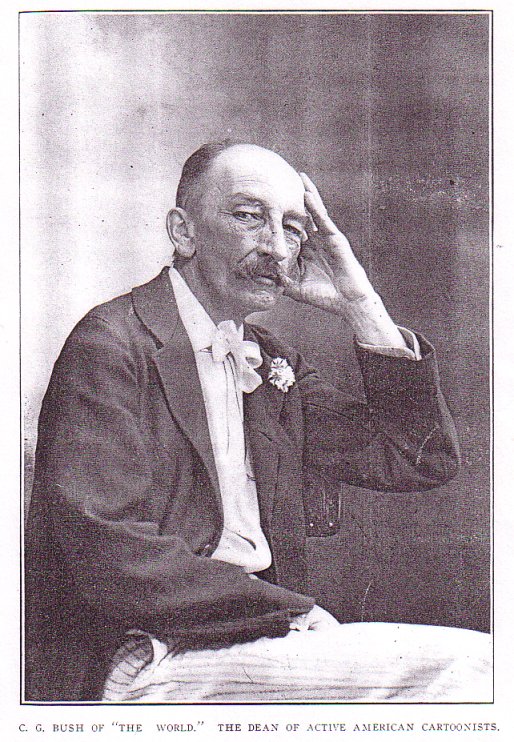
Charles Green Bush (1842-1909)

“I am obliged not only to use my pencil, but to study hard and read everything I can lay my hands on. The features of Roosevelt, Bryan, Hanna, and Croker may be familiar to me, but I must know what these men are doing. I must also know what the masses behind these popular characters think and believe. I must be conversant with the incidents and times from which I draw my inspiration. With 365 cartoons to draw during the year I must do an immense amount of thinking, for two-thirds of the ideas portrayed in my drawings originate in my own brain. I get my inspiration from newspapers, magazines, and people and I work methodically day after day. Without letting you into the secret of my political feelings, I may tell you that it very often happens that a cartoonist who is a Republican has to earn his bread and butter by ridiculing his own party and vice versa. You can draw your own conclusions from that statement, while I -- excuse me -- resume another sort of drawing!” -- Charles Green Bush quoted in “American Caricature and Comic Art,” The Bookman (US) 1903.

BUSH, FAMOUS AS A CARTOONIST, DEAD

He Was Creator of Many Political caricatures --- Died in the South

Camden, S.C. Saturday, May 22, 1909, Trenton Evening Times.

Arrangements were made today for the funeral of the late Charles Green Bush, the noted cartoonist who died here last night following an attack of heart trouble.

For years he had been the acknowledged dean of American cartoonists, and his work has been copied worldwide. He was born in Boston in 1842, and at the age of 18 was appointed cadet to Annapolis Naval Academy, being a classmate of Admiral Sigsbee.

Leaving the Academy he became an illustrator at Harper’s, and later went to Paris where he studied at Rimmel’s and with Bonnat. He immediately took his place as the foremost political cartoonist of the country and until his retirement a few years ago, wielded a powerful influence with his pen pictures.

He was the creator of Father Knickerbocker as representing New York City; it was Bush who first gave David B. Hill his little high hat with its “I am a Democrat” plume and his strenuous Roosevelt in Khaki has been the model for all such efforts on the part of all cartoonists.

The ex-president has among his possessions in his library a cherished collection of the Bush cartoons. Bush was, to those who knew him best, a delightful many-sided gentleman. He took most pleasure from his choir work in Dr. Parkhurst’s church and was known as a genius in the design of model yachts. He was a botanist of rare knowledge and was considered an authority on the cultivation of old-fashioned flowers.

The body will be taken to New York for internment.


Monday, November 15, 2010

American Propaganda in World War I


Words that Won the War, the Story of The Committee on Public Information,1917-1919, by James R. Mock and Cedric Larson, Princeton University Press, 1939.


In April 1918 the blockbuster film was not Tarzan of the Apes with Elmo Lincoln, or Mary Pickford in Amarilly of Clothesline Alley, but The Kaiser, the Beast of Berlin, a bloodcurdling film (now considered a lost film) that had theatre audiences raising the roof with hisses and boos. The film was not a spontaneous patriotic offering of the Hollywood stage but a manipulative piece of “hate” propaganda produced by the U.S. propaganda ministry “The Committee on Public Information” (CPI), which was active from 1917 to 1919. “Wild cheering marked every show when the young captain socked the Kaiser on the jaw… Street car signs were used; huge street banners swung over the crowds… and a truck paraded the streets with the Kaiser hanging in effigy and a big sign ‘All pro-Germans will be admitted free.’ None availed himself of the invitation.”


The Committee on Public Information, also known as the Creel Committee after its director, George Creel, a former cartoon gag writer, and founder of The Independent, strictly regulated the press and indoctrinated the American public through use of prepared news, pamphlets, books, cartoons, advertisements, movies, and lectures by Four-Minute Men throughout the country. The work of this massive “advertising agency” touched the lives of every man woman and child in the country, no matter how remote from the city they lived. George Creel held an unprecedented power in American life, he answered only to his close friend and president, Woodrow Wilson.


In the 1939 Preface to Words that Won the War the authors note that “France and England have become, at least for the time being, “totalitarian democracies,” and Americans ask themselves what may happen to this country if it is sucked into the maelstrom. As this book attempts to demonstrate, the advance of censorship power can be silent and almost unnoticed as wave follows wave of patriotic hysteria. If the record of the last war is to be taken, American resistance to repressive measures may not be great. The question arises whether, in the event of a new war, America would feel like indulging in the luxury of some “Creel Committee” to stand as buffer between military dictatorship and civil life.”


The CPI was created by Woodrow Wilson, with George Creel as civilian chairman, along with the Secretaries of State, War, and Navy. The censorship of news was “ironclad” and unlike Britain’s total censorship was, “voluntary,” although amendments to the Espionage Act gave the government powers to suspend any newspaper for 30 days for publishing any news of military operations. The newspapers complained but by the time America entered the war censorship of newspapers and magazines was absolute, every bit of war news was censored and controlled by the CPI.


The Advertising Division of the CPI provided advertisements for newspapers, magazines, farm papers, trade magazines, college papers, outdoor displays and theatre curtains. The leader of the Department of Pictorial Publicity was Charles Dana Gibson, Life magazine’s most popular artist, who worked at his own expense and mobilized the Society of Illustrators in the propaganda efforts of the war. They made public appearances and produced posters, murals, lithographs, prints, advertising art and cartoons. Every major illustrator in the United States worked under Gibson on pictorial publicity.


The Bureau of Cartoons was established 28 May, 1918, headed by Alfred M. Saperston at first, then succeeded by Gretchen Leicht. The unofficial supervisor was George J. Hecht, a non-salaried volunteer. The Bureau of Cartoons published the Weekly Bulletin for Cartoonists, mailed to 750 American cartoonists with suggested ideas and captions for cartoons.

One result of the propaganda war was that the innocent citizen suffered along with the guilty. A country-wide vigilante group worked under the protection of the Department of Justice. German Americans were one target, so were the Bolsheviks and the Wobblies. (Documented in a highly partisan book, The Web by Emerson Hough.) In the United States “The Katzenjammer Kids” title was changed to “The Captain and the Kids,” and in Canada “The Shenanigan Kids.”

The Bureau syndicated the war cartoons nationally through the Division of Syndicate Features, which called on the services of fifty leading writers including Booth Tarkington, Samuel Hopkins Adams, Rex Beach and Mary Roberts Rinehart. L. Ames Brown was the first director followed by western writer William Macleod Raine. In those pre-radio days the Four Minute Men were set up to speak nationally on CPI produced topics in movie theatres before every cinema attraction, many of which, documentary and entertainment, were produced by CPI’s Division of Films.

“The work, as a whole, was nothing more than an advertising campaign, Creel said after the war. He wrote his own account of the CPI titled How we Advertised America. The famous phrase war to end all wars, paraphrasing H. G. Wells, was a cynical slogan dreamed up in an advertising studio.


The CPI was reportedly disbanded at the end of the war. The amazing thing was that the CPI kept its work secret from the general public throughout the duration of that war. Every item of war news “had been censored somewhere along the line -- at the source, in transit, or in the newspaper office in accordance with “voluntary” news issued by the CPI.” At its basics the CPI was a huge advertising campaign aimed to mobilize hatred against the enemy(at home and abroad), preserve the friendship of allies, procure cooperation of neutrals, and demoralize the foe. The final result of all these labors was victory in the war, but also leads to the conclusion that the entire historical written and pictorial record from 1917 to 1918, American and allied news sources, books and cartoons, is useless to historical research except for the study of propaganda.


*Shenanigan Kids from the Montreal Standard, 1917.

Thursday, November 11, 2010

Chums

“Things have changed since those days of Chums,” said Sir Max with a smile.

“Everything has changed. When I sent down number one of Chums to the printers the horse omnibuses rattled through the streets of London; there were no tubes or electric trains; no wireless; no motors -- and, indeed, hardly any of the present conditions which we now accept as part and parcel of daily life.” -- Sir Max Pemberton, the Founder of Chums, (1931)

Max Pemberton was born on the 19th of June in 1863, a native of Birmingham. On entering journalism one of his early associates was Alfred Harmsworth, who became Lord Northcliffe. As a boy Harmsworth wrote a ripping penny dread called “The Black Hand,” never published, in collaboration with his friend Percy Westerman. It is true that Pemberton approached Cassell’s with the idea for a boy’s story paper, but Cassell’s director told him that the firm did not enter into partnerships. “We are thinking of starting a paper for boys. Will you take charge of it at the salary of four hundred pounds a year?”

Pemberton described Chums as “a modest success from the outset, though in my opinion Cassell’s hampered it by the form they adopted -- a page of two columns in the fashion of the Spectator… The size chosen was almost impossible for illustrations and within a year we had to go back to the form of the old B.O.P. (that excellent thing) and to give the boys their expected 3 columns.”

Max Pemberton edited Chums from only 1892 to 1894. He resigned when his first novel “The Iron Pirate,” became a bestseller. Pemberton’s successor was Ernest Foster, who edited until 1907. Pemberton returned to Cassell’s in 1896, and until 1906 was the editor of Cassells’ Magazine. His Most popular novel was “The Iron Pirate” published in 1893 in Chums. “Even to this day (1931) I cannot get away from the Pirate. When I was at Miami, in Florida, a stranger came up to me, smiling and holding out his engineers’ hand, and said, “I read your CHUMS as a boy, and still remember the good old Iron Pirate!” I met with a similar incident in Quebec; and while turning over some papers in a railway bookstall in New York; the head clerk spotted me and said, “Gee! Your Pirate was great stuff!”

“D. H. Parry, who knew every button on every uniform in the British Army, brought his drums and fifes and wrote me “For Glory and Renown,” a soldier’s story which many old boys remember to this day,” said Max Pemberton, of the first story in Chums first number.

Cassell & Co. published this in hard-cover as “For Glory and Renown: a story of the Wars.” David Harold Parry, the author, was born in 1868. Parry was the grand old man of Chums until 1935, and died in 1950. One of his latter serials was in the 1934-35 Chums Annual, “The Tiger of Tangier, a stirring story of fighting in North Africa in the Days of Charles the Second.” The illustrator was Paul Hardy, who when available was the artist of choice for serials written by Parry or S. Walkey.

S. Walkey’s first serial was “In Quest of Sheba’s Treasure,” which ran through the 1895-1896 volumes. A Canadian from Nova Scotia, George Hutchinson, was the illustrator. Hutchinson would also contribute 18 drawings to Chums serialization of “Treasure Island,” which ran from 29 Aug 1894- 2 Jan 1895. “Treasure Island; or, the Mutiny of the Hispaniola,” illustrated by William Boucher, cartoonist on “Judy,” first appeared in Volume 19 of James Henderson’s “Young Folks” from October 1, 1881, to January 28, 1882. Stevenson also contributed “The Black Arrow,” running from June to October, 1883, and “Kidnapped,” May to July, 1886.

George Hutchinson shipped out of Nova Scotia as a cabin boy when he was fourteen. Tiring of his job he determined to become a painter and studied in London and Paris. Hutchinson worked some time as a portrait painter and found success as an illustrator and cartoonist for the comic paper Ariel. The Review of Reviews wrote that “Like Mr. Bryan, Mr. Hutchinson never takes notes. His drawings are all done, however, when he gets home, while for his types of faces he relies on his observations on ‘bus, tram, or railway.” In 1892 he illustrated Doyle’s “A Study in Scarlet” for Ward & Lock.

Frank Hubert Shaw (pseudonym; Grenville Hammerton) was born 24 Oct 1878. He joined the Royal Navy as an apprentice on a windjammer and rose in rank to Captain. He served as a Naval sea plane pilot in 1916. His first major serial, “The Peril of the Motherland,” began in Chums on 22 April 1908, with England invaded by the current bugbear of Russia. Just before Christmas 1913 the editor wrote “Our old friend Captain Shaw has just come in to see me after a long trip in the north of Africa and through the lands of the Sahara desert. He looked so brown and full of fight that I immediately suggested another serial…” Capt. Shaw revived the future war theme on 13 Dec 1913 with the serial “Lion’s Teeth and Eagle’s Claws,” with England now invaded by Germany. The serial ended 25 April 1914 and England was in the real war by 5 August 1914.

Pemberton styled Chums originally on the Boys’ Own Paper, founded in 1879 by the Religious Tract Society. They were similar in that Chums followed the format of the BOP, including the yearly issue of Annuals, but the BOP was a no-nonsense publication that hectored its readers on cleanliness and the dangers of self-abuse. Over time Chums became closer in spirit to penny dreadful papers like the Boys’ of England, featuring thrilling historical stories with unabashed violence, school stories, and a chummy editorial style. Chums serials were better written, dropping the melodrama of Brett’s Boys’ of England for a more realistic style of writing.

It would be impossible to list all the authors who ever worked on Chums. They included D. H. Parry, Robert Louis Stevenson (second serialization of Treasure Island), Captain Frank Shaw, Max Pemberton, S. Walkey, Barry Pain, G. A. Henty, Sax Rohmer, James Oliver Curwood, Sydney Horler, John Hunter, Hylton Cleaver (sports journalist), Wingrove Willson (r.n. Walter Light Herrod,) Richard Bird, Gunby Hadath, Major Charles Gilson, Eric Wood, D. H. Parry, George E. Rochester, John Mackie, Percy F. Westerman, S. Walkey, Fred W. Young, Herbert Maxwell, Alfred Judd, Andrew Soutar, Thompson Cross, and Ivor Gresham.

The artists and cartoonists who illustrated Chums included John Abbey, Gordon Browne, Tom Browne, George Hutchinson, Cecil Glossop, Paul Hardy, Harry Lane, Stanley Berkeley, Albert Morrow, George Soper, ‘Lang’, Thomas Somerfield, H. Valda, Serge Drigin, J. T. Staniland, Herbert Bone, R. Caton-Woodville, Stanley L. Wood, H. E. Brock, Fred Bennett, H. L. Shindler, Moon Goodman, F. R., Sherie, T. Edward Marhew, Robert Strange, Eric Parker, and G. M. Payne

Draycot Montague Dell was the editor of Chums from 1926 until 1939. He contributed the serial “Ghosts of the Spanish Main” to Chums in 1934, and in 1933 co-authored, with Edgar Wallace, the short story “King Kong,” in Cinema Weekly. Cassell’s published Chums weekly and monthly until January 1927 when it was taken over by Amalgamated Press. After 1934 only the Annuals were published, every September, until paper shortages killed off both Chums and the Boys’ Own Paper in 1941. There were 48 Chums Annuals in total.


D. H. Parry:

For Glory and Renown, Serialized in Chums beginning in Vol. I, No. 1, 14 Sept 1892

For Glory and Renown: a story of the Wars, Cassell & Co., 1895

Britain’s Roll of Glory; or, the Victoria Cross, its heroes, and their valour, 1895

The Death or Glory Boys: the Story of the 17th Lancers, Cassell & Co., 1899

The Scarlet Scouts, a story of the great war, illustrated by Dudley Tennant, 1899

Gilbert the Outlaw, Cassell & Co., illustrated by C. E. Brock, 1917

With Haig on the Somme, 1917

The History of the Great War, London: Waverly, no date.

Saber and Spurs!: a tale of the peninsular war, 1926

Sources:

Sixty Years Ago and After, by Max Pemberton, London: Hutchinson & Co., 1935.

An Interview with the Founder of “Chums,” by Toy Vise, Chums Annual 1931-32, p. 23.

Seas of Memory, by Frank Hubert Shaw, London: Oldbourne, 1958.

Caricatures of the Month: George Hutchinson, London: Review of Reviews, 1892.

The Men Behind Boys' Fiction, by W.O.G. Lofts and D. J. Adley, London: Howard Baker, 1970.

Story Paper Index


Sunday, November 7, 2010

Big Budget

C. Arthur Pearson’s BIG BUDGET (‘Three Papers for a Penny’), edited by Arthur Brooke, began circulating 19 Jun 1897 and lasted until 1909. The 24 page penny weekly featured an 8 page comic section and 16 pages of fiction. Pearson tried another comic called Dan Leno’s Journal, after the famous comedian, but it folded just short of two years after 93 nos.

The Editor’s page listed the forthcoming contributors. “We have but to mention such well-known writers as Louis Tracy, George Griffith, Henry T. Johnson, Maxwell Scott, Claude Heathcote, etc., and such deservedly popular artists as Jack B. Yeats, Tom Browne, T. Wilkinson, “Yorick,” and A. Morrow, to show our readers that the Big Budget is going to be The Record Paper of a Record Reign.”

The first issue featured Tom Browne’s “Airy Alf and Bouncing Billy,” very similar in style to Browne’s “Weary Willie and Tired Tim,” from Harmsworth’s Illustrated Chips. The illustrations to “Airy Alf and Bouncing Billy” were shared by Browne, Frank Holland, a South-African cartoonist, and Ralph Hodgson under the pen-name “Yorick.” Frank Holland drew drew the recurring characters “Jimmer Squirm and Spooky the Sprat.” In 1897 Holland contributed drawings for “Chokee Bill and Area Sneaker,” in Harmsworth’s Comic Cuts.

Ralph Hodgson drew “Sunny Jim,” a commercial character used to promote Force Wheat Flakes, for the cover of Funny Pips, which lasted 16 issues starting 12 Sept 1903. I am not sure if this was the Ralph Hodgson (1871-1962) who was a well-known poet and close friend of T. S. Eliot’s. Eliot’s poet friend was also a caricaturist. A 3rd series of comic characters were “Bertie Bounder and Algie ‘Ardup.”

The fiction in the first issue was Maxwell Scott’s “Kenyon Ford, the up-to-date Detective; or, The Secret of the Ruby Ring,” Harry (Henry) Farmer’s “The Flying Phantom,” Henry T. Johnson’s “Sawdust and Spangles, a Story of Circus Life,” Harry Blyth’s “From Toil to Triumph,” and Claude Heathcote’s “The Strange Ordeal of Alfred Wharton.”

‘Maxwell Scott’ was Dr. John William Staniforth, Henry Farmer used the pen-name ‘Franklin Wright,’ and worked as literary editor at the Daily Express, Henry T. Johnson (1858-1930) used the name ‘Neil Thomson,’ and was an editor of the comic journal Fun and Trapps Holmes Vanguard story paper. Harry Blyth (1852-1898) wrote the first Sexton Blake story, “The Missing Millionaire,” for Harmsworth’s halfpenny Marvel, no. 6, December 1893. Claude Heathcote’s real name was J. Harwood Panting.

Herbert Wentworth James, Paul Herring, S. Clarke Hook, Reginald Wray (real name William Benjamin Home-Gall), and Sidney Drew (real name Edgar Joyce Murray), also contributed thrilling stories to Big Budget. Samuel Clarke Hook was renowned for his creation of Jack, Sam and Pete, a series running through the marvel from no. 385, March 1901 to no. 940 in 1922. Original stories featuring the characters also appeared in Boys’ Friend Library. Herring wrote “Kit Carson” and other westerns for Big Budget. The artist on “Kit Carson” was J. W. Homes.

Albert Morrow was the preeminent artist for the fiction section. He was born in Ireland in 1863, studied at the Belfast Art School, and made a name for himself as an illustrator, poster designer and cartoonist in London. He contributed to the English Illustrated Magazine, Tit Bits, Good Words, Chums, and Punch. He died in West Sussex, 26 October 1927.


Friday, November 5, 2010

Samuel Walkey (1871-1953)

Samuel Walkey was born at Kilkhampton, Cornwall on 10 July 1871 and was employed by a bank at 16 years of age. His wife encouraged him to write and he began working nights on romantic fiction for Cassel & Co. His stories appeared in The Storyteller, Cassell's Magazine, The Corner Magazine, Cassell's Saturday Journal, and Chums. The founder and first editor of Chums was Max Pemberton, author of “The Iron Pirate,” and a boyhood friend of Alfred Harmsworth, who was soon to dominate the field of story-paper publishing with the Marvel, Pluck and Union Jack. Chums was issued in penny weekly numbers from 14 September 1892 to 1932 and then published as an annual until its demise in 1941.

Walkey’s first Chums serial, “In Quest of Sheba’s Treasure” was published in 1895 and the serial he considered his best, “Rogues of the Fiery Cross,” in 1896. Numerous pirate and adventure serials followed including “The Pirates of Skeleton Island,” “Yo! Ho! For the Spanish Main,” “With Redskins on the Warpath,” and his final Chums serial “Rogues of the Roaring Glory.” Many of these were printed in hardcover in Britain and the United States following serialization. Paul Hardy (1862-1948), well-known for his illustration work for The Strand, was the artist most frequently associated with Walkey serials.

Walkey was best known for his gritty pirate stories but he also wrote numerous short stories featuring the two Jack-a-Lanterns, Marquis and Moonlight, with their Mystery Men, which were just as popular. Walkey described the Jack-a-Lanterns unusual background in Chums no 1096, 13 Sept 1913, in a revival of what were by then old characters. Walkey wrote in the old penny dreadful style: one (sometimes long) line at a time.

“Who was Jack-a-Lantern?

Those of you who have read the early adventures of that chivalrous and mysterious Englishman will not require to be reminded of his exploits; but there may be others to whom as yet Jack-a-Lantern is unknown.

I must therefore tell you, that at the beginning of the Reign of Terror, when the prisons were crowded with aristocrats -- when the guillotine had commenced its dreadful work -- when the most harmless and innocent people were hounded to death by monsters such as Fouquier-Tinville, when Paris had become a City of Blood -- when the vilest and lowest of ruffians were allowed to rage like wild beasts through the streets, killing those whom they willed or whom they were pleased to call aristocrats -- stories were whispered of a mysterious Englishman who, ‘twas said, flitted from prison to prison, or from château to château or from one scene of execution to another; and generally, whenever he appeared, the guillotine was cheated of a victim.

People whispered that he possessed superhuman powers -- that he had been seen in two places at the same moment -- that, while he was being pursued, a pale blue flame would dance or hover around him.

Some said that at times he passed quite fearlessly along the roads, wearing no disguise.

His usual costume was a suit of silver-grey; he was exceedingly handsome; and undoubtedly an Englishman.

As no one knew his name, people called him Jack-a-Lantern.

The revolutionary spies were always upon his trail; but again and again he fooled them, and his little vessel, the Never Tell, carried scores of those who had escaped the guillotine to the hospitable shores of England.

A boy named Chris Chesney was fortunate enough to share in many of his adventures; and Captain Barleycorn of the Never Tell was a character whom the commanders of the French frigates longed to capture, so many times had he given them the slip at the very moment when they believed they had the black barque at their mercy.

Later, a band of Englishmen, known as the Mystery Men, took service under the famous Jack-a-Lantern, and became the despair of the revolutionary spies.

Some of you have read of Sir Charles Mings and his companions.

You also know that in the course of time it was rumoured throughout France that the Jack-a-Lantern had a double, and that there were in reality TWO JACK-A-LANTERNS.

One was called by the Mystery Men “the Marquis,” the other was named “Moonlight.”

If, therefore, you care to listen to the further adventures of the two Jack-a-Lanterns, if you care to hear more of the Mystery Men, you will find in the following stories deeds no less exciting, no less daring, than of the heroes’ earlier exploits.”

Outside of the Cassell company, Walkey contributed pirate tales to Aldine’s Boys’ Own Library (1908-1914, 93 nos.) “Pirates of El Dorado” and “Rovers of Black Island,” both with covers by Robert Prowse Jnr. One title, “Cruise of the “No Surrender”” appeared in Boys’ Friend Library issued by Amalgamated Press. Those three titles are held at the Toronto Public Library in Ontario. Walkey wrote two adult-oriented adventure novels for Cassell’s: “for the Sake of the Duchess,” and “The Lovers of Lorraine.” Boy’s author Geoffrey Trease began his own writing career under the influence of Walkey’s Chums serials. Samuel Walkey died at his home in Dawlish, a seaside village on the South Devon coast on 29 Mar, 1953.


Wednesday, November 3, 2010

Magasin Général: Marie

Magasin Général (General Store) Tome 1, Marie, Casterman, 2006.

Magasin Général was serialized first in Belgium in Le Soir newspaper and in France in Bodoi, beginning with no. 91. There have been five volumes to date. The fifth tome, Montréal, is previewed HERE. Loisel, author and artist of Peter Pan (1990), was born in 1951 in France. Jean-Louis Tripp was born in France in 1958 and began his cartooning career on Métal Hurlant in 1977. Both artists currently live in Montréal. Loisel and Tripp share both script and art on Magasin Général, with colors by Francois Lapierre. Jimmy Beaulieu of Montréal provides the narrative with authentic Quebecois expressions, just enough for authenticity while remaining comprehensible to all audiences.

The heroine of this outstanding BD, a comic work comparable to the greatest of novels, is Marie Ducharme, and when the story opens she is the newly widowed proprietor of a general store in a rural village in Québec in the twenties. The first volume tells of the funeral of Marie’s husband, her loneliness and grief. What follows is a timeless journey through Marie’s community as she makes deliveries in a beaten-down pickup truck, scattering livestock as she goes. The highlight is a barn-dance ending in a drunken brawl that takes up six gorgeously colored pages.

This subtly perceptive story builds slowly but it is never dull and will not be easy to forget. The bucolic village of Notres-Dame-des-Lacs is filled with eccentric characters, the village priest on his bicycle, a man who is building a large bateau on the lake, barn dance fiddlers and harmonica players, washerwomen engaged in gossip at the creek, and barefoot children watching over goats and sheep. In Magasin Général time passes as in real life, with comedy and tragedy at every turn. The artists’ eyes for detail are incredible; every panel is an evocative work of art; every weathered face is unique; every gesture true to life.

I usually find myself skeptical of comparing comics to art or literature but for Magasin Général I’ll make the exception; it reads like a novel; a novel in words and pictures, and has the emotional wallop of all great works of art. While reading Marie I was reminded a bit of Claude Jutra’s acclaimed 1971 film Mon oncle Antoine. Magasin Général has already attracted the attention of the Québec theatre; it could well be the inspiration for another great film in the future.