Showing posts with label Bill Blackbeard. Show all posts

Tuesday, October 22, 2024

WHAT'S SO FUNNY? -- ANALYZING THE HUMOR COMIC STRIP IN AMERICA

By Rick Marschall


In 1988 I was invited to be Guest Curator in Salina, Kansas, for the opening exhibition at the new Art Center building. The focus of the exhibition was determined to be the Humor Strip in America, and the Art Center -- one of Middle America's premier independent institutions -- went "all out" to make it a memorable show.

Director Saralyn Reece Hardy contacted me at the suggestion of Marvel artist Kevin Nowlan, whose fine work I knew from my Marvel days and through both our work for The Comics Journal. When all was said and done, it was a six-week adventure, a grand exhibition with 64 originals from my collection (including a Yellow Kid painting, a Calvin and Hobbes daily, and the first Peanuts Sunday page). My friend Jim Scancarelli (Gasoline Alley) drew the poster.

I spoke to a variety of local groups and wrote study guides; a local chorale society sang vintage show tunes based on comic characters; a giant wall of the new center was painted in a Krazy Kat landscape; Universal Press Syndicate sponsored the appearance of Lynn Johnston as a Visiting Artist for a week; the Smithsonian Institution (through the Mid-America Arts Alliance) arranged for a two-year tour of the exhibition; and a handsome 48-page catalog was produced with Jim's fantasy of the Gasoline Alley crew and other legendary characters reading the funnies.

I filled the catalog with articles that would be informative on the subject; scholarly but not academic. I reproduced some noted essays from the past, but wrote one myself, and asked Ron Goulart, Donald Phelps, and Bill Blackbeard to write essays too. 

In the future I will share all these pieces in Yesterday's Papers, with illustrations, and with quotations from cartoonists about their craft. I hope they download legibly (click to enlarge images).  

The first essay has been reprinted occasionally since its first publication in 1924, exactly a century ago: The "Vulgar" Comic Strip by Gilbert Seldes. I secured permission from Seldes's son Tim, my friend who was a literary agent; it appeared in his father's iconic book The Seven Lively Arts.. It has never been reprinted in Yesterday's Papers here -- and since this great archive is a go-to site for scholars... here it is!


Tuesday, July 5, 2022

Peeps into the Past –

  A Detailed 1919 History of Penny Bloods, Penny Dreadfuls, and Penny Journals

by Frank Jay

Compiled by Bill Blackbeard and Justin Gilbert (2001)

Link HERE


Saturday, June 20, 2015

Krazy Kat in France


[Krazy Kat:] Why is “lenguage” “Ignatz”?

[Ignatz Mouse:] “Language” is, that we 
may understand one another.

[K:] Is that so?

[I:] Yes, that’s so.

[K:] Can you unda-stend a Finn, or a 
Leplender, or a Oshkosher, huh?

[I:] No.

[K:] Can a Finn, or a Leplender, or a 
Oshkosher, unda-stend you?

[I:] No.

[K:] Then, I would say, lenguage is, that 
we may mis-unda-stend each udda.

— Krazy Kat daily, January 6, 1918


Beware the little Bolshevik
Avoid the Sovietski
Like Ignatz Mouse he heaves a brick
At bourgeoise Krazy Ketski

The Quill [Greenwich Village], Vol. II, No.7, June 1918


“Krazy Kat, by Herriman, is, in the writer’s estimation, the greatest advance beyond nothingness on record.” [Harold Philips, well-known authority on Swiftian satire, who is not feeling so good today, anyhow, thank you, regards that last paragraph as “a befamixing humdinger.”] — ‘Who Is Your Favorite Comic Artist?’ in The Washington Times, Jan 13, 1922


“…who ducked the missile that came like a toss from Ignatz Mouse toward the head of Krazy Kat failed to identify the culprit…” — Chicago Daily Worker, 1926


“A jazz band of colored Macy’s employees vied for honors with several other musical detachments, including a clown band of other Macy employees, a military band of 75 pieces, a fife and drum corps, and a bugle corps. The comic supplement section of the parade represented a number of the familiar “funny sheet” characters, including Mutt and Jeff, Krazy Kat, Ignatz mouse, and Silk Hat Harry.” — ‘Santa Claus Heads Parade of Macy’s’ in the New York Daily Review, Nov 28, 1926


“Hey, E.E. Cummings, you can’t do that to this cartoon! Krazy Kat is no Republican propaganda. We don’t accept your active argument for passivity, your palming off some fillossiffical-idealism on us, your old love will find a way business and the meek shall inherit the earth stuff.” — ‘Hey, E.E. Cummings, don’t do that to Krazy!’ by Ad Reinhardt, in the daily newspaper PM, 1946
         
by John Adcock

NO OTHER comic strip in the history of humankind has been the subject of so many different interpretations as Krazy Kat. The slapstick triage of Krazy Kat, Ignatz Mouse, Offissa Pupp and the inanimate brick had appeal for children and adults, capitalists and Bolsheviks, the working classes and the halls of academia.

Adding new aspects to this search for meaning was the discovery that the birth certificate of writer-artist George Herriman identified him as “colored” which subjects the entire oeuvre to a search for racial identifiers. He is reported to have 
used the terms “creole” and “negro blood” to describe himself; his parents were listed as “mulatto” in 1880. (For further reading see Thomas Inge’s Was Krazy Kat Black? HERE and cartoonist Karl Hubenthal’s rebuttal HERE.) Was Krazy Kat Negro?… One might well ask Was Ignatz Mouse Jewish? Or; was the “kopp” Irish? There are no easy answers.

There was a time when Platinum Age comic strips — pre-1938 works — seemed to have sloped down the memory hole and were remembered only by the parents, who had gobbled them up on first appearance, and a few besotted collectors such as August Derleth and Bill Blackbeard. Most North American comic strip enthusiasts of the 60s discovered Krazy, Ignatz and Offissa Pupp through the 1969 Krazy Kat book produced by Woody Gelman and his Nostalgia Press for Madison Square Press/Grosset & Dunlap, a book which conquered Europe at the same time. A hardback book selling for $7.95. It had a foreword by Barbara Gelman and it reprinted the introduction by E.E. Cummings from a similar book collection (with different images) of the same title, published by Henry Holt and Co. in 1946. A hardback book for $3.75.

MEANWHILE the only American comics available in book form in France were Flash Gordon and Prince Valiant, published respectively in 1968 and 1970 by SERG, a non-profit organization animated by the same people who had made the seminal exhibition ‘Bande dessinée et figuration narrative’ at the Musée des Arts Décoratifs, in Paris, in 1967. In Italy, the fat Italian magazine Linus began reprinting Krazy Kat strips, in Italian translation, as early as 1965. Linus inspired a French cousin, Charlie mensuel (they shared the same covers), which disseminated comics culture through France from February 1969 to February 1986. Georges Wolinski, the second and principal editor, from 1970 to 1981, opened its columns to Krazy Kat, leading to protests from some of its readers. But for the most part the French reader had to wait until the 1980s to read the Futuropolis Krazy Kat books in native French language.

Recently, another French publisher Les Rêveurs has published three fat volumes of Krazy Kat Sundays, translated into French by Marc Voline, with the fourth and last volume still in production. The Les Rêveurs Krazy Kat volumes use the same boards as the recent Fantagraphics books but there’s a big difference. The covers on the Fantagraphics volumes were designed by Chris Ware, a fantastic artist whose work in this context seems discordant, like it was composed with a mechanical drafting set. Herriman’s style was the exact opposite. He drew in a loose scratchy scribble with an abundance of crosshatching comparable to free-form music — like ragtime or jazz. Very wisely Les Rêveurs chose their cover designs to highlight the enigmatic art of George Herriman.   

MARC VOLINE writes to Yesterday’s Papers —
French Krazy Kat volumes are more than just reprints of the Fantagraphics editions. In order to contextualize, and fill — as well as I could — the double time-gap (one century!) and space (an ocean!) for French readers, I substantially expanded Ignatz Mouse’s debaffler pages. Thus it may be of some interest to Americans who read Rabelais’ language, and even to those who don’t: if they miss the additional debaffling, they’ll at least partake in the lyrics of all the songs uttered by Krazy and his fellow Coconinians.” [Editor’s Note: Songs from the comic strips are treated in the endnotes for the years 1925-44 of the Sundays.]
I asked Voline for details of his work as a translator. Was Krazy Kat his first venture into translating comics?
“After having spent three first semesters studying History at Paris 1 Sorbonne University, and having just begun working as a journalist (in the cultural field), my first translation in 1977 — I was 20— was a literary one: three Chesterton short stories. From the Other Stories section of the 1922 collection The Man Who Knew Too Much (The Garden of Smoke, The Five of Spades, The Tower of Treason), published as a little book under the French title of the latter: La Tour de la Trahison. The following year, for a literary review, I translated a small text from a big Krazy Kat fan: Gertrude Stein. Since then, I translated works by Jack London (To Build a Fire), Thomas de Quincey (The Avenger), Giovanni Papini (Gog), Jeff Noon (Vurt, Pollen)…
My first venture into translating comics occurred in 1982 when I was writer-editor at Métal Hurlant, a comics monthly created by Mœbius and Druillet (you may remember its American edition, Heavy Metal). My first two translations from English were Mike McMahon’s Judge Dredd and the Hernandez Brothers’ Love and Rockets. Then I began translating Lorenzo Mattotti and other Italian artists from the Valvoline group.From 1984, I was comics editor at Albin Michel publishers. There I translated strips, which are amongst the most demanding — and rewarding! Harvey Kurtzman’s Jungle Book, ten volumes of Tales from the Crypt (mostly Jack Davis, plus some Wally Wood and Reed Crandall), and eight volumes of Scott Adams’ Dilbert. As a writer, I worked on comics and children’s books with comic strip authors like Yves Chaland, Jean-Louis Floch, Max, Tramber… All of Métal Hurlant extraction.
My first brief round of Krazy Kat translating was in 1996, for a short lived comics tabloid weekly called Strips, edited by artist Placid. Actually, the Strips magazine episode wasn’t my first foray into Krazy’s wonderland. Translating and publishing Krazy Kat had been a personal obsession for a long time! I first ordered Krazy Kat strips — through Opera Mundi, the distributor of King Features Syndicate in France — in April 1974, for a fanzine I was planning, and, as attested by the fact I still received the KFS microfilm catalog in 1982, I must have nurtured the same project when I was a Métal Hurlant editor at Les Humanoïdes Associés publishers. The more recent Krazy Kat venture began as a project with Jean-Louis Gauthey, of Cornélius publishers (who published Crumb and Burns in France). But being a perfectionist, Jean-Louis was quite reluctant in view of the poor quality of some of the material (obvious in the Les Rêveurs volume 2, for the years 1930-34), and he eventually renounced it. As for the genesis of the Rêveurs edition, I told it in a June 2012 interview with the comics site Du9, whose English translation — with a few mistakes — you’ll find HERE.
Les Rêveurs is the creation of two friends, the comic artist Manu Larcenet and Nicolas Lebedel, who is the acting editor. Manu Larcenet conceives and colors the Krazy Kat covers (“his great pleasure”). As for the inside layout of this series, the title pages are those of the first volumes of Fantagraphics, the rest of the books contain layouts by graphic designer Camille Aubry.

A BETTER LOOK. The French volumes are nearly twice the size of the Fantagraphics editions (26,5 x 37 cm, or 10 5/8 x 14 3/4 inches) which makes for easier reading and allows for a better look at the fine feathered and crosshatched ink-lines as in the originals. The first volume features 273 pages, the second 264, and the third 272. Krazy Kat kompletists will want to own both publisher’s worthy efforts.


Vol. 1 [1925-1929] Articles and Notes Krazy Kat & Années Folles by Marc Voline L’homme Derrière le Chien, Derrière la Souris, Derrière la Chat – George Herriman 1880-1944 by Bill Blackbeard Le Bouffon de Cour, Hearst, Herriman et la mort du nonsense by Ben Schwartz Krazy Notes 1926-1929 [Similar to the ‘Ignatz Mouse Debaffler Page’ in the Fantagraphics volumes] by Bill Blackbeard and Marc Voline
Vol. 2 [1930-1934] Articles and Notes Le Baron et le Duc by Bill Blackbeard Krazy Notes 1930-1934 by Derya Ataker, Bill Blackbeard and Marc Voline
Vol. 3 [1935-1939] Articles and Notes Krazy Kolors of Kokonino by Marc Voline Krazy Notes 1935-1939 by Marc Voline

Wednesday, April 27, 2011

From Weird Tales to Hogan's Alley


Bill Blackbeard, who passed away 10 March 2011, is rightly remembered as the man who saved the comics, but he was also a writer of no mean ability who wrote articles incessantly for pulps, fanzines and hardcover books. His prose language drew on Victorianisms, army slang, atrocious puns, beat prosody, the poetry of George Herriman and the wild imagineerings of Elzie Segar. He often took off on wild flights of fancy, image stumbling over image in wild endless exuberant sentences. 

In his correspondence he would use archaic phrases like “more anon,” “prithee,” and “ninnavent.” One letter to me began with “A good, loud Jack Benny “Yike”!” Even his titles reflected his reading, such as: “The Doom that Whirled toward Minnie; or, Mickey Mouse and the Phantom Artist,” from The Riverside Quarterly Vol. 6 No. 1, 1973, evocative of the Victorian penny dreadful.

The following list isn’t meant as an exhaustive listing of all Bill Blackbeard’s works. I imagine a complete list would be huge. Leaving aside most of his introductory articles for hard-cover book collections I’ll just talk about a few articles I do know of.

I don’t know when Bill B. (born 28 April 1926) started his writing career but it may have been with the November 1943 Dorothy McIlwraith edited Weird Tales story “Hammer of Cain,” collaboration with a regular contributor, James Causey. I lose sight of his writing at this period although he seems to have been directly involved with “first fandom” at the time. “Pipsqueak Prometheus,” a “devastating dissection” of L. Ron Hubbard appeared in Shangri La, # 20. Los Angeles Science Fantasy Society, 236 ½ North New Hampshire, Los Angeles 4, Calif., at 15¢ each. The article was reprinted in 1962 (see below). A review can be found HERE.

Bill can be found in 1956 with Famed Los Angeles fan centre close's doors forever,” in Fantasy Times no. 249:FTM3-FTM4, June (2) 1956, and SF and Fantasy,1941-1956,”in Fantasy Times No. 254:25-27, September (1) 1956.

He next appears as a contributing editor to The Riverside Quarterly, begun on August 1964 (Vol. 1, No. 1). The sf/fantasy zine was edited by Leland Sapiro, associate editor was Jon White, and Red Boggs and Arthur Jean Cox were also contributing editors. Drawings were by Charles Schneeman and layout by Bjo Trimble. I didn’t find any articles by Bill in the first or second issues but there is a note in no. 2: “…finally to Gus Wilmorth, originator of our ancestral Fantasy Advertiser...” It is possible that Bill wrote for the Fantasy Advertiser which ran in its original form from April 1946-June 1963. The editors were Norman E. Gus Wilmorth, Roy Squires, Ron Smith and Jon White. This second issue of RQ the address moved from Los Angeles to Saskatoon, Saskatchewan. Tipped by Huib van Opstal about his Riverside Quarterly contributions I wrote Bill and asked him a few questions.

“The editor of RQ was Leland Sapiro, an old sf fan friend and math professor who was in Thatsacatchyone seeking tenure; I had written some articles (in CA) for books I had edited that he wanted for his zine. Leland was not Canadian: he hailed from LA, where he grew up as a nephew of Igor Stravinsky and the grandson of the Aaron Sapiro who took on Henry Ford for a series of anti-Semitic articles in the Ford Co magazine, and won: a landmark case in law.”

Bill began writing a regular column about comic strips and popular culture in Vol. 4, No. 4, Mar 1971 beginning with a negative article about Woody Gelman’s Krazy Kat hard cover collection (1969). The article in Vol. 5 No. 1, July 1971, “From a Corner Table at Rough-House’s,” is one of his most personal, opening with a statement quoted from Jim Harmon’s The Great Radio Heroes which is then used as launching point to ramble on with childhood reminiscences and experiences with “the arts,” a critique of current comic strips, magazines, pulps and comic books. A reading of Jules Feiffer’s The Great Comic Book Heroes brought out a protest that “every last one of the ill-drawn, ill-written colour pages… makes my gorge rise in revulsion precisely as it did in those otherwise wonderful childhood days when I first looked at the early Detective Comics and Action Comics, or even their odder, cruder predecessor More Fun Comics. I didn’t think they were worth a dime then… I still don’t. Yet I continually took them down off those dawn age comic racks with ever-fresh (but always shafted) interest and hope.”

In Vol. 5 No. 3 he wrote for the first time about “The Bungle Family,” Vol. 5 No. 4 was about “Krazy Kat” and Gilbert Seldes. A substantial 12 page article appeared in Vol. 6, No. 1, 1973, it was the aforementioned “The Doom that Whirled toward Minnie; or, Mickey Mouse and the Phantom Artist,” which would later appear in All in Color for a Dime (Arlington House 1970). In Vol. 6, No. 3 there was an excerpt from his ‘work in progress’ (possibly the introduction to the unfinished work) “The Endless Art Warped with Fancy, Woofed with Dreams: the Literature of the Comic Strip.” He cites Krazy Kat, Thimble Theatre, Polly and The Bungle Family as “easily equal to the work of Chaplin and Keaton in the cinema, or to that of Waugh and Lardner in fiction (certain of the characters swaggering and rambling through the epic poetry of E. C. Segar’s Thimble Theatre are, in fact, so stunningly realized that they can be measured without embarrassment against the best of Dickens’ figures)…”


As far as I can tell Bill Blackbeard wrote 9 articles for The Riverside Quarterly, some short pieces, some long pieces and a few book reviews. “The Eighty Year Shaft; the Grand Scam of Comic Book Reprints since the Turn of the Century,” started in Vol. 7 No. 2, March 1982, and was continued in Vol. 7 No. 3 as “The Eighty Year Shaft Part II: Grab-Bag Packages.” His last contribution (last I know of, publishing was irregular) was “A Saga for Sagendorf’s Sake,” to Vol. 7 No. 4, a negative review of Popeye: the First Fifty Years (1979).

I think The Riverside Quarterly ended with volume 8, No. 4, August 1991. During this period, judging by the list of address changes, Sapiro published the zine from 1964-1991 from Los Angeles, Saskatoon, Sask., Lake Charles, La., Gainesville, Florida, Garden City, N.Y., Hartzville, S.C., Plano, Texas, Waco, Texas, Lake Charles again, and finally Regina, Saskatchewan.

Bill Blackbeard wrote a science fiction story called “The Recruits” for Winter (not sure if that's the title of a magazine or a zine) in 1963. Another classic title is “Pipsqueak Prometheus: some remarks on the writings of L. Ron Hubbard,” from Inside No. 1: 23-31. October 1962. Inside may have been a tabloid or a zine.


One book that has been attributed to Bill Blackbeard is Kiss, Screw, Pleasure and Sex which was published by Greenleaf Classics in San Diego, 23 December 1969. It was advertised in Ramparts magazine in 1969 for $1. It is listed in the University of California’s Catalogue of banned publications, cinematograph pictures, and records from 1st August, 1968 to 30th June, 1980. Greenleaf Classics published a number of “scholarly” books about s-e-x, but so far there is no proof that William Teach was a pseudonym used by Bill Blackbeard. You can find some discussion of the matter HERE.


Much of the early criticism and discussion of comic strips that appeared in hard-cover books earned Bill’s scorn for slipshod research but he did find hope in many of the “competent strip researchers” like Mike Barrier, Denis Gifford, Maurice Horn, Jim Ivey, Dick Lupoff, Donald Phelps, Martin Williams, and Don and Maggie Thompson “some of whom have been forced to write, for lack of editorial imagination elsewhere, in an exuberant weedpatch of amateur publications devoted to the excessive celebration of comic book superheroes…”

Undoubtedly further Bill Blackbeard articles filled the pages of numerous other fanzines (comment below if you have any titles to add.) In June 1985 Bill B. was a contributing editor of Fantagraphics late, great NEMO: the Classic Comics Library edited by Richard Marschall. That first issue had a marvelous BB article on “The Forgotten Years of George Herriman,” introducing an early Kat-like fantasy to the world in the form of “Gooseberry Sprig.” No. 2 featured “Another Origin: the Comic Strip,” tracing the history of young Randolph Hearst. In Volume 3 Bill B. wrote about what must have been his favorite comic character in “E.C. Segar’s Knockouts of 1925 (and low blows before and after): The Unknown Thimble Theatre Period.” NEMO no. 10 had “Bill of Fare: Mutton Jeff -- Mutt and Jeff’s Family Album.” There was a long stretch with no Blackbeard until NEMO 22 where Bill reviewed Harold G. Davidson’s Jimmy Swinnerton: the Artist and his Work as “The Man who Grew up with the Comics.” Unless I missed something this was his last contribution to NEMO.

In later years Bill was writing for Hogan’s Alley, one of his last articles was about Harry Tuthill’s “The Bungle Family”. I tried ordering that number online but unfortunately they don’t ship into Canada so I missed it. (*Note: the previous sentence would seem to be a false memory on my part -- they do ship to Canada -- see comments.) A list of Bill’s many introductory articles to various book collections would fill a book. I’ll just mention a few of my favorites. “Desperate Measures: How Harry Hershfield Hung a Cliff a Day in 1913” appeared in Dauntless Durham of the U.S.A.: the complete strip, 1913-1914 (Hyperion Press 1977).

Flying Buttress Classics Library's Tarzan in Color series Vol. 1 featured one of those long titles Bill loved so much “Artist of the Absurd a Pained and Amused Look at Rex Maxon’s Six-Month Stint on the First Twenty Eight Tarzan Sunday Pages (Which are Not to be Found in this Book), and Other Crucial Matters.” I recall writing Bill B. an email twitting him about wasting so many pages on an artist he professed to despise, which he took with great good humor. In Vol. 2 it was “Tarzan’s Foster Father; Notes on an artist and an Era.” Vol. 7 had “Burnished Bronze: Tarzan a la Mode De Hogarth.” There were probably more but these are the only copies I have.

Fantagraphics published Popeye Vol. I I Yam What I Yam! in 2006, Bill contributing Black Laughter Comments on the Grimly Comic Development of a Major American Epic of Witchcraft and Fisticuffs as Refereed by J. Wellington Wimpy.

Outside of the realm of comic strips Bill also wrote “Pulps and Dime Novels” in The Handbook of American Popular Literature (Edited by Thomas Inge, Greenwood Press, 1988.) Bill informed me that his extensive revision, “Pulps, Penny Dreadfuls, and Dime Novels” would be included in a new Greenwood volume due out in 2002. I have never found the revision and am not really sure if it ever saw print. Bill contributed “That Nonpareil All-American Boy reaches age 80,” to the Smithsonian Magazine, June 1976. The All-American Boy was, of course Gilbert Patten’s Frank Merriwell.


When Bill Blackbeard began chronicling the comic strip there was no appreciation of comic strips by academics and institutions. Comics were still an untouchable subject for adults. The study of comic strips was considered to be the domain of morons and illiterates. Most critical articles on the comics, as Bill noted more than once, appeared in the lowly form of the zine, with low distribution and a small readership. Bill Blackbeard considered the best of the comic strips to be the equal of great art, cinema and literature, and spent his highly productive life trying to convince the world that the subject was worthy of their attention.

I’ll let Bill have the last word, to take us back to the beginning, from “Mickey Mouse and the Phantom Artist.”

“Flat against the cold, mossy stones above the green-jawed depths of the crocodile pit, arms outstretched to either side of his wall-clinging body, edging cautiously along a narrow ledge away from the trapdoor entrance, the little guy calculated his chances of making it to the distant end of the ledge before one of the lunging saurians just below snapped its hungry jaws about an ankle and jerked him down into the black, threshing waters. It was 1933, and a hundred thousand readers had turned to the comic page to find out what would happen next…”

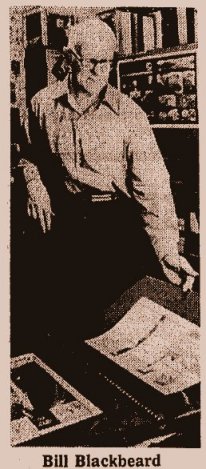
Photos top to bottom:

“Comics, cartoons win favor in collection” Montana Standard 13 Dec 1970
“12-Room House is Crowded Comic Museum” Capital Times 21 Jan 1972
“He sets up academy for laughs” Evening Capital, 16 Feb 1981
***A great interview from Jeff Levine's Destroy All Comics no. 3-A, dated August 1995, HERE.
***Bill Blackbeard, disguised as Popeye, in his own strip HERE.