|
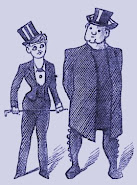
| 1 [1898] The Bee, Vol. 1, No. 1, May 16 |
“He is much given to exploration and adventure.
Has prospected and operated mines throughout the northwest; broken the world’s
records in a gas balloon; constructed and operated aeroplanes, and killed all
manner of big and small game in North and Central America. He is an expert
horseman, and an expert rifle, pistol and shotgun man.” – Cartoons Magazine,
1915
 |
| 2 [1906] John Campbell Cory portrait |
JOHN Campbell Cory was born
September 11, 1867, in Waukegan, Illinois to Benjamin Sayre Cory, Jr. and Jessie S.
(MacDougal) Cory. There were six children. The first child, Benjamin Sayre III
(1865-75), died of scarlet fever at the age of 10. Next was John Campbell Cory,
two years younger than Benjamin. Robert MacDougal Cory was born on August 24,
1870, married , and was working at the East Helena Smelter in Montana by 1897.
Agnes L. Cory was born
September 1, 1872, and died in New Jersey in November 1900. John Campbell Cory's sister Fanny Young Cory was
born at Waukegan in October 1877. She was married to Frederick Cooney at Helena,
Montana on April 12, 1904. She had 4 children, one of whom died in infancy. Fanny Young Cory’s famous King Features comic strip Little Miss Muffet ran from 1935 to 1956. She died July 28, 1972.
 |
| 3 [1930] Fanny Young Cory |
“My early interest in art began with intense
admiration for my brother Jack. It was he who made possible the instruction I
received in the Metropolitan School of Art in New York and also at the Art
Students’ League. By the time I was 19 years old I was earning my own way with
an occasional lift from him.” – ‘My Own Story by Fanny Y. Cory,’ Indianapolis
Star, 1930
The sixth child was son McKenzie Cory who was 2 months old in June 1880.
 |
| 4 [1906] Us Fellers, written by Izola L. Forrester |
There was one other
cartoonist in the family. He was a cousin, Benjamin Cory Kilvert (1879-1946), from the Canadian
branch of the Cory’s. He was close in age to Fanny Young Cory and may have drawn inspiration from his uncle’s career. He was an illustrator of children’s books, newspaper supplements and magazine articles. In 1908 he drew a full-page comic strip called Muffy Shuffles about a poor city girl trying and failing to hold a variety of jobs. Other comic strips were Buddy Spilliken’s Diary (1908), and Dorothy and the Killies (1914-15). As B. Cory Kilvert his cartoons appeared in the New York Herald, the New York Journal, Hamilton (Ontario) Spectator, and Life magazine.
 |
| 5 [1908] Muffy Shuffles, June 14 |
The fine artist and photographer Kate Cory (1861-1958) was also related to the Cory’s.
John Campbell Cory’s first known employment
was as an architect’s assistant in Chicago in 1881. In 1882 he was employed as
same, this time in New York City. Cory was residing in Indiana in 1884 where he
worked on a farm for two years. Then he began working as an animal illustrator,
specializing in horses. He worked for some time on the Western Horseman, a
periodical published in Indianapolis and contributed to livestock and turf
periodicals.
By 1889 he was in Chicago
working as a newspaperman. John Campbell Cory married Bertha Pollock of
Milburn, Illinois, February 14, 1890, at Chicago, Cook Co., Illinois. They never had any children. In
1897 he was working in the horse-racing department of Hearst’s New York Evening
Journal and was soon drawing political cartoons for the publication. Cory
claimed to have no political affiliations.
In May 1898 Cory left Hearst
for a short-lived New York color comic weekly called The Bee. He was the owner, chief
cartoonist and managing editor. His uncle Charles Dickinson Cory was business
manager. The Bee ran to twelve issues from May 16 to August 2, 1898. It was discontinued in the fall and Cory joined the staff of
Pulitzer’s World as a cartoonist. In 1898 he drew a feature called The Funny
Side of Life in Montana. He was the “star man” in the Sunday World’s New Comic
Weekly, edited by Geo. W. Peck (Peck’s Bad Boy,) that began in December 1900.
 |
| 6 [1901] The World, January 15 |
In 1901 J. Campbell Cory was the Vice
President of the New York School of Caricature. Cory drew sequential gags for
the New York World from an address in New Jersey, spent some time at Waukegan
Lake, Illinois, and then visited relatives in Helena, Montana in 1901.
“I like the (mining) business, and having paid
the price for my education in that line, it is my intention some day to resume
operations with pick and shovel.” – ‘J. Campbell Cory, Cartoonist,’ by B.O.
Flowers, The Arena, No. 194, January 1906
By 1903 he had taken a
residence at Helena where he lived with his father (mother Jessie had died at
Waukegan in 1888), brother Robert, uncle David, and cousin James Warren Cory.
The 1903 Helena City Directory lists J.C. Cory as President of the Knickerbocker
Development Company. On June 19, 1903, The Northwestern Exploration Company,
with offices in Manhattan, was incorporated with $200,000 capital. J. Campbell
Cory of Helena, Montana, was one of the directors.
 |
| 7 [1903] Columbia Courier, June 12 |
“Deer
Lodge County: Knickerbocker Mining Company. This company, comprising Mr. Cory
and associates, is operating mines near Beaver Creek, across the Missouri River
from Helena, and is shipping high-grade copper ore.” – Engineering and Mining
Journal, August 8, 1903
In 1904 the Engineering
& Mining Journal reported that “The Standard Ore Co. is in control with J.
Campbell Cory at the head.” The same year the Helena Directory listed J.C. Cory
as President and general manager of Sun River Mining. He was residing at the
Monticello, presumably a hotel.
 |
| 8 [1905] The World, April 17 |
Sometime between 1903 and 1905
J.C. Cory was employed as a “picture drawer” on the Butte Miner. It was probably at
Butte that he began his association with the comic writer Berton Braley, at
that time a well-known Montana newspaperman. In spring 1905 he left Montana for
New York’s World newspaper where he stayed until the following spring of 1907. Earlier,
on March 31, 1906, he had been granted US Patent no. 849,600 for a Golf Ball
Marker.
 |
| 9 [1908] The Golfer’s Magazine |
In the spring of 1907 he
organized an expedition to explore territory 800 miles north of Vancouver,
British Columbia. He was leading a group of “prominent financiers” through the
wilderness in search of land, mineral, water and power rights. The Panic of ’07
left him busted and he returned to New York. Cory was member of New York’s Rocky
Mountain Club, formed for residents and former residents of the Rocky Mountain
States in 1907.
 |
| 10 [1908] The Golfer’s Magazine |
“His next venture was in publishing The Great
West, a monthly publication which he started in 1908. In June of that year he
became cartoonist with the Cincinnati Times-Star, and it was during the period
of his work with this paper that he began making amateur balloon ascensions. In
June, 1910, (residing in Hamilton, Ohio) he made a flight of six hundred and
thirty-five miles in ten hours in a gas bag which, unofficially, broke balloon
flight records of that day.
He remained with the Times-Star for eighteen
months and then became identified with the Scripps organization. His cartoons appeared in the Scripps publications from 1912 to 1914.” – History of
Colorado, Denver: Linderman Co., Inc., 1927, Vol. 4, p.502
 |
| 11 [1912] cover of The Cartoonist’s Art |
J. Campbell Cory’s 1912 book The Cartoonist’s Art (Chicago: The Trumbo Co.) was reprinted in 1920 (New York: The Prang Co.).
 |
| 12 [1912] advertisement for The Cartoonist’s Art, November 23 |
In February 22, 1913, Cory
departed for Colon, Panama. His cartoons appeared with text by “Uncle Dud,” a
nom de plume assumed for his well-known baseball columns. The Tacoma Times
described Panama as “America’s ditch” and “the place where the American nation
is CUTTING THE THROAT OF A HEMISPHERE.” His acquaintance Berton Braley also
made the trip to Panama and on their return the two men teamed up for an
illustrated poetry newspaper feature. On March 29, 1913, Cory was in Washington
studying the wildlife for a feature entitled Who’s Who in Wilson’s Cabinet.
 |
| 13 [1913] Tacoma Times, February 3 |
The September 1913 issue of
Printer’s Ink had this announcement:
“Cartoons and advertising
are to be combined by the Cory Cartoon Advertising Service Company of Chicago.
The incorporators are William B. Fitzgerald, Melanie Malzen and J.F.
O’Donnell.”
 |
| 14 [1915] March 22 |
The death of Cory’s father,
Benjamin Sayre Cory, was reported on October 19, 1913, in Chicago. In 1914 J.C. Cory was
residing at Chicago, Illinois. A notice posted in Fourth Estate: A Weekly
Newspaper for Publishers, Advertisers, Advertising on February 6, 1915, stated “Jack
Cory, for years on the New York World, is now illuminating the Chicago Herald’s
front page by his cartoons.”
“During his nomadic career, Mr. Cory has
succeeded in breaking his nose six times in as many different ways, with the
cumulative result that it is not much of a nose to look at any more, but as he
complacently observes, ‘there’s enough nose left to break at least once
more.’” – Cartoonists Magazine, 1915
 |
| 15 [1915] Cory’s Kids |
By March 1915 Cory was
drawing a comic strip titled Cory’s Kids for the McClure Newspaper Syndicate
and was staff cartoonist on the Chicago Herald. A 1917 advertisement in
Cartoons magazine advised “In writing to J. Campbell Cory address in care of
The Publisher’s Feature Bureau, 417 South Dearborn Street, Chicago, Illinois.”
 |
| 16 [1918] The Shenanigan Kids |
Starting on September 10,
1918, Cory ghosted Rudolph Dirks’ daily The Shenanigan Kids comic strip. From
November 1918 until his death Cory was cartooning for the Rocky Mountain News
and the Denver Times. He was a member of the Denver Press Club and with Perce
Pearce of Chicago founded the Denver Academy of Applied Art (1920) which taught
commercial and fine arts.
 |
| 17 [1920] The Denver Academy of Applied Art |
Cory died November 25, 1925, in
Denver, Colorado, and was buried in Milburn Cemetery at Milburn Illinois. He was
58 years old. A Memoriam from an unnamed source was quoted in the History of
Colorado, Denver: Linderman Co. Inc., 1927 –
 |
| 18 [1920] The World, January 29 |
“Like all great workers in this field of art his
becoming a cartoonist was a gradation from the artist, the humanist in him
stirring for expression. He became a cartoonist because of his sense of humor
and because he could use the cartoon so effectively in attacking wrong things –
and Cory at the bottom of his heart was a crusader. He hated wrongdoing and his
sympathies were with the weak and undefended. In his day, a full generation
ago, Cory stood at the very head of American cartoonists and his cartoons
became part of national political history.”
 |
| 19 [1906] The World, January 11 |
The Bee cover image courtesy Richard Samuel West at Periodyssey.
Cory’s Kids page courtesy Alfredo Castelli.


 Posts
Posts