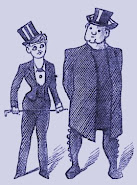
In the 1890’s star cartoonists and humorous writers worked hand in hand. Walt McDougall supplied comic illustrations to Bill Nye’s newspaper columns while M. Quad’s humorous columns featured the fine ink work of C. E. Toles. Caption and comic strip artists were also in high demand as illustrators of hardcover books by the famous humorists. Frederick Burr Opper, W. M. Goodes, E. W. Kemble and A. B. Frost all illustrated books by the leading humorists of the day.
Many of the humorists mentioned in Walt McDougall’s article The National Joke can be sampled on Ron Evry’s old time radio podcasts. Ron is an avid researcher who has dug up many obscurities by the best humorists of the nineteenth and early twentieth centuries. Narrator Ron’s latest is a reading of James M. Bailey’s (The Danbury Newsman's) story “An Accommodating Reporter,” Basement Episode #1414, which incorporates some McDougall HERE.
The Weekly News and Courier, Wednesday morning, March 4, 1896.
THE NATIONAL JOKE.
WALT M’DOUGALL DESCRIBES THE FAVORITE JESTS OF THE RACES.
The Slam Bang Joke That Is Popular In England -- Rough and Tumble Humor In America -- The Popular Thing In France and Germany -- The Jokes That Never Die
The common notion that the humorous or funny bone is the natural seat of humor in the human body is erroneous, but as man is the only animal generally addicted to the practice of jesting and fitted with a funny bone there may be something in the theory. Some dogs and most monkeys possess a misty sense of humor, it is certain, and there are men, some of them editing funny papers, who have as confused a sense of the comical as these lesser animals.
Humor itself is a subtle, ethereal essence that was divinely imparted to a few rare souls to enable them to truly perceive measure and judge the value of the things of this life and shed the electric light of a higher wisdom upon them for the proper guidance of the less gifted. Humor is the sense of proportion exaggerated. It is the last, best gift to suffering man. It is a mascot that works nights, a poultice for pain, a balm for aches, burns, chilblains, malaria, insomnia and bankruptcy. It turns a bore into a jeu d’esprit and a piano next door into a celestial harp. If used in moderation, it is a blessing, but when carried to excess it biteth like a serpent and stingeth like an adder. Hail to it! Long may it reign!
Humor has evoluted from a physical fact to a mental exercise, from a chance luxury into an actual necessity. Its primal source was exemplified in pain and trouble, its origin being the mirth evoked among savages at the sight of distorted or crippled humanity. A hunchback or a clubfooted man even today is a huge joke among barbarian peoples. In their uncultured eyes he is quite as humorous as one of Zim’s pictures of a colored man being kicked in the stomach by a long legged cow or Francis Wilson in comic opera. Savages find vast amusement in witnessing a captive burning at the stake. They really keenly enjoy a torturing bee, and an Eskimo has been known to laugh gleefully at seeing his wife in the embrace of a polar bear. Time brings its revenges, however, and today the humorist is the victor, not the victim. He tortures his audience and goes home to laugh as he counts the proceeds.
To the deep thinking mind there is something saddening in the thought that humor is even of pain, but it is, alas, too true. “Humpty Dumpty” and “Punch and Judy,” both old comedy effects, testify to this creation of laughter by the misfortunes of others, and it underlies many of the comic effects of today.

Ghosts of Dead Jokes Haunt Us
Students of this interesting subject have long and earnestly searched for the original funny man, the one who is to blame for all the puns, jokes and quips now strewn knee deep along time's pathway, but he is lost in the foggy background of antiquity. Peer into the dim past, haunted by the ghosts of those who jested before the alphabet was invented, and yon will see the already aged spooks of the mother-in-law, the bulldog, the pants seat, the William goat and the baldhead joke, as well as many, many others. These jests were uttered in tongues now dead and forgotten, but their spirits still live.
And yet the original joker must have existed. I mean the first jester, not the practical joker, who was a simian prototype, but the man who by comically reciting his own misery made others laugh and who became a favorite at mastodon or cave bear banquets and had delicate morsels of marrow sent him by his admirers. His Paleolithic gags are still lying in wait in back country taverns, and each generation finds them new and funny, and nations yet unborn are awaiting them in the silence of the hence. This prehistoric jester was the father of humor, just as his boon companion who carved on reindeer horn or mammoth tusk was the father of art -- the first men who took an optimistic view of life.
The striking feature of the jests of antiquity, when we come within the historic period, was in their primitive coarseness, even obscenity, which is generally laid to the rudeness of the age. The ancient joke was quite décolleté at both ends. It is a sad commentary to know that one of our greatest and most prolific humorists has remarked that “the funniest and wittiest things unfortunately could not be told in decent society.” Every classic work has some well meant attempt at humor which probably served its purpose. Even Greek and Egyptian mythology had lists of the practical jokes of the gods themselves.
The Bible is probably the only work that lacks a humorous element -- that is, of deliberate purpose. The semireligious plays of mediaeval times were more than half buffoonery of the coarsest, lewdest sort, and quite until the beginning of this century humor had a decidedly ripe flavor indeed, and such of it as was printed is now read and kept where the children cannot get at it.
It is a fact; moreover, that popular humor must smell of the soil, so to speak, even now. Perfume it, and its aroma evaporates; polish it, and it is dull and pointless. It must still carry the element of buffoonery, even if it sometimes grates on refined ears, and bear the pang of suffering somewhere in it for somebody.
The Good Old Jokes.
To the mass of the people, the great body of nonthinkers, the old, old joke is ever precious. It is greeted again and again with laughter and applause, and no matter how changed in dress or altered in expression it still goes. It seems a contradiction to add that it goes because the majority of people cannot remember a humorous remark more than a few days, and the dear old joke, with its long, mossy whiskers, seems new to most of them.
One may hear today upon the variety stage the same old “gags” that our fathers roared at 50 years ago, and in the comic papers of this week read the jokes that broke up homes in Aryan mountain regions before the dawn of letters and caused the prophet to ask the conundrum : “O grave, where is thy victory? O death, where is thy sting?”
There are styles in humor. To one who has studied the subject distinct geological eras mark the growth of funny sayings. From the dwarfed court jester of the dark ages, with his cap, bells and bladder, to the funny man of the comic press is seemingly a long step, but the interval has been filled by the coffee house wit, the stage comedian, the circus clown, the minstrel end man, the lecture bureau entertainer, the traveling drummer and the comic artist. To us in this enlightened age it seems funny of itself that at one remote period men and women laughed at conundrums. That was all they had to be hilarious with.
Then came the age of puns. Once a punster was the equal of kings and popes. He had free passes on the stagecoach and to the theaters. People stopped conversing upon religious or political topics and held their breaths when he was about to emit a pun, and his clever sayings were repeated all over town, generally as original with the repeater. He led conversations and led them up to its puns, and he was not shot or even indicted.
England today is the last refuge and stronghold of the pun. There it still wields a feeble sway along with other effete institutions, like imprisonment for debt, Dunraven, etc., but elsewhere it has been stamped out and branded as a crime or misdemeanor.

Samples of English Humor.
There are, however, in England several humorists who are of a more advanced type, whose productions have something of the liveliness of the American spirit. W. S. Gilbert and Jerome K. Jerome often have spasms of fun that seem to be spontaneous and unaffected. Even Punch of late has flashed a spark or two of sedate merriment. The following sample serves to illustrate the assertion. An obsequious curate is pictured as breakfasting with his bishop, who remarks:
“Why, my dear Mr. Stiggs, I really think you have a bad egg there!”
“Oh, no,” the curate replies; “parts of it are very good, I assure you.”
Now, that's not bad for Punch, you know.
But I digress. The punning period was followed by that of humorous writings like “Sam Slick,” the “Biglow Papers,” “One Hoss Shay,” “Darius Green,” etc., true humor which took all hearts by storm. I am now speaking of American humor, of course. This was, properly considered, the beginning of the present era. It was the period begun by John Phoenix continued by Artemus Ward, Bret Harte, Mark Twain, Bailey, the Danbury News Man; Bob Burdette, M. Quad, Eugene Field, Bill Nye and a host of others, each in turn taking the popular fancy.
The essential quality of these various writers cannot be strictly and distinctly specified; one cannot lay his finger on the particular distinguishing feature of each, but while these authors are distinct in themselves there is a generic air that marks them, as of a family, the product of American soil and environment. With but few exceptions their work is humor pure and simple, satire being lacking until the bloom of their youth had passed and they had entered into other literary fields or had heard their own stories told as original by several thousand other humorists. Each had his own distinct era, being for a time as popular as a new puzzle or a patent cough mixture until another came who by a fresher combination of words and circumstances eclipsed the glory of his predecessor and made his methods seem stale.
Such work as was essentially good or truly novel, such as the “Squibob Papers” of John Phoenix, Harte's “Condensed Novels,” the “Biglow Papers,” “Carroll's Semi-Idiotic Verses” and others, to say nothing of some stuff that I intend producing when I get time, will probably endure as classics, to be studied when the humorist is properly recognized as the most enlightened, advanced and gifted of men. In that period he will be selected as the best fitted to grace high offices and will control the destinies of mankind and lead them to heights now undreamed of. This will occur when we have outgrown the idea that the lawyer is the sum of human achievements and the man best qualified to advance human interests.
The Passing of Certain Humorists.
I n looking back over the periods of popularity of each humorous writer it is curious to note that each stood alone for a time without a rival and held the stage with his audience in convulsions of mirth until a fresher comedian stole his laurels by a newer juggling of phrases. We can all recollect when Mark Twain's humor was the only true metal, all others being spurious or plated goods, and how all the world roared at “Innocents Abroad.”
Things went then as humor that now would attract the attention of the grand jury.
I remember -- and I am younger than most people suspect who have judged my age by the vast wisdom that permeates and exudes from my work -- I remember, I repeat, that the joke about the man who left a placard on his beer, stating, “I have spit in this,” and returning found thereon another line, adding, “So have I,” was a joke to set the table in a roar-in the most refined society. We now consider this joke somewhat passes, and allusions mal de mer are regarded as vulgar. It is a sample of the humor of that not very remote period, and even this is preferable to the conundrum or the pun. Also in this connection it is lamentable to observe how sadly lacking in humor now and how pointless, even melancholic, seem most of the button bursting and side splitting productions of those erstwhile favorites like the Danbury News Man, whose sketches were considered at the time the funniest ever written; of Ten Eyck White of the Chicago Tribune, whose “Lakeside Musings” were copied about 1883 into every paper; of the Texas Siftings’ southwestern jests, which, with .those of the Philadelphia Call, the Burlington Hawkeye and later the Detroit Free Press, kept the original “humor columns” of every country paper crowded to repletion.
The steady outpourings of these gifted humorists soon made their technique familiar, and weak imitations, warranted “just as good,” were produced by the local funny man in every village sheet. It is quite easy to acquire any particular style of humor after its creator has produced enough of it to make the brand familiar, just as it is easy for a man who can draw well to imitate Zim’s, Hengler’s, Caran d’Aches’ or Chip’s pictures as far as the mere handiwork is concerned. The soul only is lacking.
And all these men have created such a hunger and thirst for humor that in response to the demand there are now thousands of jesters, and a humorists' union is now proposed to keep prices up. With the increasing facilities for acquiring the art, when jesters are popping up on every side and humor rapidly becoming an actual necessity, it is a serious outlook for the old hands, for humorists threaten to become as numerous as the writers of decadent novels.
The germ theory might explain the increase of funny men very satisfactorily. Perhaps the bacillus of humor, once rare and ill adapted to its surroundings, has found its natural field and has increased inordinately under favorable circumstances in the blood or mayhap in the brain of man. This would account for the phenomenon.

Four National Types of Humor.
There are four natural, fundamental types or sources of national humor, as far as I am aware. There may be others, but of these I am sure -- to wit:
The English idea. This is primarily a pugilistic encounter, a slam bang set-to. A variant or outgrowth of this idea is the “Humpty Dumpty,” “Punch and Judy,” split stick and knockabout art as seen on the variety stage. It is the Ally Sloper kind of fun today, largely entering by various devices and changes into British popular fun of all sorts.
The American primal idea is that of a man being kicked over a fence by a mule. Now, don't smile, but ponder. The billygoat’s sudden onslaught, the dynamite joke, the banana peel's treachery, the hole in the ice joke, the bicycle catastrophes and a hundred others are all drawn from this fountain head. No other nation is jocular upon the subject of death, the least humorous event in a man's career. In Weary Walker's comical misery and the dweller in Lonesomehurst’s troubles the “kick” is the source of the fun.
The French fundamental root is the comic appreciation of marital infidelities, the disclosure of a man involved with another man's wife, or vice versa. This has been a most prolific source of Gaulois merriment from time immemorial and very successful in increasing the gayety of that joyous nation. It is presented in a hundred thousand ways, but they are all traceable to this foundation. The mere fact of a wife's unfaithfulness is somehow comical to your true Frenchman.
The German basic idea is less easy to describe, being more complicated, but it may be summed up as being largely connected with the acts of eating, drinking and digesting in various forms. It is a substantial, meaty, beery and material form of humor, and it also is of a more pliant and versatile nature than any of the others, admitting of more variations and extensions than any of them, I imagine.
Of Spanish or Russian humor I am as ignorant as of Zulu or Chinese, although I am informed by eminent linguists that all these nations possess very excellent brands, but I suspect from a casual glance over a Russian newspaper that the humor of that nation is still in the state of pun making. Russian and also Norwegian names indicate a tendency toward a rash and unguarded use; or rather misuse, of the alphabet, and this of itself would lead to a free handling of syllables and words, and thus tend to the making of puns.
The Up to Date Jest Is Brief.
The chief quality of the latter day jests is briefness, The art of condensation has been acquired, and in comparing the humor of this year with that of a half century ago the distinguishing feature is seen to be in the latter's terseness. Lowell's humor in the “Biglow Papers” is smothered in a mass of erudition. Phoenix’s, Artemus Ward’s and Mark Twain’s humorous thoughts were long drawn out and much involved, but today we get; our fun in. homeopathic doses in most instances. Conciseness has added to its flavor as well as made the art more difficult, perhaps.
A half century ago it took quite a page to frame a bon mot in suitable wording. Like a diamond ring in a wedding cake, you had to dig it out. Now it is set solitaire. Even Mark Twain grows paragraphic when he says that “the Arabs will take anything but a joke.”
This is perhaps due to the fact that the pecuniary rewards of literary work are greater than of yore. It was all very well to incumber a jest with a wreath of words when a writer received 50 cents per page, but now, when jokes -- even feeble little witticisms about the new woman -- sell at $ 1 each, it is different. When a farmer with a facetious mind can bundle up a dozen paragraphic quips of a morning and mail them to a metropolitan comic weekly and receive a check in return, it is plain that times have altered.
Pictorial humor has helped toward this terseness of expression, Sullivant’s picture of the hippopotamus and her baby, ear deep in water, illustrates this. The mother, awakened, says:
“Well, what do you want now?”
The baby answers, “I want a drink of water!”
Comment is needless.
It pays well. On looking over the field of acknowledged humorists, past and present, one observes, with deep, calm satisfaction, that they have all prospered. Even away back in the days of literary poverty Hook, Steele, Smollett and the rest of them lived on the fat of the land, even if they didn't own real estate. Artemus Ward, Derby, Harte, Bailey -- all made lots of money. Mark Twain failed for over $1,000,000 and is coining another fortune in Australia. M. Quad, Bill Nye and the rest carry around fat bankbooks and open wine on every possible occasion.
The reason a humorist acquires wealth is that he is of a simple, pure nature, without acquired, vicious tastes, like a yearning for steam yachts, race horses, diamonds or pate de foie gras, and he just soaks his money away where moths do not corrupt and it never is disturbed except for charitable purposes.
All humorists have quiet, simple tastes as regards living and dress. I never saw one who knew the correct number of studs for a dress shirt bosom or who could make a salad dressing, but they can all, without exception, draw up a cast iron contract, and no one ever sold a gold brick to a professional funny man. This is authentic.
WALT MCDOUGALL
*Many thanks to Leonardo De Sá for all his help with transcribing this post.


 Posts
Posts