Showing posts with label TAD Dorgan. Show all posts

Thursday, December 7, 2023

The Great Horse Hoax –

 LEO CARILLO

‘The First Reader’, by Harry Hansen, The Pittsburgh Press, August 13, 1943

Horseplay doesn’t get much attention in this soberly serious town nowadays. Practical jokes are considered amateurish and foolish antics, symptoms of a fading mentality. A man can’t stand on his head in front of the Public Library without giving his wife grounds for divorce. Obviously, we have grown up, but the crazy cavorting of the old days must have been fun for spectators.


Leo Carillo, Variety 20, 1910

I don’t doubt that one of the liveliest of hoaxes was that of the horse lost in the subway, which Harry J. Coleman, the veteran newspaper photographer, describes in his rambling and rattlety-bang reminiscences, “Give Us a Little Smile, Baby.” This happened in 1903, a long time ago, surely, but as important to some people as Washington’s farewell in Fraunce’s Tavern and the Big Blizzard that tied up the Long Island Railroad. The horse, as Harry Coleman describes it, was the invention of a vaudeville comedian named Leo Carillo, who could imitate the call of a wild stallion on the lone prairie, hitherto unheard in the New York subway.

Leo Carillo, Variety 18, 1910

You have to take into consideration two elements now missing: the practice of making the rounds of “the better bars,” which was being built and there was Harry Coleman and the two cartoonists – TAD and George Herriman, and the fact that the subway was just being built and there was every likelihood that a horse might fall into it. TAD and his pals put on an act at a subway tunnel and Carillo bellowed and neighed, and soon a crowd collected. “The police reserves arrived with ropes, ladders, and sappers.” Shovel bearers arrived from the white wings. The fire department arrived with ladders. It was early dawn and there were plenty of alcoholic celebrants afloat. Carillo sped up and down the subway whinnying and neighing.

Its one of those stories that gains in the telling, and at the end Coleman says the scene was “an inextricable mass of fire department equipment, police squads, milkmen, and drunks, all engaged in the largest horse hunt in history and the most frustrated.

I am not one to deny that it happened. I wasn’t there. Moreover, Coleman is yarning about the exploits of the past, and that’s good even in these days, when drinks come high. In that day, long ago, when “drug stores sold drugs,” TAD (He was the late Thomas A. Dorgan) was quite a joker.


Monday, December 4, 2023

Cartoonist Quotes –

THOMAS ALOYSIUS DORGAN 

"TAD" [1877-1929]

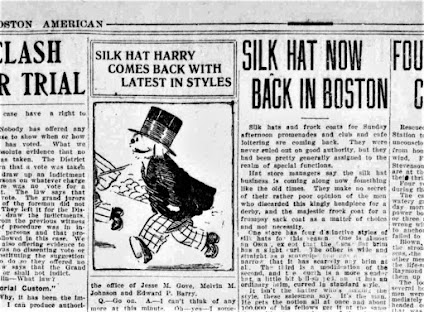
Silk Hat Harry's Divorce SuitJuly 3, 1913

“I started ‘Judge Rummy,’ ‘Bunk,’ and the other dogs during the trial of Harry Thaw; they sort of ‘kidded’ the case and became popular. I have been drawing these characters ever since. The 'Indoor Sports’ I thought of about seven years ago (1912), when I was confined to my home with rheumatism. I thought what a lovely indoor sport it was, this sitting around the house looking llke the wreck of the Hesperus. Other indoor sports suggested themselves and this series has been going on ever since… I might add that It was Judge Rummy who first called the Ford car a “flivver.” – TAD Dorgan, ‘Are Cartoonists Doleful?,’ The Sun, May 25, 1919

It was reported in the Boston Sunday Post in 1929 that Dorgan’s “Indoor Sports” was syndicated to 20,000,000 readers daily. His salary was well over six figures yearly…


Wednesday, February 1, 2023

AMONG THE NIGHT BIRDS –

 Coulton Waugh, NY Tribune, Sept 22, 1918 

Leon Trotzky, the Russian foreign minister who is trying his best to perpetuate the Harry Thaw of Potsdam, is well remembered among the night birds at Jack’s restaurant. He used to appear there with Benjamin De Casseres, the poet. De Cessares found Trotzky in “The Gilded Snake,” in West Eighth Street. He introduced him to Frank O’Malley, Tad Dorgan and other Bohemians. Trotzky was like an elephant in a toy store and bucked around proclamating himself. He wore one pin, a Waterbury, and had twelve cents. He is known to have borrowed 8 cents from Jack Francis, a Broadway press agent, to buy a haircut one night in one of the dingy 8 cent hair-cutting places. He drank rum, cursed Wall Street and smoked innumerable foul-smelling Russian cigarettes. This is the man who is now trying to be president of the planet. Washington Herald, Jan 18, 1918


Friday, June 17, 2022

Jack’s Sporting and Literary Society –

 THE NIGHT THEY BUMPED OFF HERMAN ROSENTHAL.

by John Adcock

Boardman Robinson, New York Tribune, July 20, 1912

“We take him to a dago joint down on the east side and let him eat a lot of ravioli and listen to the wops. He always got a kick out of that… then we take him up to the McAlpin and set him up in a window on the top floor where he can look straight up Broadway. He just sits there and looks at the lights and traffic and talks about the old mob up at Jack’s café.” — Ike Dorgan about his brother’s last days, to Westbrook Pegler in ‘Death Claims Tad Dorgan, Phrase Maker’ in the Chicago Tribune, May 3, 1929

THE ROARING FORTIES

The term “roaring forties” designated both a region and a glamorous era in time specific to New York. Geographically they started (roughly) at 40th Street and extended northward on Broadway to 42 Street and on to 50th Street. Damon Runyon recalled

Twenty years ago, the era of the Roaring Forties was commencing to pass. It had succeeded the era of the Gay Nineties and the Broadway South of 42nd street. Some of the Gay Nineties lapped over briefly into the era of the Roaring Forties, as one area always laps over into another for a spell. Lillian Russell, “Diamond Jim” Brady, the Hoffman House, Martin’s, Sherry’s, Delmonico’s, Shanley’s and Mouquin’s still were going concerns and bright memories of Manhattan Island.

The Roaring Forties era brought on the glamor, that was to become tradition, of the Knickerbocker hotel and Enrico Caruso and Jack’s restaurant and the Hippodrome and Murray’s, with the revolving glass dance floor, and the Castle’s and Healy’s and Releenweber’s and the Follies and Churchill's and Rector’s. It was the era of Wilson Mizner and Irving Berlin, and George Cohen and of the Harry Thaw trial and the Herman Rosenthal murder and the old Waldorf. – ‘The Brighter Side of News,’ Damon Runyon, Times-Union, Oct 3, 1939

THE PRINCE OF REPORTERS

O’Malley was known around town simply as “O’Malley of the Sun.” Despite the veil of anonymity — the old Sun did not use “by-lines” — O’Malley became widely known as a reporter and humor columnist. The brilliance of his style identified him to all who commonly read the paper. O’Malley’s reign as the prince of reporters began in 1906 and ran on until 1920, when he resigned to contribute to magazines and publishers.

Frank Ward O’Malley, Tad Dorgan, Hype Igoe, Benjamin DeCassares, Wilson Mizner, “Spanish” Jack O’Brien (cable editor on the old NY Sun), Tom Geraghty, Ring Lardner, Damon Runyon, George Luks the cartoonist, Stuffy Davis, Jim Huneker of the Sun, Vince Barton, and Jack Francis were members, some regular and some on the periphery, of ‘Jack’s Sporting and Literary Society’ who met at Jack’s restaurant with its famed Battling Nelson grill during the Roaring Forties.

That was a year—1912—notable for many things. So much happened that our great major Broadway sport of all night discussion and tableside debate hit a new high for all time. For one thing newspaper men will tell you that 1912 was the greatest year for news in journalistic history, at least in variety. Early in the year the Titanic went down, one of the very greatest news stories of all time. Then, just before 2 o’clock the morning of July 16 gunmen procured by Police Lieut. Charley Becker murdered Herman Rosenthal thereby beginning a murder yarn that held the front-page attention of readers for months. – ‘Back on Broadway – Golden Era of Indoor Sports,’ Frank Ward O’Malley, Buffalo Evening News, Aug 23, 1930.

Hype Igoe, 1938

Hype Igoe was a cartoonist and sporting columnist on the staff of the San Francisco Examiner. The year following the earthquake he came to New York and worked on the New York American’s art staff for a few years, thence to New York Sun as a writer of boxing, later to the Tribune, and finally a member of the World’s sports staff. Igoe was on the scene of the Rosenthal killing:

THE NIGHT THEY BUMPED OFF HERMAN ROSENTHAL

‘O’Malley Greatest of All, Igoe Tells Bill Corum,’ Albany Times-Union, New York, Nov 30, 1932

Dear Bill Corum: When Frank Ward O’Malley passed on in Paris a few weeks ago, I got me the sinks. Sad, because Time, greatest of all the line buckers, had taken another of the disappearing old guard.

I don’t know that you ever knew him. Not to have been in his company at some time or another in your newspaper career was to have missed a gentle genius of his kind. Our (Arthur) Brisbane always called him “the greatest reporter in the world.” Chronicling was only one of his sidelines. He played at being a human being better than anyone I had ever met. He wrote with tremendous sweeps of English, yet each line seemed leavened with the sweet wit which dominated his soul.

For twenty years or more O’Malley, with Tad (Dorgan), Ben De Casseres, Wilson Mizner, “Spanish” (Jack) O’Brien, Harry Pollock, Vernie Barton, Corse Payton, Jack Francis, Arnold Rothstein, Jack Shaughnessy, Freddie Griesheim, and the bold bad boys of “wire tapping” and “the boats,” made Jack’s eating and drinking shebang our ole swimmin’ hole. That was before the camel prohibition came.

Herman Rosenthal

Bill, the night they bumped off Herman Rosenthal! It was maddening in the whirl of its excitement. Charley Meeghan, the then sports editor of the Morning Telegraph, and myself, had sauntered into George Considine’s New Metropolis, in 43rd, to gas and read “copy” on Charley’s printed story of a bout we had just seen in old Madison Square Garden.

Charley had wired his story from the ringside and here we were, 20 minutes later, reading it in type that couldn’t have been cold in the printing.

Charley, who is no more, Bill, looked up and said “Great age, Hype, great age. The fight isn’t half an hour old and it–” Charley never finished that sentence.

Bang-bang-, bang, bang, bang!!!

Five shots, Bill, two fast, then three.

“Backfire, Charley?’ I said.

“Backfire, hell,” said our waiter as he did a standing, sitting dive under the table. Before he disappeared, he pointed one long great cloud of powder reeking finger at the big open window. A smoke was floating into the room.

With the five shots came the piercing voice of Artie Hall, a famous blues singer. She was sitting at a table with Billy Atwell and Lieutenant File of the police department. From a rear seat, facing the door, Artie Hall had jumped to her feet and hit high C in a scream which still rings in my ears.

Miss Artie Hall, June 1900

File, in light civvies, his back to the door, whirled around, whipped out a long blue service gun and was through the door like an antelope. They brought him up on charges of negligence afterwards and Charley and I testified on his behalf. We told how he had gone “out in the smoke” not knowing what fate had in store for him.

Charley and I ran to the front door. A figure lay sprawled on the sidewalk, face downward. The fallen man’s right hand was stretched out full length and between the first two fingers, standing straight up, there was a half-consumed cigar. A little ribbon of blue smoke curled upward from it, which through some strange miracle, had not been disclosed from the man’s fingers as he crashed, stone dead, to the sidewalk. The maddening whirl in its beginning!

“Herman. It’s Herman,” whispered big “Judge” Crowley.

“Herman who?” I asked.

And from over my shoulder came the answer- “Herman Rosenthal, by God!”

I whipped around and there stood Frank Ward O’Malley. Always the “greatest reporter.” He had beaten Swope and Hill and the others in from the ole swimmin’ hole. He hadn’t waited for night editor’s orders. He had started with the first crack of the four gunmen’s gats. Indeed, a reporter, Bill.

Charles Becker

The strange death watch we kept in Jack’s that night. Becker was electrocuted for that slaying. O’Malley had gone up to Sing Sing as our and the old Sun’s representative. As the dawn came, we, Mizner, Tad, De Casseres, O’Brien, Payton, Barton, (Arnold) Rothstein, old Jimmy Wakely, Francis, Shaughnessy, (Jack) Dunstan himself, Henry M. T. Beekman, the great barrister, who coined the famous “old age is the death of enthusiasm” line, myself and one or two others, sat around a big table with our watches in the palm of our hands.

Each, in ghastly fashion, was trying to picture what Becker was doing. What his last moments were like. Each trembled in the strange excitement of that weird death vigil. Three minutes to go and it would be 5:30 of the morning, going away time in the big house in those days.

O’Malley came with the story. We clung to his Poe-like tale as ivy to an old oak. Bill, you’ll probably remember that Becker collapsed so pitifully that they asked a Negro companion in death to “wait on Charley.” Charley’s nerve was gone, Bill, and the Negro said he’d “sit it out until Charley had it over with.”

Breathlessly we waited for O’Malley’s return. Mizner got in the first word.

“Well?” he quizzed?

“Bill, the black man showed the “Czar of the Tenderloin” how to die,” said O’Malley.

“Then why the hell didn’t you lead off your story with that line?” stormed the exacting Broadway wit.  One of O’Malley’s better lines, which never got into type until now.

Frank Ward O’Malley! His lute laid aside for all time, Bill. I can see him now, black silk cords hanging from his nose glasses, handsome, kindly, sweet singer of prose! He was the only great reporter of my time who never talked of himself. I often wonder if Frank Ward O’Malley ever knew Frank Ward O’Malley.

Odd thing, Bill, they never put him on a big fight story. How he could have garnished the tragedy of the crushing of the Orchid Man at Boyle’s Thirty Acres or the malleting of the ox-like Willard at Toledo! A reporter!!

Hype Igoe.

Lt. Charles E. Becker, a brutal cop on the take, was convicted of Rosenthal’s murder and electrocuted on July 13, 1915, at Sing Sing prison.

THE BRAIN

Power of the Press, even when the Power was only half a horse. Arnold Rothstein, who came into Jack’s every morning, was one of the most delightful beer companions with whom I have ever sat out a session. He impressed me as being a great executive who simply took the easiest way in a country where craft and graft are all ye need to know. – ‘Jack’s,’ Benjamin De Cassares, American Mercury, Nov 1932

The man who ran the gambling parlor on the second floor of the Metropole at the time of Rosenthal's demise was the gambler Arnold Rothstein. He took over where Rosenthal left off, soon running New York’s drug and gambling rackets. His fate was the same, shot in the abdomen outside the Park Central Hotel on Nov 4, 1928. Rothstein was one of the peripheral members of ‘Jack’s Sporting and Literary Society.’ In a ‘Hollywood Day by Day’ column in New Movie Magazine, by NEMO (O. O. McIntyre), the author wrote.

I had dinner with Jack the other night and he told me what I didn’t know before: that Arnold Rothstein, the murdered gambler, used to join that famous restaurant round table, and that no one around the board had a more razor-like wit.

Damon Runyon called him “The Brain.” Runyon recalled “He was the villain in a Fitzgerald novel. He carried on where Becker left off after Rosenthal’s murder; introduced the modern gangster; served crime as pay off man; taught politician and crook how to work profitably together.”

Arnold Rothstein, financier of the New York Underworld – Lindy’s restaurant on Broadway was his favorite hangout, and it was from there that a telephone call summoned him to his death. Frequently he sat all night in Lindy’s. drinking cup after cup of coffee and swapping gossip and wisecracks with such figures as Damon Runyon, the reporter; T.A. “Tad” Dorgan, the cartoonist; Jack Lait, Con Conrad, and Harry Hershfield. – ‘The Murder of Rothstein,’ Chicago Tribune, April 28, 1940

––To be Continued––

Miss Artie Hall, 1903

Artie Hall was a white "coon-shouter" from Georgia who first appeared on the stage in 1899. She mixed her own brown make-up and at the end of her act she would lower her blouse to show the white skin beneath the cloth. Newspapers hectored her for showing too much torso at the reveal, and for showing her underwear while dancing. By 1912 language had changed, and she was now known as a "blues-singer."


Thursday, March 3, 2022

DEATH OF TAD! –

 ‘Merriest Guy in America’


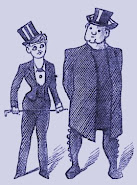
[1] TAD DORGAN, Daffydills, Cupples and Leon, 1911

New York – “Tad,” the cartoonist who has been called “The Merriest Guy In America,” died In his sleep yesterday at his home in Great Neck, L. I. After nine years of taking it from fate as an invalid and a last five years of bondage to a wheel chair.


[2]  TAD DORGAN, Boston American, Nov 17, 1911

He was 52 years old last Monday and his real name was Thomas Aloysius Dorgan. He was born In San Francisco, and the first national intimation that something had happened to make life a little easier to bear came a few years later when the phrase, “Twenty-three- Skidoo” swept the country. That was “Tad’s” phrase, and it skidooed him from a $5-a-week office boy on a San Francisco newspaper to the East, three square meals every day, and the gorgeous idea of making “Judge Rummy” a national institution during the Thaw trial.

The expressions “Tad” kept putting in the mouths of his horde of cartoon characters have since been tossed glibly about by millions of his fellow citizens. Most of them - the phrases - are meaningless but irresistible.

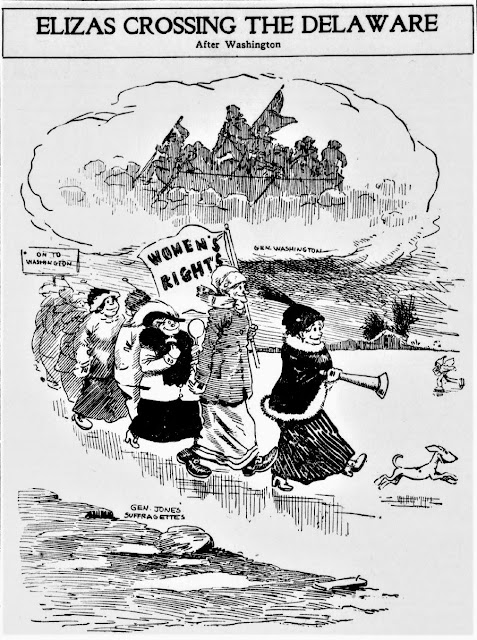
[3] TAD DORGAN, ‘Elizas Crossing the Delaware – After Washington,’  LA Herald, Feb 24, 1913

“We Have No Bananas” 

“Officer, call a cop,” “Daddy, I see ducks,” “See what the boys in the back room will have” - these awaken memories as sentimental as love songs. “Dumb-bell” is prying its way into dictionaries, as may “Cake-eater,” “Dumb Dora,” “Drugstore cowboy” and “Nickel-nurser.” 

They are all “Tad’s”, and so are “Finale hoppers,” “Storm and Strife,” “Cat's Meow,” “For crying out loud,” and “What, no spinach?”

“Yes, we have no bananas” was his, too, and it became the most popular song of a decade. Many like best of all, however, his classic: “Drop that wheelbarrow - what do you know about machinery?” Although, “Let him up —he’s all out” has its loyal following.

These gaudy expressions rolled off “Tad’s” pen and a week later they would be in the mouth of every amateur wise-cracker from Baton Rouge to Point Barrow. “Tad's” eye first discerned that a hat was a “skimmer” and that eyeglasses were “cheaters.”

Dorgan was possessed of an encyclopedic savvy of prize fighting as well as of the homelier amusements of his fellow citizens. His stories of the Gans - Nelson and Jeffries - Johnson fights are classics of sports writing. He looked at fights and fighters with the same tender attention that Sir Joseph Duveen bestows upon old masters, and his tendency was to become tremendously excited.


[4] TAD DORGAN & HYPE IGOE, c. 1910. Courtesy Rob Stolzer (see more HERE)

Heart Trouble

The Dempsey-Miske affair in Benton Harbor, Mich., in 1920 seemed mild enough to many people but it marked the beginning of the end for “Tad.” He was forbidden by physicians ever to attend another boxing match. Something had happened to his heart.

Even at that time, “Tad’s” general appearance was that of an object any reasonably determined wind could blow through a keyhole. He was more than thin. Such hair as he had was of an indeterminate sandy shade, He limped slightly with a motion that furthered the effect of scuttling before the wind. 

And the second, third and fourth fingers of his right hand had been lost somewhere early in his career. A factory accident in his youth was reported to be responsible for the missing digits. This was before “Tad” learned to draw, grasping his pen with the thumb and forefinger remaining to him.

“Tad” was as little handicapped in work by his heart as by his crippled hand. Confined to a wheel chair for the past five years, he continued to write boxing articles and draw his cartoons, getting his sports news over the radio. He died three weeks ahead in his work. His last cartoon, for publication May 21, was delivered to the office of King Feature Syndicate two days ago.

by an unknown author from an unknown newspaper from 1929


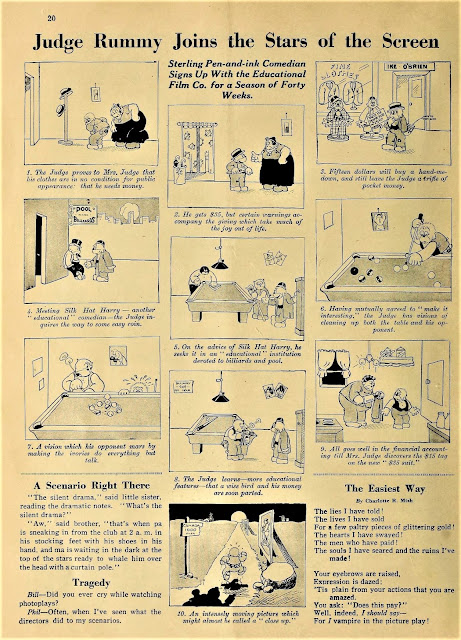
[5] TAD  DORGAN, Judge Rummy Joins the Stars of the Screen (with Silk Hat Harry,), Film Fun, January 1919

Note: TAD Dorgan must have been familiar with Cockney slang where “trouble and strife” referred to “wife.” TAD apparently used (above) the phrase “storm and strife” to the same purpose.

One old baseball term that qualified as good Americanese is “boner.” This is an abbreviation of “bonehead play.” The first man to use this form was T. A. Dorgan, or Tad, the sport-page cartoonist of the Hearst papers who had a baseball character called Bonehead Barry, the bush league bear. We owe “bonehead” and “boner” to him. – Westbrook Pegler, May 27, 1947

According to an article in ‘Fights and Fighters from Punch’s Scrapbook,’ The Mail (Adelaide SA), Oct 29, 1938: In writing an article about the match lost by Terrible Terry McGovern to Young Corbett on Nov 28, 1901, Tad Dorgan said, “Corbett got Terry’s Goat” — and thereby coined a phrase.” 

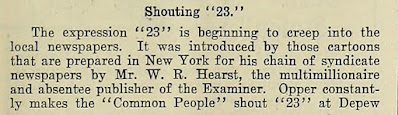
Note: About 23 Skidoo, the phrase credited to TAD Dorgan and popular in the 1890s. 23 was revived by FB Opper according to The Wasp Jan 27, 1906. Both were based on the knitting lady at the foot of the guillotine in Dickens. Skidoo was from the Greek word shedad, the Norse skedad, the American skedaddle meaning scatter or scat.


Wednesday, June 19, 2019

A Picture Story With But a Single Word


by TAD DORGAN

March 1, 1915

April 3, 1915

May 1, 1915

May 7, 1915


Wednesday, September 19, 2018

TAD — His Monument

His Monument
Will B. Johnstone
New York World
May 25, 1929

Sunday, April 29, 2018

Eddie Campbell’s The Goat Getters

     
“Goat getting” long has been a favorite stunt of many great ring-men. But I’ve never practiced the art. I’ve never tried by one ruse or another, by trickery or subterfuge, to take the nerve or the confidence out of my opponent. I felt it wasn’t necessary … This “goat getting” is supposed to get a man so excited and so frothy that he loses control of his poise and his calmness, and in his own furious anger swings wildly, and is always off balance because of frantic eagerness to deliver a killing punch. Gene Tunney, heavyweight boxing champion,  March 10, 1927
     
by John Adcock

MAJOR THESIS. Comic artist Eddie Campbell’s latest book — elaborately titled inside as, THE GOAT GETTERS: A new angle on the beginnings of comics casting a bright spotlight on THE FIGHT OF THE CENTURY. And Reserving a Few Mellow Sidelights for The San Francisco Graft Trials, Harry Thaw’s Murderous Crime Of Passion, The Story of the Lemon. ARTISTS: JIMMY SWINNERTON!! TAD DORGAN!! ROBERT EDGREN!! BUD FISHER!! RUBE GOLDBERG!! GEORGE HERRIMAN!! written and designed by Eddie Campbell — is not yet available but already causing some conversation over its major thesis; that the early sporting cartoon, as practiced by men like Tad Dorgan, George Herriman and Rube Goldberg, is the “missing link” in histories detailing the origin of the daily black & white newspaper comic strip.

BIRTHPLACE SAN FRANCISCO. The Amazon blurb (where the reader can sample a chapter or two) in similar fashion presents the book as “a new take on the origin of the comic strip,” while Eddie Campbell claims that the sporting page was the venue for the invention of the daily comic strip, and that San Francisco was its birthplace. Is it a coincidence that the best of these cartoonists, Tad Dorgan, George Herriman, Rube Goldberg, and Milt Gross (once Tad’s office-boy) carried their slang-heavy verbal and artistic slapstick into the most successful of the daily newspaper comic strips? I think not — and each and all of them drew their verbal inspiration from Tad Dorgan.

SPORTING LANGUAGE. Critics like myself do not have to agree with Campbell’s conclusions to enjoy this splendid book, a sprawling epic which aims and succeeds in providing “a reconstruction of the whole picture,” with a focus on boxing, counting the days when the sporting pages — modeled on the British sporting newspapers like Pierce Egan’s Life in London and Sporting Guide (1824) and Bell’s Life in London (1827) — gave several sporting cartoonists ample column space to experiment with vivid language and pictures. The language was the language of the sporting underworld; rich in slang, celebrating the gambler, the pug, the bum, the gangster, and the rube. This was during a period when boxing was illegal in most states and fights were staged on barges, in farmer’s fields, and in sweltering boomtowns in the desert. Ears were torn, eyes were gouged, and tons of blood were spilled. Most of the sporting cartoonists of this era (approximately 1894-1913) not only celebrated this preoccupation with the lag’s life — they lived it. To them it was the most significant and fondly remembered time of their lives.

FIRST TIME. The Goat Getters is the first time an author has attempted to chronicle the entire early days of the sporting cartoon and my hat is off to Eddie Campbell for his superb work in hunting down, cleaning up, and collecting together over 500 illustrations from those far off golden days. Campbell is a marvelous writer too. He brings the natural insight of a cartoonist and a humorist to his observations. Among the many artists covered are Homer Davenport, Jimmy Swinnerton, Tad Dorgan, Robert Edgren, Bud Fisher, Harry Warren, Rube Goldberg, George Herriman, Kate Carew, Fay King, Clare Briggs, Harry Hershfield, A.D. Condo, Nell Brinkley, Dan Leno, Hype Igoe, Robert Ripley, Sid Smith, Pete Llanuza, and a large number of other comickers both famed and forgotten. And oh yes, there are goats, plenty of goats — fifty on the last 4 pages alone.


Front cover title: 
THE GOAT GETTERS. Jack Johnson, the FIGHT of the CENTURY, and How a Bunch of Raucous Cartoonists Reinvented Comics, by Eddie Campbell, IDW Publishing/Ohio State University Press (The Library of American Comics), Hardcover, 320 pp., ISBN 978-1684051380 — available May 1, 2018

Sunday, February 25, 2018

Leo “The Lion” – Cartoonist O’Mealia


1913 [1] Odd Facts About Stars of Prize Ring, in The San Francisco Call, Sep 15. “…“Jack” Johnson always laughs when in the ring…”
“What did Leo do today?” was the question from the steady Daily News readers of his time. A sports cartoonist like no other I’ve seen doing this work, Leo had a style all his own. It was pen and ink painstakingly applied — line by line — by his talented hand, adding to it a whimsical sense of humor. He signed his name “By Leo” and put his trademark small lion in every drawing. The lion was a lovable little squirt of an animal who sometimes would run around the edges of the cartoon delivering a message. A cartoon without that lion was not a genuine Leo. — sporting cartoonist Bill Gallo, 1960

1913 [2] Lion plus Leo signature.

by John Adcock

Leo Edward O’Mealia was born in Le Roy, New York, March 31, 1884. The family moved when he was fourteen and he grew up in Rochester New York where he “played baseball in the Caledonian Avenue vacant lots that back up to the Pennsylvania Railroad yards, and he was a pupil in Immaculate Conception school.” O’Mealia’s first job as a cartoonist was on the old Rochester Herald under John Scott Clubb where “I was put on sports … they made an artist out of me.” His most popular creation was called Sod Bug, about an insect who commented on local baseball games. From the Herald he moved to the Rochester Times, still drawing sporting cartoons, and compiling a collection of his newspaper cartoons titled Mut and Flea Brain Leaks. He sold over 1000 copies in advance of publication.
   
1913 [3] Three Men in a Tub, in The Evening Herald, July 29. “…I thought it was very dangerous, but it’s nothing but cheese!…”
Mr. O’Mealia worked on the New York Journal under the late Winsor McCay, once one of the best-known cartoonists in the country, and was assistant to the famous “Tad” Dorgan, the sports cartoonist of the daily paper. When Tad’s heart, which he always said was one of those “dime-a-dozen tickers,” gave out, Leo subbed and later succeeded the renowned Dorgan. Comic Strip Artist Visiting Old Home Town, in Rochester Democrat Chronicle, Aug 3, 1935
Winsor McCay was drawing political cartoons for Hearst at the time and touring the vaudeville circuit with the animated Gertie the Dinosaur. The company made a stop in Rochester and played the Temple theatre. John (Mickey) Finny, the Temple’s manager, introduced McCay to O’Mealia over a poker game. Through McCay’s intercession he was given a job as cartoonist on the “sporting side” of the New York Evening Journal. There he was given into the charge of sporting cartoonists/columnists Tad Dorgan and Hype Igoe.
   
1913 [4] The History of a White Hope No. 1, in The San Francisco Call, Sep 2. “…He “threw” all the strong men…”
On the journal he was doing small fill in bits when Arthur Brisbane, Hearst’s great editor, stopped at the young man’s drawing board, admired his work, and advanced him to a full-fledged sports cartoonist. At that time, he adopted the slogan “Leo the Lion,” which has identified his sports cartoons ever since.Seen and Heard, Henry W. Clune, Democrat Chronicle, June 13, 1957
1913 [5] The History of a White Hope, in The San Francisco Call, Oct 15. “…Moran walked all around the ring…”
The Great White Hope era began on Dec 27, 1908 when Negro boxer Jack Johnson defeated the Canadian Tommy Burns in Sydney, Australia. Jack London, journalist, called for retired champion James Jeffries to return to the ring to “remove the smile from Johnson’s face.” The period ended April 5, 1915 when Jack Johnson lost the Heavyweight Championship to Jess Willard at Havana, Cuba.

1913 [6] Here’s a Regular Hard Luck Story, in The San Francisco Call, Oct 27. “…He holds the stakes…”
One of O’Mealia’s one-panel serials on the sports page was about a boxer named George “Sledge” Seiger, titled The History of a White Hope. O’Mealia left after two years to draw comic strips for Associated Newspapers syndicate. For the next seventeen years he drew comic strips. Among them were Little Pal, Freddie’s Film, Jungle Definitions and Wedlocked. In 1929 he began drawing an adventure strip called Sherlock Holmes (he was reportedly also illustrating reissues of Conan Doyle novels at the time) followed by another comic strip, Sax Rohmer’s Fu Manchu.

1930 [7] Sherlock Holmes – The Musgrave Ritual; A New Adventure, Leo O’Maelia comic strip after Conan Doyle.
The busy cartoonist was reported to have assisted Percy Crosby on Skippy and Robert Ripley on Believe It or Not. He gave up comic strips in the early 30s to work as a free-lance illustrator and as a comic book artist at National periodicals drawing for More Fun, Action, Adventure and Detective Comics. He was one of the cartoonists Jerry Siegel considered for the drawing of Superman.

1950s [8] “I’ll string along.” Opening of the Baseball Season — with the  Pirates, Reds, Orioles, Senators, and a Dodger fan.
1950s [9] Photo of Leo O’Mealia.
In 1939 O’Mealia signed on with the New York Daily News. His first assignment was illustrating Jimmy Powers sporting column. Leo (“The Lion”) Edward O’Mealia died on May 7, 1960, at Brooklyn, New York.

1955 [10] Who’s a Bum! Leo O’Mealia’s classic victory cover outsold every other paper that October Wednesday when the Dodgers beat the Yankees — read Bill Gallo’s background story in our Further Reading link to the Daily Mail.
     
Other cartoonists signing with ‘Leo’ were the American Leo Hershfield, the Dutch Leo Debudt, and the Dutch Alfred Leonardus Mazure or Maz.


FURTHER READING. Genuine Leo – Gallo Remembers Leo O’Mealia, by sporting cartoonist Bill Gallo in the New York Daily News, May 8, 1960 HERE.