Showing posts with label Frederick Burr Opper. Show all posts

Saturday, April 1, 2017

I Thought of a Tramp — The birth of Happy Hooligan


 “The awful part of this work is its speed. (…) It almost seems to me now like shoveling coal into a furnace, or pouring water into a bucket without a bottom. It just goes on and on.” —lF.lOpper, 1930

“MR. OPPER has drawn Happy Hooligan for the past 30 years (1900-30), and a daily cartoon, when he has the time and inclination to do so.” Frederick Burr Opper was born in Ohio in 1857, in Madison, a small town in the middle of the state. He never went to college and only attended school until he was fourteen.
“First I went to work in the little general store there, and after that on the village newspaper. No, not to draw or write, just a general factotum all over the place. When I had been there about a year and a half, I decided to come to New York, and took a job in a dry goods store doing a little of everything, writing price tags and such things. All this time I had an idea of selling my drawings to the comic papers.”
[2] Happy Hooligan’s dreams, 1908.

FOR THREE YEARS, in between his other work, he sold cartoons and comic pictures to Frank Leslie, who eventually took him on his staff. He then went to Puck for eighteen years, leaving there to work for Mr. Hearst.
“It happened that they wanted a new series of comics, and I set about inventing one. I thought of a tramp. Tramps were not so very new; there had been all kinds of tramps, so I decided to make him a little different by putting a can on his head. What gave me the idea was that at that time all the saloons put their empty kegs in the streets for the breweries to pick up and refill. The tramps would hang empty tomato cans around their neck, go to these kegs and tip the remains of the beer from the empty barrel into their cans.”
[3] Chicago Examiner, January 22, 1911.
“Besides the comic strip Mr. Opper does several cartoons a week, more or less of a political nature, for the daily papers. In order to do this he has to do a great deal of newspaper reading, so as to be absolutely up to date on current events. (…) His only relaxation? Sketching! He likes to go to Europe, preferably the little English villages, and sketch with a soft pencil and a sketch book, even as you and I. (…) Incidentally, he is much more proud of his sketch book than his comic strip. He has two children and six grandchildren.”
[4] Tomato can hat. Cartoon by Jimmy Swinnerton in San Francisco weekly The Wasp, Sep 2, 1893.
HE MOVED with his family to an old-fashioned home in New Rochelle in 1916. His workroom is the sun parlor on the first floor. “Before that we lived near Stamford, Conn. We had a great big old-fashioned farmhouse a hundred and fifty years old, although I’ve never farmed in my life.” He sold their farm and part of the sales agreement is the present house in New Rochelle. They lived on 78th street in New York at first, with the house in New Rochelle used as a Summer place. At the time of this article and interview, F. Opper is seventy-three years of age.
“Comics have become a great industry. Years ago, when I was first in the game, there were only three or four of them. Every city in the country now has its comic artist, and also buys from feature syndicates. The business is getting bigger and bigger, until I do not see how it can grow anymore without toppling over.”
[5] Chicago Examiner, June 21, 1908.

★ With text extracts from: ‘Our Famous Neighbours — Frederick Burr Opper Of New Rochelle — Creator of Happy Hooligan, New Rochelle Cartoonist Finds ‘Fans’ Prone to Criticize Slightest Errors — Sketching His Chief Relaxation,’ By Alissa Keir, in The Yonkers Statesman, Wednesday, December 31, 1930, page 5.

NOTE. In this article the ‘32 years’ of Happy Hooligan has been changed into a more correct ‘30 years’ by Yesterday’s Papers. Our lead picture was first published on a 1904 Valentine’s Greetings postcard.

Saturday, April 28, 2012

A Caricaturist of the “First Water”


The Commoner, August 2, 1901
An early interview from 1905 with author Frederick Burr Opper, who signed his cartoon, caricature and comic strip artwork with ‘F.O.’ or ‘F. Opper.’ Five pages published in ‘Little Visits with Great Americans; or, Success ideals and how to attain them,’ by Orison Swett Marden (ed.), two volumes, New York: The Success Company, 1905: 353-357.


Letter from 1902. His letters and contracts Frederick Burr Opper signed with his full signature ‘F.B. Opper,’ as in this busy author’s letter that concerns a proposed book of F. Opper cartoons. Written on New York Journal stationery, the original is shown at the bottom. A full transcription reads:
Feb. 13, 1902
Peter Keary, Esq.

Dear Sir:

I have received your polite letter enclosing copy of contract, with the change made. The contract now seems to be alright and if you will send two duplicate copies of it signed, I will send one back to you signed.

I have got the material together, and find there are 38 or 39 originals of those subjects you selected. There are also three or four of which you will have to make plates from the clippings as I have not the originals. Beside this there are 16 or 17 originals of subjects you did not select, but which will be available to pick from. I will send all the originals in one large bundle, as soon as I receive your reply, with the contracts. I enclose herewith two photographs of myself, from which you can select one to use in the book, if you wish, also my signature to put under it. I have been thinking about the cover, and it seems to me that it would be better, after all, not have a humorous cover design, but a cover with good bold, attractive title lettered on it, in some good combination of color for letters and background. However this we can discuss later.

As regards the Antediluvian things I may do in the future, I haven’t been able to do any for the last ten days for the reason that I am now doing the cartoons for the Morning Journal, which, with my work for the Sunday Journal, leaves me no time to do anything for the Evening Journal. How long this may continue I cannot tell, but while it does I shall be unable to turn out more than an occasional Antediluvian. I thought I ought to tell you this so that if it makes any difference in your plans as regards the book you will know it in time. Of course I like to do the cartoons for the morning paper, yet I regret the interruption a possible stoppage of my Antediluvians and other comic series on account of it. However I will have the bundle of originals all tied up ready to send you as soon as I get your answer. With many thanks for your pleasant words, I am, Yours very truly,

F.B. Opper

Courtesy of Don Kurtz.

See ‘Our Antediluvian Ancestors’ HERE.

Frederick Opper: A Cartoonist of Democracy


Benjamin Orange Flower wrote this article  in
The Arena, Vol. XXXIII, No. 187, June 1905: 583-593


Monday, December 26, 2011

Sorrows of Satan


Frederick B. Opper's Sorrows of Satan editorial cartoons in the Chicago Examiner were based D. W. Griffith's film adaptation of the novel The Sorrows of Satan by Marie Corelli.


Tuesday, March 30, 2010

Muybridge and the Comic Strip


While cartoonists A. B. Frost and Henry Stull left undeniable proof of their indebtedness to the work of Eadweard Muybridge others were less obvious about his influence on their comic strip work. One way of identifying Muybridge influence is by imagining that an animator’s in-betweener could fill in the spaces between actions to create a free-flowing cinematic animation. Charles Green Bush’s “At the Photographer’s,” HERE, is a case in point. The cartoon above by Frederick Burr Opper, “Some Studies of a Character Artist at Work,” was published in Puck 30 November, 1887.

Eadweard Muybridge’s photographs of humans and animals in motion made a world-wide stir in scientific and artistic circles and he went on the lecture circuit to explain his earth-shaking discoveries with the aid of a zoopraxiscope, which an English writer described as “a magic lantern run mad.” On 18 November 1882 Muybridge lectured on “The Romance and Reality of Animal Motion” for a packed house in a show sponsored by the New York Turf Club.

He illustrated his lecture by projecting his stationary photographs on a canvas screen and afterward, as a New York Times columnist wrote, “displayed the figure of the animal, first at a walk across the canvas, then pacing, cantering, galloping, and even jumping the hurdle. The effect was true to life, and the spectator could almost believe that he saw miniature horses with their riders racing across the screen.” He followed up with animations of a running bull, a goat, a deer, and a man, all walking, running, jumping, and in the case of the man, turning somersaults.

The first silent movie, “The Great Train Robbery,” was not produced until 1903, and the first animated cartoon was J. Stuart Blackton’s “Humorous Phases of Funny Faces,” in 1906, but comic strip artists were already anticipating animation in work done in the 1880’s and 1890's.

Below is another Frederick Burr Opper cartoon on caricature from Scribner’s circa 1883.


See also part II HERE

Saturday, March 6, 2010

In Caricature Country


“… in Caricature Country you can always smile and often laugh, and it is only the natives who have troubles and never the visitors.” >

Caricature Country and its Inhabitants by F. Opper, The Independent Volume 53, January to June 1901.


Thursday, January 21, 2010

The Happy Hooligan of Nations


A wonder by Frederick Burr Opper. This is from the British Review of Reviews of W. T. Stead, Volume 25, 1902.


Wednesday, October 28, 2009

Our Antediluvian Ancestors


“Why,” said he, “one of the great delights of my boyhood was the work of Charles Keene, the English cartoonist. He was the master of a style of drawing that could never be improved upon. I admired him very much and owe a good deal to him in the way of inspiration.” - Frederick Burr Opper to London Daily Mail, 3 October 1903.


Above Charles Keene illustration from Punch.


Friday, July 24, 2009

Human Procession


Human Procession, Newark Advocate, January 2, 1914

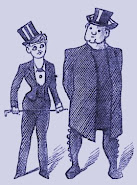
Every profession has its dean, and Mr. F. Opper does the deaning for American cartoonists. The benign and benevolent appearing gentleman – he is all of that, which proves that looks are often deceitful – has known fifty-seven varieties of annums, having been born at Madison, Lake county, Ohio, fifty-seven years ago today, January 2, 1857. His full name is Frederick Burr Opper, but he signs his work simply “F. Opper.”

Mr. Opper’s alma mater was an Ohio village school. At fourteen he left that institution to take a post-graduate course in a county newspaper office. He had decided that newspaper work offered the shortest path to fame and fortune, and while this would indicate that Freddie wasn’t a very bright lad, it must be remembered that he was only a poor country boy. At school, and while acting as devil in the rural newspaper office, Opper was very fond of drawing, and even at that tender age he made caricatures of local people. It is understood that the subjects of these sketches were no more pleased with them than Mr. Bryan, Mr. Root, Mr. Archbold, and other worthy gentlemen who have since felt the sting of the Opper lash.

After a year in the newspaper office, Mr. Opper decided to go out into the great world. If he had been an ordinary lad he would have chosen Cincinnati or Cleveland or Columbus or Canton, or some other Buckeye state city beginning with C, as the One of his operations. But, no. Nothing less than New York would do for Freddie Opper. For a time he kept the pot boiling by working in a store, drawing display cards and doubling as a salesman. It was only a little while, however, until he placed several sketches with several New York comic papers, including the “Phunny Phellow” and “Wild Oats.” This work attracted the attention of Frank Leslie, who gave the youthful artist a regular job on Leslie’s Weekly. After three years with that publication he went to Puck. For eighteen years his work appeared weekly in Puck, but in 1899 he accepted an offer from Mr. Hearst, and has been with the Hearst publications ever since. His work now appears regularly in all of the Hearst papers and in scores of others.

In addition to the newspaper work, Mr. Opper has illustrated books for Mark Twain, Bill Nye, George V. Hobart, and Finley Peter Dunne. Among his best known cartoon series are “Happy Hooligan,” “Maude,” “Alphonse and Gaston,” “John Bull,” “Willie and his Papa,” and “The Cruise of the Piffle.” “Uncle Trusty” and “the Common People” are well-known figures in Mr. Opper’s cartoons.

Tuesday, September 9, 2008

Katzies Ghosts : Frederick Burr Opper


The Katzies ghosted by Frederick Burr Opper, creator of Happy Hooligan. According to my freind Holmes "I agree that this is likely an Opper creation, but it's even more of an admixture than it first appears! The black man is Sam from Jimmy Swinnerton's "And Sam Laughed" strip!"

And that is not all, the character of the mule is a spoof of Opper's own 1904 comic strip And Her Name was Maud!

Bedelia, I'd like to steal ya, was a top jazz hit of 1903. One mystery remaining, who are "der Raxies," vaudeville artists ?

Winnipeg Tribune 27 July 1918. Original was copyright King Features Syndicate 1904.