

 Posts
Posts


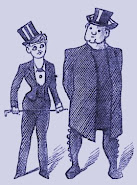


THOMAS WORTH, FORGOTTEN
COMIC ARTIST
By E.M. Sanchez-Saavedra
One of America’s most
prolific nineteenth-century comic illustrators, whose drawings once adorned the
walls of homes, apartments, saloons and the covers of magazines and dime
novels, is nearly forgotten today. The career of Thomas Worth (1834-1917)
spanned the period from the elaborate hand-pulled lithographs of Currier and
Ives to the mass-produced magazines of the twentieth century. Despite his long
life, very little biographical information has survived beyond the huge corpus
of his illustrations.
According to Harry T.
Peters in Currier and Ives -- Printmakers to the American People (New
York: Doubleday, Doran & Co., 1942), Thomas Worth was born in Greenwich
Village, NYC and began to draw when he was a child. When he was in his late
‘teens, he submitted a sketch to the lithographers Currier and Ives. Nathaniel
Currier looked at the humorous scene of two boys driving an ash wagon and said,
“This is a clever thing. We’ll give you five dollars for it just as it is.”
Although never a regular staff member, Currier and Ives considered him one of
their major contributors. Over the years hundreds of his drawings were redrawn
on stone and published as individual lithographs and sets. An avid sportsman
and fisherman, Worth produced many prints of trotting horses and outdoor
scenes. He is best known for several long series of comics: “Railway
Incidents,” the “Howling Swell” series and seventy-five “Darktown” prints.
These last represent what Stephen J. Gertz has termed “the dark side of Currier
and Ives” (pun obviously intended).
Unlike the often-saccharine
mush and wallowing nostalgic subjects now associated with the lithographers,
the Darktown prints were a celebration of the worst racial stereotypes current
in the nineteenth century. They were also among the firm’s largest sellers –
one print sold 73,000 copies! Worth’s drawings were augmented by those of James
Cameron (1829-1862) a young Scottish immigrant.
Although most Americans
after about 1860 got their dose of “the funnies” from comic magazines,
newspapers and almanacs, Currier and Ives’ huge output of political and social
“comics” drew upon a much older tradition of elaborate satirical cartoons and
caricatures, dating back to the late seventeenth century. Prints by the
brilliant English artists William Hogarth, James Gillray, Thomas Rowlandson,
the Cruikshank brothers and others represent the finest works of this class –
meticulously hand colored large copperplate prints. The technique of
lithography, involving drawing on flat stone blocks with crayons, rather than
hand-incising millions of minute lines into a copper plate or woodblock,
reduced the expense and time required to turn an artist’s drawing into a
finished print. Currier and Ives employed the process to mass-produce
affordable art for anyone who wanted to brighten up a drab room. The ephemeral
political cartoons were meant to be purchased, examined, discussed -- and
ultimately discarded.
Thomas Worth bridged the
two traditions and contributed to a wide variety of venues. Shortly after
selling his first drawing to Mr. Currier, he took a bundle of sketches to
Harper and Brothers. Charles Parsons, head of Harper’s art department, liked
what he saw and Worth’s work would appear in the firm’s many publications for
decades. The iconic masthead of Harper’s Weekly A Journal of Civilization
is signed with the monogram “TW,” and might possibly be a Worth design.
In the 1880s and ‘90s,
Thomas Worth’s signed drawings began to appear in the Frank Tousey story papers
and later nickel weeklies. Older designs made the transition from
black-and-white formats to the new colored covers after 1898, when Tousey
“modernized” the appearance of his weeklies. Many engravings in Tousey papers
were anonymous, but Worth’s stature was a definite asset and his full signature
or initials appear on his illustrations.
According to Harry Peters,
who knew Worth personally, “He liked good company and had an impressive
capacity for liquor.” He and his wife Louise S. Worth are buried in East Islip,
New York.


See also HERE


