

 Posts
Posts


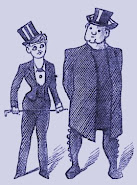


In the Early Days of cartooning and illustration's Golden Era, there were a fair number of A.B.s -- A B Frost; A B Shults; A B Walker, A B Wenzell; and I suppose we can add the vintage comic-strip character Abie the Agent.
We will spend a moment here and tip our YP hat to Arthur Burdett Frost. He was an artist whose immense talents and achievements arguably are the most neglected of American cartooning's pivotal figures. He certainly was a major progenitor of the comic strip format, both experimenting and codifying the language and structure of graphic narration.
If Frost was not the father of the American comic strip, he must be recognized as a godfather, a major branch on the family tree, a prophet who entered the Promised Land he espied.


He lived between 1851 and 1928, literally spanning -- and often dominating -- the fields of illustration and cartooning otherwise identified with F O C Darley and Frank Bellew through to Norman Rockwell and John Held, Jr. He studied under the great painters Thomas Eakins and William Merritt Chase; he illustrated a Christian (Swedenborgian) novel written by his sister and then scored a national sensation with hundreds of spot illustrations for Out Of the Hurly-Burly by Max Adeler; he joined the staff of the Daily Graphic, America's first illustrated daily newspaper; he drew for many magazines including Puck, Life, Scribner's, Collier's, Harper's Weekly and Harper's Monthly; and he illustrated more than a hundred books.
Frost was not merely prolific; many cartoonists and illustrators manage to keep busy. It seemed that everything he touched was significant. The authors whose works he illustrated were among the most prominent of his day: Mark Twain; H C Bunner; Frank Stockton; Theodore Roosevelt; Thomas Bailey Aldrich. He illustrated two of Lewis Carroll's books in the wake of the latter's Alice successes. If Frost never had drawn humorous illustrations and strips he would be remembered today for his hunting and wildlife work. Or, perhaps, his gouache paintings of rural life. Or, certainly, his classic folklore and ethnic themes as exemplified in illustrations for the Uncle Remus stories; their author Joel Chandler Harris paid tribute to Frost in one of the books, "you have taken it under your hand... The book was mine but now you have made it yours." The US Golf Association was founded in 1894, and Frost was an early addict of the links; his many drawings, illustrations, and books helped popularize the sport.

But a special mention must be made here of Frost's contributions to the development of the comic strip. In (primarily) the back pages of the "literary monthlies" Harper's, The Century, and Scribner's, Frost drew what were called "series," not termed strips, in the 1880s and '90s. It is possible that these multi-panel cartoons were fashioned in order to accomodate the advertisements between which they were nestled; or perhaps they were designed to encourage readers not to neglect those ad pages.
It is more likely that Frost's multi-panel strips were an organic outgrowth of his desire to tell stories -- freeing himself from staid depictions of moments in time. The great Punch cartoonists in England invariably drew frozen images with lengthy multi-line dialogue underneath; Frost was about presenting unfolding action. And "action" was his watchword. In his series there was movement, agitation, motion, perfervid activity. These tendencies virtually dictated that a story would progress from panel to panel, bursting the confines of a single image.

Regarding the "animation" in Frost's art, it is clear that he was inspired by the photographic experiments of the eccentric genius Eadweard Muybridge, whose studies of human and animal figures in motion -- captured in thousands of images like isolated frames of motion pictures -- largely were financed by Leland Stanford and published in several weighty volumes. In the course of things, Frost flawlessly captured shadows, correctly understood anatomy, and composed his scenes as arrestingly as did any fine artist.
It was "fine art" that lured him to France and away from his pen-work and myriad thematic preoccupations between 1906 and 1914. He was charmed by the Impressionists -- who wouldn't be? -- and despite his color-blindness he painted among the masters around Giverny, hoping to capture their "feel." Ironically, Frost met one mode of expression he could not master. His attempts at oil-on-canvas Impressionism was flat and uninspired. He returned to the United States, drew some series but mostly panel cartoons in pen and ink, especially for Life in the '20s. He died in 1928 in Pasadena CA.
There is much to share of A B Frost's impressive work; and we shall, perhaps category by his various categories, in days to come. As I have said, his "series" heralded the birth of the comic strip; as precursors they usually were pantomimic, and when he employed dialog it was in traditional typeset captions, not speech balloons. But the early signs of Frost all pointed to graphic excellence and comic strips.


