Showing posts with label Peter Maresca. Show all posts

Monday, January 6, 2025

Little Jimmy in a Big Book

 
Meanwhile:
The Modest Pioneer
Jimmy Swinnerton

by Rick Marschall

Comics fans and scholars, and everyone in between, will be happy to learn that the latest production of Sunday Press Books has been released. JIMMY! is the multi-tasking title, referring to one of the Founding Fathers of the American comic strip, Jimmy Swinnerton, and his major creation, Little Jimmy.

There is everything major about this book, as it is a typical production of SPBooks and its genial genius Peter Maresca -- oversized, many pages, in all color, chock full of rare artwork, and chocker full of information, dates, and critical appreciation.


Swinnerton was hired by the young William Randolph Hearst when the latter no-yet newspaper mogul was commencing his empire -- not the least as Godfather of the Comics -- in San Francisco. It was in the '90s, and Swinnerton was to live, himself, into his 90s. In the years in between he created cartoons and strips based on California bears and New York City tigers; animals on the Ark and Mount Ararat; the irrepressible Sam and his laugh; the irascible Mr Batch; the Canyon Kiddies of the Far West (whose adventures took them to color magazine pages and animated cartoons); and even an adventure Western strip, Rocky Mason. 

There is more, far more, in Swin's colorful life and career. Sent to the desert in a doctor's attempt to ameliorate his death-sentence of TB, Swin lived there for many decades -- legendarily the sixth White man to settle in Palm Springs -- and became as one with nature and Indian culture. Along the way he became a respected painter of Western landscapes. And he lured his cartooning friends to visit; Rudolph Dirks passed through, George Herriman remained.

I once talked to, but never met, Jimmy Swinnerton (Milt Caniff asked me to help Swin sell his artwork) as I had briefly met Rudolph Dirks. The Sunday Press book JIMMY! fills in the gaps of things we might have talked about. Despite my voluminous collection of Swin's newspaper and magazine work (and paintings my son now owns, and collects), Pete Maresca has characteristically discovered treasures including sketches, photos, and personal drawings. More, his selection from decades of Sunday pages expertly chose the funniest and (yes) visually stunning examples.


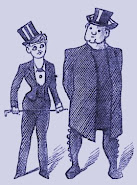
 Somehow escaping inclusion in JIMMY! is this drawing from almost 130 years ago, 1895. It has been on my wall for years and I take  delight in appreciating its youthful and random spirit. Presumably the man with the hat is young Swinnerton -- who ought to have been smiling, as Hearst plastered this poster all around San Francisco, making the young artist a star.

As I say, there is a cornucopia of surprising and excellent artwork and information in this book. Swinnerton's reserved style managed to mask humor and even mayhem whose comic excesses easily rivalled that found in neighboring strips like the Katzenjammer Kids and Happy Hooligan. In addition he quietly made substantial contributions to the nascent art form of the comic strip -- like parallel action ("Meanwhile -->") and flat blacks and areas of colors, likely inspired by poster art and Japonisme, which look was adopted by George McManus. 


JIMMY! and other Maresca Masterpieces can be found at www.SundayPressBooks.com  An imprint of Fantagraphics Books. 

Thursday, December 31, 2020

A Crowded Life in Comics –

Lucky Lucchese Memories

by Rick Marschall

“Have you lived here all your life?” “Not yet,” is the answer packing the most optimism. 

“Yesterday’s Papers” and “A Crowded Life” are dots I intentionally connect here. I have sort of chosen to live in the past, as a trained historian and collector of vintage and nostalgic pieces of days agone; and as someone who sometimes forgets what I’m supposed to do tomorrow.

A couple of artifacts have bubbled to the surface as I try yet again to sort my collection, currently seven storage units and every room of the house, sigh. It was fun to find some materials from my first Lucca Comics Salon in Italy. Lucca was the world’s prototypic comics festival. Its first year was in Bordighera; Angouleme in France grew larger, as did San Diego; and it split for awhile, like an amoeba, with a rival event in Rome. But Lucca is Lucca.

It is a small city or large Medieval village, a commune inside a complete ancient wall, in Tuscany, close to Florence, Pisa, and Heaven. I keep threatening, here, to tell more of Lucca, and I will – but Where to start? how to organize my tales? The first year I attended was 1978, and it already was the 13th “salon.” I attended thereafter in unbroken succession, usually as guest, juror, speaker, or exhibitor, or all of those, as well as American representative, for many years.

The festivals were like family reunions, only seeing the world’s great historians and critics who gathered there; and, eventually, where I met the world’s greatest cartoonists. Many of the great friendships and “connections” I have today were forged at Lucca, so you can understand my affection.

It all seems like yesterday, but these materials from my “first date,” 1978, are more than half my life ago. Our mind’s memories are merciful, however, when the ancient past can  seem fresh.

I will quickly share some incidents. I attended in 1978 partly as an emissary of Marvel Comics, where I was an Editor involved in the creation of what became EPIC Magazine. I convinced Stan Lee that I could scout European talent there, and indeed I made contacts with cartoonists who appeared in the magazine.

One was a Bosnian cartoonist living in Zagreb, Croatia, named Mirko Ilić. His work blew me away – detailed, a great sense of design, and a unique manner of depicting unfolding narratives. Evocations of darkness and doom and, in lighter moments, irony. His work appeared in the first issue of EPIC; and soon Mirko himself was appearing the United States.

Mirko became Art Director of TIME International, and of the op-ed pages of The New York Times. He opened a studio and has become a major figure in American art, design, and graphics. He has specialized in designing visual “identities” and motifs for major hotels and restaurants; collaborated with Milton Glaser on the title sequence for the movie You’ve Got Mail; and has co-authored books on design with the great Steven Heller. After I left the Illustration Department and moved to California, Mirko became a Professor in its Masters program; I wish we had overlapped.

The sketch he drew for me displayed his thematic preoccupation, at least of emotional content and style. The strip was a typical page of his that showcased his ironic outlook on life. It is from the exhibition and catalog of his work at Lucca. The other cartoonist so showcased was his fellow Yugoslav (this was pre-“Fall”) Ivica Bednjanec.

The late Ivica, sadly little known in the West, surely was Croatia’s most prolific and beloved cartoonist. He created many characters and series for children and adults; in comic and semi-serious styles; and wrote his own works. In a sketch he caricatured me as a marshal (not surprisingly), rudely treating his popular character of the time, Gentle the convict.

Speaking of caricatures, I met up at that Lucca with an (already) old friend, Peter Maresca. This was long before Peter became a lord of Silicon Valley and publisher of the great Sunday Press line of reprint books. But he was into collecting and curating vintage Sunday comic pages. His sales of these sheets each year paid for his travel and seeded a generation of Europeans’ appreciation of classic American strips.

As at book fairs like Frankfurt and Bologna, most of the business and all of the fraternizing at Lucca happened at grand three-hour meals; and far into the night at the bars and lounges of hotels (I had meals in America; I learned to dine in Italy and France). Will Eisner used to say that he and I saw each other more often in Europe, at such venues, than in America; and so it was with Peter. In my haze one night I drew a caricature of Peter enjoying a grappa or amaro. To prove I am an equal-opportunity mangler of likenesses, I also show a self-caricature from the same sketchbook page. Also, here, a photo at Peter’s table with Michel LaBelle and Eric Leguebe of Paris; Maurice Horn; myself; and Peter. I think 1980; Peter clean-shaven.

Yes, more than half a lifetime ago. After a stretch where I produced some reprint books (Little Nemo, Krazy Kat, Polly and Her Pals; and titles like Popeye, Little Orphan Annie, and Red Barry for Fantagraphics) Peter eventually went pro with his Sunday Press reprint volumes. Major works like the brand-new Milt Gross volume, and obscure gems like White Boy and The Upside-Downs have received their due. Splendid work. I don’t know about anyone else, but I refer to books of the SP dimensions, and I have done a couple myself, as “Maresca Format.”

It is a famous aphorism that “Waterloo was won on the playing fields of Eton,” where generals contended as youths. It might be said that much of comics scholarship and reprints was hatched in the commune of Lucca – or, to risk a pun – in the lounges of Lucca and the eatin’ spots too.


– 30 –

 109