Showing posts with label Frank Bellew. Show all posts

Friday, February 7, 2025

DOING RESEARCH FOR "YESTERDAY'S PAPERS"

 Oh, don't you love 
those rotting cellulose fibers?

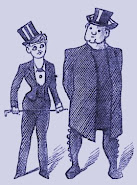
A series of drawings depicting the Administrator of Yesterday's Papers researching graphic treasures and sequential comic art for the delight of scholars, fans, and curiosity seekers. 


OK. This is neither your Admin, nor even a self-caricature of the cartoonist, the brilliant Frank H T Bellew (1828-1888). A subject of the British crown who migrated to the United States, Bellew drew for the very first issue of Harper's Weekly in 1857; for the rival Frank Leslie;s Illustrated Newspaper; and for virtually ever paper of his day, comic and otherwise. His trademark signature was a triangle.

One of the first depictions of Uncle Sam (Brother Jonathan) was drawn by Bellew, and his son Frank -- known by the obligatory and natural nickname "Chip," (we shall call him Little Boy Bellew) -- was also a cartoonist. Chip, who specialized in dog cartoons, died young, only eight years after his father. 

This "series," titled Research, appeared in Harper's Weekly in 1859.


-- Rick Marschall


Sunday, February 16, 2020

A Crowded Life in Comics –

Frank Bellew – Research, 1859 

Memories Speak Volumes, and Vice Versa.

By Rick Marschall.

I think it is plausible that sensors, or synapses, or microscopic engineers in the brain do work that we will never understand. How and why we dream, often in complicated scenarios, I will never understand. There are a lot of things I do not understand, but I think science will never solve this one.

The brain is a muscle, I have heard, and that became apparent to me about a decade ago when I wrote three books, two of them with elaborate research and footnotes; three very long magazine articles; my weekly blog; and much else I eventually computed at about 400,000 words for the year, all while being caregiver for my wife. The “brain is a muscle” theory was brought home when I was fairly insensate for a couple months afterward. (You can save your electrons if you are tempted to write in with questions like “How could you tell?” because I was the first to address that…!)

But like dreams, there is another question whose answer seems obvious, yet still ultimately elusive. It is confirmed uncountable times in our lives – how do smells trigger memories, even visual images, in our minds? I know that olfactory nerves from our sneezers connect to the brain, sure; that’s how we know something caught fire in the kitchen. But how is it that… well, here is one example:

As a young cartoon fan, I first discovered Puck Magazine, individual issues, when I was in second grade. My father visited Book Store Row in Manhattan on many weekends, and I invariably accompanied him. That neighborhood, now more a memory than anything else, was several blocks south of Union Square Park, its epicenter roughly 14th Street and Fourth Avenue. There were even maps of the approximately 125 used-bookstores clustered in the area.

A store called “Memory Shop,” whose owner was the perpetually knowledgeable but slightly dazed Marc Nadel (I think the spellings are correct), was a sort of heaven-on-earth to this young fan. Its specialty was what we would call today “popular culture” – movies, comics, cartoon books, Broadway memorabilia. It was at the top of rickety stairs in a nondescript building – now probably a parking garage – opening to a large room messily overflowing with cases and boxes and piles of… everything from sheet music to bound volumes. Marc had a gargantuan movie poster of Rudolph Valentino in Son of the Sheik, too large for any wall. So it was tacked to the ceiling, covering almost all of it, kind of a pop-culture worshiper’s Sistine Chapel.

One bookcase had several volumes of Puck Magazine from the 1880s. Magic to me. Gigantic they seemed to a fifth grader. I was already hooked on vintage comics and cartoons from books my dad had, like Coulton Waugh’s The Comics. And I was already devoted to F. Opper, still my favorite cartoonist. Years before Happy Hooligan, he drew political and gag cartoons for Puck. The 1889 volume was my first purchase at The Memory Shop.

Marc held the rest until income from my paper route enabled me to buy the next and next volumes at the heady price of $25 each. I have never maintained much of a savings account since then, proving the adage that “the child is father to the man.”

Those summer nights, when I acquired that bound volume, are as fresh to me as yesterday. I had already purchased loose issues of Puck, Judge, and Life along Book Store Row, but there was something impressive about an oversized volume, hundreds of pages of vintage cartoons, many colored in lithographed glory, terrific artwork by unknown names who eventually became closer friends of mine than schoolmates.

But those olfactory nerves! The paper in that volume was quality, not pulp. They were not fragile nor yellowing nor slowly degrading. Yet they gave off an aroma – a fragrance I would call it – that was distinctive. And today, about 60 years later, when I pull that 1889 volume off the shelf, and I smell that certain aroma anew… it is not new. Not only do I recognize it, but I have a mental image of myself at 10, sitting on the sofa in the enclosed porch my father had built that year. A portable TV was on, but I ignore it as I discover and rediscover those pages of Puck and my new friends Opper and Keppler and C J Taylor and Ehrhart and Dalrymple and Syd B Griffin.

Since then I have appreciated bound volumes more than individual issues of newspapers and magazines, and I am like the old fellow in an old cartoon. I believe it was drawn in 1859 or 1860 by Frank Bellew, one of the real pioneers of his craft. He was probably the most prolific cartoonist of his day. “Probably” is not in play – his signature, often enclosed in a little triangle, shows up in countless journals, from the famed Harper’s Weekly to obscure almanacs.

This is one, likely by him but oddly unsigned. I discovered this about the time when I scored that volume of Puck. Except for the bald head and wizened features, that devotee was me. Joined at the hip to an old bound volume; reading it at every moment; executing a bibliomaniac’s calisthenics to read it. Discovering things on every page. And savoring the sort of perfume that only collectors of Yesterday’s Paper can perceive and love.

– 30 –
68

Thursday, March 19, 2015

Chalk Talk and Lightning Cartoonists


[1] J.W. Bengough.

by John Adcock  

IN an 1895 interview with Frank Beard the American artist claimed to have originated the chalk talk “about twenty years ago (1875).” Claims like this one should always be treated with suspicion; a case could be made that cave paintings might have been accompanied by lectures thus qualifying as chalk talks. The earliest lectures on caricature with diagrams would appear to be by the pioneering British/American cartoonist Frank Bellew as noted in Frank Leslie’s Illustrated Newspaper on December 28, 1861, as follows,
“We are glad to see that Frank Bellew, Esq., is about to make the public partake of his extensive knowledge of Comic Literature and Caricatures, by giving Lectures upon those subjects. The first is to be on Caricature, and will be illustrated by humorous diagrams made at the moment. 
[2]
The second will be on the London Punch which cannot fail to be of great interest, as he has been, and still is, one of its favored contributors and artists. When it is said that he is also the leading caricaturist of Frank Leslie’s Budget of Fun, we can add nothing more in his favor. His first Lecture will be given in New York.”
The earliest American chalk talkers seem to have entertained in churches, YMCA type organizations, and later Vaudeville. In England it was done through churches and Music Halls. In time the cartoonists took up the stage and lecture hall billing themselves as “lightning cartoonists.”

[3] An outdoor chalk talk by Charles L. ‘Bart’ Bartholomew.
A newspaper column from February 13, 1876, comments on Beard doing a chalk talk in a church in Wisconsin. A squib from the St. Louis Globe-Democrat on July 29, 1875, mentioned “Thomas Nast will chalk and talk again. Beecher will talk, but will not chalk. That is to say, each will lecture the coming season.” Canadian political cartoonist J.W. Bengough, of Toronto, Ontario, gave his first chalk talk with cartoons at the Toronto Mechanics’ Institute on March 20, 1874. He used black conté crayons “not much thicker than slate pencils” on white newsprint paper. Thomas Nast was his hero.

[4] Caricaturist Tom Merry.
The earliest chalk-talking cartoonists I have found in England were Tom Merry, billed as the “Lightning Portrait Delineator” in the May 28, 1876, theatrical paper The Era, and Edgar Austin billed as the “Lightning Cartoonist and Instantaneous Sketchist.” I found the following description of Austin in The Standard for March 5, 1879: “Edgar Austin’s lightning cartoons of well-known people are truly astounding.” Austin was the stage name of William Edgar Piercey or Piercy who died in his lodging on the Waterloo Road, Lambeth, at 32 years of age on February 28, 1893.

[5] Valda, the Lightning Cartoonist, Chums, May 9, 1894.
Other early British practitioners of the chalk mentioned in newspaper advertisements were Alfredo, “the Lightning Cartoonist,” who was featured in Pall Mall Gazette, Oct 22, 1899, and Erskine Williams, “the young  Lightning Cartoonist,” in The Era, Oct  12, 1889.

[6] Livingston Hopkins, 1892.
Bengough toured Australia with his chalk talk performance and in 1899 American/Australian cartoonist Livingston Hopkins of the Sydney Bulletin gave a humorous lecture on caricature in that city using chalk on a blackboard.

[7] Clare Briggs.
In 1913 May Van Dyke was in Vaudeville billed as the “girl lightning cartoonist.” Traveling medicine shows also had their performing cartoonists. Ludwig, an American lightning cartoonist of 1916 was billed as “21 years of age and 21 inches tall.”

[8] Neysa McMein.
By 1895 lightning cartoonists were ubiquitous in Europe and the Americas particularly among the artists of the comic supplements. Clare Briggs, Sidney Smith, John T. McCutcheon, Fontaine Fox, Frank Wing, Carey Orr, Frank King and Winsor McCay were the most illustrious names associated with lightning cartooning. McCay carried it further than most — he gave lectures while pointing his stick at animated motion pictures.

[9] Robert Ganthony.
The ancient entertainment is still ongoing although ink markers and paper have replaced chalk and blackboards. You can watch film of the great British lightning cartoonist Bill Tidy in action HERE and HERE.

[10] Winsor McCay.
[11] J.W. Bengough.
[12] Charles L. ‘Bart’ Bartholomew.
[13] Clare Briggs.
[14] Frank King.
[15] John T. McCutcheon.
[16] Sidney Smith.
[17] Sidney Smith.
[18] Reverend Phillips E. Osgood.
[19] Fontaine Fox.
[20] Charles Plumb.
[21] Sidney Smith.
[22] J. Stuart Blackton.
[23] Winsor McCay.

Random Recollections 
by Robert Ganthony (1899) HERE.

Chalk Talk and Crayon Presentations 
by ‘Bart’ (1922) HERE.

J.W. Bengough’s Chalk Talks (1922) HERE.

★

Friday, March 2, 2012

Vanity Fair: a Civil War Comic Paper

  
“Vanity Fair, another sixteen page quarto was commenced December 31, 1859. Louis H. Stephens was the publisher, and Frank Wood, the burlesque writer and dramatic critic was the editor. The cartoons were drawn by Henry L. Stephens, a brother of the publisher, assisted by Bellew, E. F. Mullen, McClenan, Sol Eytinge and others. The corps of writers embraced among others Fitz James O’Brien, William Winter, dramatic critic of the Tribune, Henry Clapp, Jr., (“Figaro”) Richard Henry Stoddard, George Arnold, Edmund Clarence Stedman, Fitz Hugh Ludlow, Charles Dawson Shanley, C. F. Browne, (“Artemus Ward”) and Thomas Bailey Aldrich. After a little over a year, Charles Godfrey Leland became the editor and was succeeded in a brief time by “Artemus Ward,” who left, after contributing some of his best sketches, on a lecturing tour. Charles Dawson Shanley then assumed editorial control, and continued until the periodical expired on the fourth day of July, 1863, aged about three and one half years.” -- Comic Periodicals of America HERE

Henry L. Stephens, the principal cartoonist on Vanity Fair, was born in Philadelphia 11 Feb 1824 and died at Bayonne, New Jersey 13 Dec 1882. His first venture into comic art was illustrating a small pamphlet entitled Billy Vidkins. He studied at the Philadelphia Academy of Fine Arts and was engaged as an artist by Frank Leslie in 1859 followed by a stint at Harper’s Weekly. In 1863 he began a series of chromolithographs and drew cartoons for Mrs. Grundy in 1868 and for Punchinello in 1870. He was an accomplished watercolorist and illustrated The Comic Natural History of the Human Race, six volumes of Nursery Rhymes for Julius Bien, Mother Goose Melodies, published by Hurd & Houghton, and Aesop’s Fables. In 1860 R. M. De Witt of Frankfort Street published The Goblin Snob: an Extra Extravaganza and Funny Phantasy imagined and perpetuated in nearly fifty plates by Henry L. Stephens. Vanity Fair was published from 100 Nassau Street, jokingly known in the trade as “the Swamp.” Several volumes are available for perusal HERE


Monday, August 10, 2009

Frank Bellew (1828-1888)


TOP: “Raising the Wind; or, Both Sides of the Story,” Principal cartoon by Frank Bellew in The Lantern, 13 Mar 1852.

Frank Leslie’s Illustrated Newspaper, 28 Dec 1861 >

We are glad to see that Frank Bellew, Esq., is about to make the public partake of his extensive knowledge of Comic Literature and Caricatures, by giving Lectures upon those subjects. The first is to be on Caricature, and will be illustrated by humorous diagrams made at the moment. The second will be on the London Punch which cannot fail to be of great interest, as he has been, and still is, one of its favored contributors and artists. When it is said that he is also the leading caricaturist of Frank Leslie’s Budget of Fun, we can add nothing more in his favor. His first Lecture will be given in New York.


The Late Frank Bellew.

Mr. Frank H. Temple Bellew, the veteran artist and caricaturist, died recently in Metuchen, N.J. Mr. Bellew’s father was Lord Temple Bellew of Wiltshire, England. The son, who was born sixty-five years ago, married against his father’s wish and was disinherited. He followed the calling of an artist and furnished sketches and articles for the London papers, achieving considerable success. In 1857 he came with his family to America and began to draw for Harper’s Weekly, furnishing sketches for the first number of the paper ever published. He also drew for Harper’s magazine.

He tried various ventures in the comic paper line, but without success. In 1860 he founded The Picayune, with Artemus Ward as editor. It was a bright paper but only lived six months. Later he tried another comic paper, Wild Oats, but it also soon disappeared. For some years his work has appeared in the principal New York pictorials and comic papers.

Mr. Bellew drew in black and white, and his signature surrounded by a long triangle has long been familiar to readers of comic papers. He also once wrote for the magazines over the signature of “Au D’Tramp” and “Triangle.” He was very original in comic work, and never found a time when his ideas failed.

Mr. Bellew was a widower. He left an unmarried daughter and a son, who draws over the signature of “Chip,” signifying “of the old block.”

-Atchison Daily Globe, July 11, 1888.

Frank Leslie’s Illustrated Newspaper, 26 Jan 1861 >

Personal.

JOHN BROUGHAM, the popular contributor to the BUDGET OF FUN is “expatiating on the Continent of Europe” When the pantomimes have had their run, he will complete his engagements in London. Mr. Brougham made a mistake in hankering after an England that rejected him, and abandoning an America that received and fostered his talents.


The Lantern’s Light

Luck of the Little Illustrated Paper of Thirty-Six Years Ago

I have not seen it stated in any of the sketches of his career that Lester Wallack* was at one time an editor. And although he was such in a comparative sense only, the fact, nevertheless, is worthy of record. In 1852 the late John Brougham** originated and published a little illustrated paper here, modeled after the London Punch, calling it The Lantern. Its flame was a brilliant one. Once a week all the leading contributors and artists connected with the paper used to meet at dinner, as do the artists and editors of Punch today, to make suggestions for and decide upon the principal cartoon to be printed in the next issue.

The meeting was held every Saturday night at Windust’s, a famous restaurant on Park-row, and after every one had dulled their faculties with well served viands and muddied their brains with innumerable draughts of sherry and ale, cigars would be lit, the brandy decanter passed around and John Brougham sitting at the head of the table, with Lester Wallack at the other end, would call the meeting to order and the business of the evening would begin. The assemblage generally broke up at about 3 in the morning; and when the subject for the cartoon had at length been decided upon, my old friend Frank Bellew would go home and make the design. In the editorial duties of the paper, Lester Wallack, so Mr. Brougham has told me, was his right hand man, while a Mr. Tinson, whom if I am not mistaken, was a carpet manufacturer, with no ability whatever in art or letters, was chief adviser. Just why these two gentlemen were chosen it is impossible to say, for their artistic and general ideas were far inferior to those of others in the party. Nevertheless the fact remains.

The contributors to The Lantern were all men of genius. They belonged to a certain set that marked a sort of Elizabethan era in the annals of New York journalism. There was Fitz James O’Brien,*** the author of many charming bits of verse, and an able literary and dramatic critic, who enlisted in the Union army at the breaking out of the war, and was killed while serving as aide-de-camp to General Lander. There was Thomas Dunn English, one of the few who survive today, notwithstanding the bitter attacks made upon his character by Edgar Allan Poe – attacks which were calculated to kill outright any ordinary man. Thomas Power, who was christened Micawber by the party, both for his traits in common with, as well as his resemblance to that gentleman, and William North, author of “The Slave of the Lamp,” and who afterward committed suicide, were also members of the Lantern club. Thomas Butler Gunn, who stammered so that no one could understand what he said, but who was, nevertheless, a very able writer and artist, was another of the Lantern’s leading contributors, and there are many more whose ghosts I might conjure up were it worthwhile doing so. – JOHN PRESTON BEECHER in New York News. Nov 7, 1888, Bismarck Daily Tribune

*American actor, playwright and theatre manager.

**British actor. John Brougham (1814-1880)moved to the United States in 1842 where he worked as an actor, author, editor, and contributor to comic papers.

***O’Brien was the author of the famous early science fiction story The Diamond Lens (1858).