
 Posts
Posts


BROADWAY WEEKLY
Feb 11, 1904

♪♪♪




BROADWAY WEEKLY
Feb 11, 1904
♪♪♪


“I am obliged not only to use my pencil, but to study hard and read everything I can lay my hands on. The features of Roosevelt, Bryan, Hanna, and Croker may be familiar to me, but I must know what these men are doing. I must also know what the masses behind these popular characters think and believe. I must be conversant with the incidents and times from which I draw my inspiration. With 365 cartoons to draw during the year I must do an immense amount of thinking, for two-thirds of the ideas portrayed in my drawings originate in my own brain. I get my inspiration from newspapers, magazines, and people and I work methodically day after day. Without letting you into the secret of my political feelings, I may tell you that it very often happens that a cartoonist who is a Republican has to earn his bread and butter by ridiculing his own party and vice versa. You can draw your own conclusions from that statement, while I -- excuse me -- resume another sort of drawing!” -- Charles Green Bush quoted in “American Caricature and Comic Art,” The Bookman (US) 1903.
BUSH, FAMOUS AS A CARTOONIST, DEAD
He Was Creator of Many Political caricatures --- Died in the South
Camden, S.C. Saturday, May 22, 1909, Trenton Evening Times.
Arrangements were made today for the funeral of the late Charles Green Bush, the noted cartoonist who died here last night following an attack of heart trouble.
For years he had been the acknowledged dean of American cartoonists, and his work has been copied worldwide. He was born in Boston in 1842, and at the age of 18 was appointed cadet to Annapolis Naval Academy, being a classmate of Admiral Sigsbee.
Leaving the Academy he became an illustrator at Harper’s, and later went to Paris where he studied at Rimmel’s and with Bonnat. He immediately took his place as the foremost political cartoonist of the country and until his retirement a few years ago, wielded a powerful influence with his pen pictures.
He was the creator of Father Knickerbocker as representing New York City; it was Bush who first gave David B. Hill his little high hat with its “I am a Democrat” plume and his strenuous Roosevelt in Khaki has been the model for all such efforts on the part of all cartoonists.
The ex-president has among his possessions in his library a cherished collection of the Bush cartoons. Bush was, to those who knew him best, a delightful many-sided gentleman. He took most pleasure from his choir work in Dr. Parkhurst’s church and was known as a genius in the design of model yachts. He was a botanist of rare knowledge and was considered an authority on the cultivation of old-fashioned flowers.
The body will be taken to New York for internment.


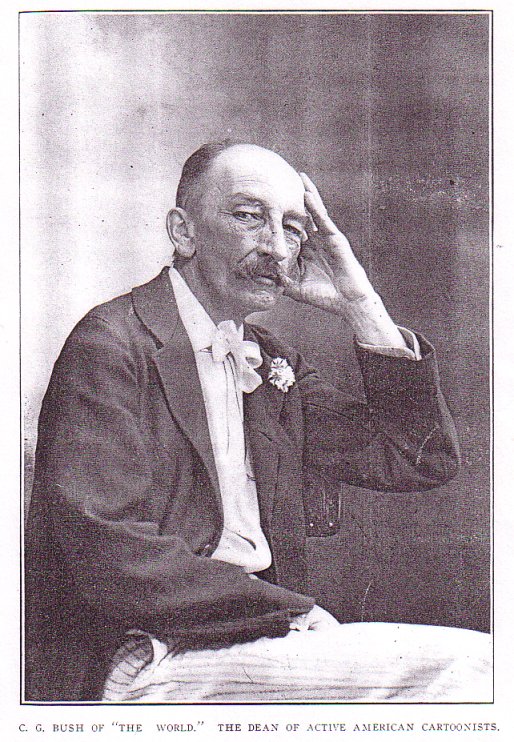


Charles Green Bush, a contemporary of Homer Davenport’s, was born in Boston in 1842. He began contributing political cartoons to Harper’s Weekly in the 1870’s and in 1875 studied art in Paris with Léon Bonnat, the portrait painter before returning to New York in 1879 to continue at the Weekly. Both Harper's Weekly and Harper's Magazine were pioneers in the early use of sequential art in America, most importantly in the work of A. B. Frost.
Bush was not known for his comic strip work but in 1890 he drew a series of comics for Harper’s Weekly that show the influence of A. B. Frost, and, in the case of the animated ‘baseball’ strip, probably Eadweard Muybridge, whose photographic studies in human and animal locomotion (1878) had a seminal influence on both the cinema and the comic strip.
Charles Green Bush (1842-1909) illustrated Canadian writer James De Mille's novel The Lady of the Ice (1870), Adeline Dutton Train's Faith Gartney's Girlhood, (1891), and Rhoda Thornton's Girlhood by Mary E. Pratt.(1874). In his book The Political Cartoon, Charles Press argues that the first use of Uncle Sam in a cartoon was by Charles Green Bush on February 6, 1869 in Harper's Weekly, as Frank Weitenkampf showed in "Uncle Sam Through The Years : A Cartoon Record, Annotated List and Introduction," an unpublished manuscript in the New York Public Library, 1949, 24 pg. By 1900 Press states Bush was known as the "dean of American Political cartooning."


