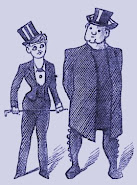
Punch’s political cartoons – called the “big cuts” because they were full-page size – were
discussed after the weekly Punch dinner, as M.H. Spielmann wrote “often by the aid of
the evening papers,” and settled by ideas put forth by the group.
John Leech
had done most of the big cuts, but as his health decreased in the 1860s he
only supplied sketches, with John Tenniel doing the finished drawings. Tenniel’s
signature did not begin to appear on the political cartoons until 1862.
 |
| Portrait of John Leech from the National Gallery |
Spielmann quotes Tenniel as saying “As for political
opinions I have none; at least, if I have my own little politics I keep them to
myself, and profess only those of my paper.”
The cartoons issued during the American War of Secession
were, in the words of Henry James, issued “under a dark star.” Spielmann wrote
that Punch’s political cartoons “carried weight and influence; they were the
nation’s ideas…”
To the British nation’s press the American war was an
economic irritation, interrupting the trade in cotton. They feared the war
would spread north and Canada would suffer a war of annexation. There was also
a bit of schadenfreude involved stemming from the War of Independence.
The gorilla cartoon is a double-barreled slam at Charles Darwin’s new theory and at the Emancipationist’s slogan of “Am I Not a Man and a Brother?” that William Wilberforce and Darwin’s grandfather Josiah Wedgwood developed in the late 18th Century.
Punch seemed to be of two minds:
O Jonathan and Jefferson,
Come listen to my song,
I can’t decide, my word upon,
Which of you is most wrong.
I do believe I am afraid
To say which worse behave,
The North imposing bonds on trade,
Or South that men enslave.
Putnam’s
magazine
opined that Tenniel’s Lincoln cartoons “were charged with a venom and
malignancy such as, so far as our knowledge of those things extends, were never
equaled in caricatures published anywhere in the world.” For the most part
Americans were remarkably forgiving after Tenniel published his touching
cartoon of the martyred President, ‘Britannia Sympathizes with Columbia’, on
May 6, 1865.
*Thanks to E.M. Sanchez-Saavedra


 Posts
Posts