Showing posts with label King Features Syndicate. Show all posts

Friday, May 2, 2025

AN INSIDE LOOK INTO THE BULLPEN OF EARLY HEARST CARTOONISTS - I

 "A Half-Million Dollar Feature Service."

by Rick Marschall


The history of newspaper syndication -- and specifically the distribution of cartoons and comic strips -- is a story yet to be told, and told well. 

There are many misperceptions in the tale(s), some surprising turns, and motivations of various parties. It is a tale that involved creativity on the part of innocent cartoonists having their fun... cigar-chomping businessmen... and casual decisions that set the course of an industry.

Our look at one corner of this world, as it was created by a handful of gods, lifts a curtain or two. And it will provide a look at some of the earliest of cartooning stars in the orbit of William Randolph Hearst. The newspaper mogul was in a real sense one of comic strips' godfathers. Lesser but consequential members of that galaxy are Rudolph Block, who will be represented here; and Moses Koenigsberg, a behind-the-scenes manager of the material we will share.

By the mid-'teens of the 20th century, syndication had become a side-effect of big-city newspapers and the spread of journalistic empires. But its growth was sloppy and disorganized -- or, as some historians might maintain, merely "organic." I will skate through history in generalities, because generalities are collections of truth without being adorned by details and statistics. 

Around 1884 the publisher S S McClure introduced the modern concept of syndication by securing agreements from authors like Robert Louis Stevenson to serialize chapters of new books to newspapers. The idea simultaneously promoted new books and attracted newspaper readers, especially if they bought papers to satiate their curiosity about each next episode. Charles Dickens and W M Thackeray had serialized their books in English publications in the same manner, but for weekely and monthly periodicals.

In the United States, small enterprises follow, modestly, McClure's lead, nut major syndication began in earnest almost by accident when newspaper titans Hearst and Joseph Pulitzer distributed their own material, generated by their flagship papers (in, respectively, New York and San Francisco; and New York) to other of their properties in between. The next step: the practice morphed into sales in smaller cities. Rural papers that could not afford their own high-salaried cartooning stars, or print full-color comic supplements, could sign syndication deals that gave them big-city patinas.

Smaller operations were de-facto syndicators: the World Color Printing Company and (ironically) several McClure-owned properties offered pre-printed material and full color sections to rural newspapers.

Another irony, or anomaly, is how the larger concerns of Hearst, Pulitzer, Col McCormack of the Chicago Tribune, and others, long regarded income from syndication as a minor consideration versus publicity, covering their costs of salaries and production, and consolidation of territorial monopolies.

(In a 1952 letter to Al Capp, Harold Gray recalled that long-held priority of syndicates. And in a 1937 King Features Syndicate internal corporate report, it held that even licensing and merchandising income was secondary compared to the publicity that accrued to client newspapers.) 

Back to the mid-'teens. 

The competition, particularly among their comics and cartoons, between Hearst and his rivals, had become so intense that some services had a surfeit of talent. By 1917 his comics operation filled the daily and Sunday pages of the dozen papers in the Hearst chain.  A few years earlier the Hearst organization had spun off Buster Brown, Little Nemo, Polly and Her Pals, and other strips under a purportedly rival umbrella, the Newspaper Feature Service. This enabled Hearst papers to run two comic sections every weekend, perhaps one on Saturday, or to provide Hearst rivals in certain cities with their own comic sections that didn't appear to be generated by Hearst! (In New York City, for instance, Hearst's deadly competitor the New York Tribune was able to run a four-page NFS color comic section that appeared to readers to be the Trib's own.)

By 1917, Hearst's lieutenant Moses Koenigsberg split up the syndicate operations even further. Eventually there was King Features, a sort of holding company or sales agent for all the syndicates; Central Press Association; International Feature Service, Newspaper Feature Service; and others. The material we will be sharing here and over subsequent weeks is from a rare book published for prospective clients by the International Feature Service.


The book in my collection was once the property of the Hearst cartoonist Tom McNamara, whose bio and drawings are featured therein. His name and address (in the Bronx) are featured on the cover, and Tom designed a colophon in colored pencil and affixed it to the cover. 

There is also a page devoted to a brief bio and a photograph of one of Hearst's chief lieutenants, an architect of two decades of Hearst comic-strip activities. Rudolph Block was editor of comic sections and cartoons; he suggested many ideas for the cartoonists; and directed promotions and themes. He might be better remembered today if he had not been -- evidently -- a bastard to work with. Some time ago in Yesterday's Papers I wrote about him:
 
Rudolph Block was a de facto director of the Comic Art departments in the Hearst enterprises. He was talented enough (in his "other life" he was a short-story and Yiddish-theater writer as Bruno Lessing) and Hearst relied on him. But by a lot of evidence in my research I could find no cartoonist who did not bristle under his tutelage. Block was the real reason that Rudolph Dirks took Hans and Fritz, and his Katzenjammer Kids, to Hearst's rival, the Pulitzer chain. I have a letter by Frederick Opper (Happy Hooligan) to Block's successor expressing relief that Block was gone. When I interviewed the daughter of R F Outcault (The Yellow Kid; Buster Brown) the sweet, diminutive, 96-year-old lady responded to my question about whether she knew anything of her father's relations with Block. She leaned forward and said, "My father though he was a son of a bitch."

And a similar story about why Frank Willard did not remain with Hearst as Billy DeBeck did: Ferd Johnson told me that Block interfered and criticized Willard so much that one day "he punched Block in the face." Of course the cartoonist parted from Hearst; returned to Chicago, and, now with the Tribune, he created Moon Mullins.

... and so forth!

So to an extent this book was a panegyric to Block / Lessing. However, after the first spread, the pages were devoted to the cartoonists (and feature writers) of IFS. 


Out of deference to Tom McNamara, this installment will feature his page, his bio and photo. McNamara was not the most accomplished of cartoonists, and his several strips through the years were only of moderate success. Us Boys, On Our Block, and other titles for Hearst were minor presences in the daily and Sunday sections. He later drew Teddy, Jack, and Mary for the Chicago Tribune Syndicate with less credit, losing in a famous poll of readers.

But McNamara was accomplished in other fields. He scripted many plots on the Hal Roach lot, most notably many Our Gang comedies. And he was a great friend and frequent companion of cartoonists. I have letters that Hearst Editor Arthur Brisbane wrote him, suggesting gags for his strips; and George Herriman was a particular friend. He addressed his letters to McNamara "Dear Rubber Nose," and this book was acquired from Herriman's daughter among letters, sketches, and photographs in my collection by the creator of Krazy Kat. 

One regret about this great book is the space taken up by the awful drivel of text. What could have been valuable documentary information is a minimum of that, and awful poetry carrying promotional foofaraw. We will, however, take what we can get. After all, this represented a "half-million dollar feature service." 


The blank spots and the penciled Xs suggest that McNamara was supposed to draw more of his characters, besides Skinny Shaner and Shrimp Flynn. Perhaps he was out on a bender at deadline time,or simply overslept. He was one of Us Boys in the Hearst stable.


Thursday, October 24, 2024

VISITING KING FEATURES' ALL-STARS, 1928


MAJOR CARTOONISTS GATHER FOR GROUP PHOTO, AND ALMOST SMILE -- 1928


by Rick Marschall

Well, I am being a little sarcastic about America's most prominent fun-makers of the day displaying lassitude, if not boredom. This is a snapshot, and perhaps a moment later they all beamed from ear to ear. Plus, it was while Prohibition still in effect, and newspapermen never "wet their whistles" during the Dry Era.

Seriously, this moment-in-time is interesting glimpse into the people and activities of comics' Golden Age. I have amassed a huge collection of cartoonists' photos -- I mean candids and informal shots; not promotional portraits -- and intend to fashion a History of Comics viewed "behind the drawing board," weaving the growth of the business through anecdotes and private tales. This will unfold in Yesterday's Papers and in NEMO Magazine, maybe into book form. My friends Ivan Briggs and Jim Engel, fellow collectors of this specialized genre, have valuably pledged their help.

The occasion of this jolly gathering was related to the "Just Kids Safety Club," a feel-good promotion built around Ad Carter's eponymous strip. It promoted, obviously, safety -- like encouraging young readers to form clubs and pledge not to walk in front of moving trucks. It promoted, collaterally, the Just Kids comic strip. It lives today, among collectors, by the dozens of character-themed pinbacks that subscribing newspapers distributed to kiddies.

We could run the photo and list the names of the King Features artists and executives; but I will identify the guys, too, by their creations or credentials. Usually I am good at this, but there is one face I cannot place. I will correct in the future when my memory returns. (The photo comes from the collection of my late friend Mary Joe Connolly, daughter of the KFS president.)

I am guessing the photo was taken in 1928. All the guys are wearing Just Kids buttons in their lapels... the "Safety" campaign lasted from 1928 to about 1931... some of these cartoonists were just "hitting" at King Features (Chic Young); some would be leaving (Gene Carr); one was recently hired (Connolly, succeeding Moe Koenigsberg). After 1930, there would have been other faces. 

I will provide the guys' most prominent strip or job, not their full biographies. Left to right, standing: Jimmy Murphy (Toots and Casper); Jack Callahan (Freddy the Sheik); Chic Young (Dumb Dora at the time); Rube Goldberg; Russ Westover (Tillie the Toiler); Harry Hershfield (Abie the Agent); H H Knerr (The Katzenjammer Kids).

In the center, at a slight angle, Ad Carter himself. His role in the promotion included appearances at local newspapers. My own mentor as a cartoonist was Harry Neigher who was on the staff of the Hearst paper in Albany, the Times Union. He told me stories of being assigned the task of shepherding Carter through his appearances and propping him up when asked to draw sketches for the kiddies. (Despite Prohibition, his condition was common among cartoonista and newspapermen of the era.)

Continuing: J T Gortatowski (Hearst executive; head of the Newspaper Feature Service; connected to King Features; later an associate of John Wheeler); then... the manager of the hotel where this event was held (this according to Mary Joe Connolly); Ed Verdier (Little Annie Rooney, which he he drew only into July of 1929, another clue that this photo was taken before then); [unknown to me]; and Joseph V Connolly himself. When Koenigsberg was fired, partly for accepting a medal from the French government, Connolly was hired from the New Haven Register and immediately initiated promotions like the Banshees extravaganzas during American Newspaper Publishers' annual conventions. He guided Blondie through its early years, including the ideas of her marriage to Dagwood and a readers' contest to name their baby. And the Just Kids Safety Club was his brainchild.

Seated, left to right: Guy Viskniskki (Hearst executive, former colleague of John Wheeler as syndication pioneer); Walter Hoban (Jerry On the Job); George McManus (Bringing Up Father); T E Powers (editorial cartoons); Gene Carr (creator of dozens of strips for many newspapers and syndicates since ca. 1902, at the time drawing a daily-strip incarnation of his classic Lady Bountiful).

Speaking personally, among the carr-toonists shown here I have a couple connections. A classmate in first grade was a granddaughter of Gene Carr, and one day her mother brought a scrapbook of his work to class (the cartoonist recently had died). I met John Wheeler, mentioned here, as well as Joe Connolly; I acquired archival material from the widow and daughter, respectively, of these giants of journalism. And I many times met with Rube Goldberg and, especially, Harry Hershfield, when I was young.


A few of the pinbacks issued as promotions in the Just Kids Safety Club campaign. Children actually were encouraged, through local newspapers, to form clubs for which membership certificates and rules sheets were printed. In the strip itself, a storyline featured the character Mush Stebbins almost being injured on a city street.

Wednesday, February 18, 2015

Circulation magazine – 14 covers from early 1921 to early 1927

   
[1] Circulation #29, April 1927, King Features Syndicate’s worldwide newspaper services — cover by Dan Smith.

Of the 1920s Circulation magazine little more remains than rumours. Published almost a century ago by King Features Syndicate, Inc. in New York, its 1921 subtitle was ‘A Magazine for Newspaper-Makers.’ Its contents hovered between gimmicky and entertaining. Its tone was highflying. But its press run was a modest 5,000 issues per number — sent via direct mail ‘to every newspaper executive in the country, and to hundreds of advertising agencies and national advertisers’ — and its numbers were published at irregular intervals with gaps of several months at a time. For some years Circulation was edited by Sidney Loeb. The four sides of its front and back covers were printed in colour, the interior pages in plain black and white; the printing was of ordinary quality but the journalists and comic authors and artists clearly enjoyed contributing to it. The magazine was reportedly the idea of journalist Moses Koenigsberg (b.1879), the man at the helm of several Hearst companies: Newspaper Feature Service, Universal Service, and finally King Features Syndicate since 1915.

[2] Universal Service — M. Koenigsberg, President.
The greatest mystery at present is why the KFS company in the year of its centenary celebrations still hasn’t been able to retrieve any files on Circulation magazine — not even back issues.

[3] Circulation #4, September 1921, ‘Circulation Chat’ editorial page, illustrated by Joe McGurk.
The rumours about it are as yet hard to prove. Collector and historian Bill Blackbeard mentioned it in 1986 as ‘…the old Hearst trade magazine Circulation…’ But no specification of the total number of issues had and has been found yet. Blackbeard’s research in the mid-1960s, when he’d found only one issue of it, led him to the New York Public Library, which seemed once to have owned ‘a full bound run’ of Circulation. As it turned out these bound issues had mysteriously disappeared from the library’s shelves already.

[4] Circulation #3, July 1921, “Wuxtry!” — cover art by Nell Brinkley.
In January 2001 in Angoulême, France, comics historian Robert Lee Beerbohm surprised and excited me and other interested researchers with xerox copies of ten Circulation issues, of 44 or more pages per issue. Not one of us had ever seen it. (We were all invited by Thierry Groensteen for his international symposium ‘Comics in Europe,’ my lecture about the Dutch shenanigans at the time was titled The Comic Strip: the Incredible Shrinking Medium.)

[5] Circulation #9, September 1922, “Forty-five Minutes Ahead!” — promoting the fastest newspaper news by telegraph, supplied by Universal Service, Inc.
Up to now just 15 numbers have resurfaced of Circulation magazine (11 full issues, plus from 3 issues only the covers, and from 1 issue only the interior). Issues are downright rare. My present estimate is that at least 29 issues were published. The earliest I saw is from 1921, the latest from 1927. Of one — number 4 of September 1921, with the McGurk “Wings of Circulation” cover — I have not been able to find an original full-colour version.

[6] Circulation #4, September 1921, “Wings of Circulation— cover art by Joe McGurk.
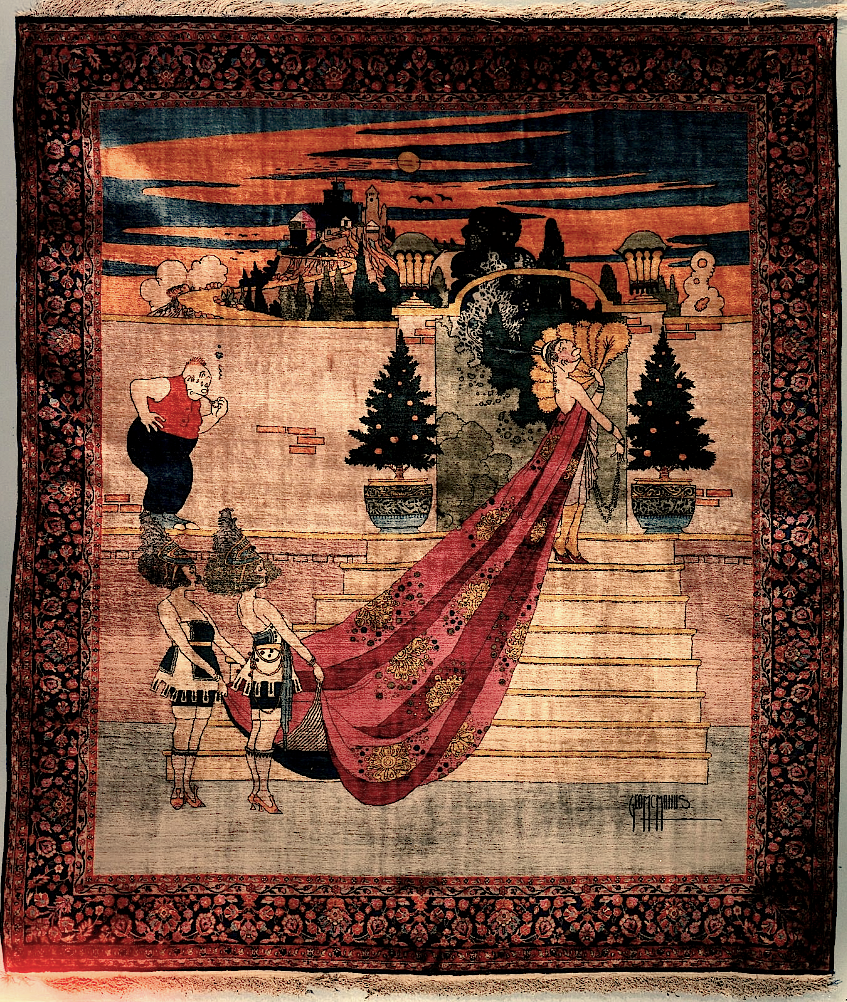
[7] A 1925 photo of comic author-artist George McManus in front of a Persian rug made after his Circulation cover art.
[8] The resulting Persian rug — made after the cover of Circulation #6, February 1922.
[9] Circulation #18, February 1925, the Persian rug article.
[10] Circulation #9, September 1922, “Please page Barney Google!” — cover by Billy DeBeck.
[11] Circulation #11, March 1923, Barney Google on his horse Spark Plug — cover by Billy DeBeck.
[12] “Barney Google Fox Trot” — 1923 sheet music front cover by Billy DeBeck.
[13] Circulation #12, April 1923, ‘The Picture Folk’ — a poem about the soul of the Sunday Funnies.
[14] Circulation #12, April 1923, Bringing Up Father — cover by George McManus.
[15] Circulation #13, July 1923, “Hey Boob!” Boob McNutt prepares for the 4th of July— cover by Rube Goldberg.
[16] Nemo, the classic comics library #24, February 1987, cover for a special issue on Rube Goldberg.
[17] Circulation #18, February 1925, St Valentine’s Day — cover by James H. Hammon.
[18] Circulation #19, April 1925, Bringing Up Father — cover by George McManus.
[19] Circulation #4, September 1921, comic author-artist Elzie Segar ‘…getting ideas at home where all is quiet…’ — strip cartoon by E.C. Segar.
[20] Circulation #20, Augustus 1925, five bathing beauties present “Front Page Marine News” to Neptune, the god of water and of the sea — cover by Alexander Popini.
[21] Circulation #22, December 1925, Polly and Her Pals, wooden christmas tree and puppets — cover by Cliff Sterrett.
[22] Circulation #25, July 1926, Abie the Agent and friends blown away from the author’s table, with a self-portrait of their maker — cover by Harry Hershfield.
[23] Circulation #26, September 1926, “The Magic Carpet of the Comics” — cover by Louis Biedermann.
[24] Circulation #26, uncropped xerox copy of the front cover.
[25] Circulation #18, February 1925, “A Scribe’s Lament” by William F. Kirk — illustrated by James H. Hammon.

You have now seen fourteen surviving Circulation covers, most over ninety years old, finally shown together here — some in damaged state, some xeroxed, some too closely cropped, but, one excepted, all in their original colours.

Any lead, or any more background information to solve this Circulation mystery is welcome.

Huib van Opstal

[ to be continued ]


This is part 2 of a series — see Part 1 HERE.


THANKS TO
[all issues] Robert Beerbohm & BLB Comics       
[10] [14] courtesy of Brian Walker 
[20] courtesy of  Carsten Laqua & Galerie Laqua 
[4] courtesy of Craig Yoe & I.T.C.H.     
[17] courtesy of Rob Stolzer  
Mark Johnson
Cyril Koopmeiners
Ianus Keller


Wednesday, December 31, 2014

Circulation magazine – a Chat with King Features Syndicate, Inc.

     
[1] Sidney Loeb, the Editor of CIRCULATION magazine, is introduced to Little Jimmy's Lil’ Ole Bear! 

"The circulation of CIRCULATION MAGAZINE - subtitled: 'A Magazine for Newspaper-Makers' - is just 5,000 copies an issue. Because it is sent to every newspaper executive in the country, and to hundreds of advertising agencies and national advertisers, it is registered as third class mail. If you miss your copy write to us, and we'll mail one to your home." - Circulation Chat editorial, in #4, Sep 1921.

[2] King Features sold journalistic productions of all kinds, and notably comic strips in black-and-white and full-colour.
[3] Circulation #4, Sep 1921, cover by Joe McGurk. "Can you fancy Kayo Tortoni, the beautiful newsie of the skies, delivering your paper every morning?"
[4] Circulation #25, July 1926, "Bughouse Fables" by Paul Fung.
"King Features Syndicate, Inc. - the greatest family of circulation boosting comics on earth!"

[5] Circulation #3, July 1921, "Why Are Comic Pictures Necessary in Sunday Newspapers?" by Arthur Brisbane. 
[6] Arthur Brisbane.
[7] Circulation #18, Feb 1925, Happy Hooligan is hired to laugh, strip by F. Opper.
[8] Circulation #12, Apr 1923, Jimmy Swinnerton at work in Canyon Country.
[9]
"The COMIC-ARTISTS Show That They can DRAW!" Circulation #26, Sep 1926.

[10] Circulation #24, May 1926, Li'l Ole Bear M.D. - for which Jimmy Swinnerton pictures his editor who signed the article as "Noted Author and Critic" Beol Yendis.
[11] Circulation #25, July 1926, "The Newspaper Art Gallery" by Sals Bostwick.
[12] Circulation #3, July 1921, "To Laugh or Not to Laugh" by Alexander Black.
"King Features Syndicate, Inc. - the greatest family of circulation boosting comics on earth!" Circulation Chat editorial
         
[13] Circulation #18, Feb 1925 Harold H. Knerr - author of the strip "The Katzenjammer Kids" - was interviewed by Walter E. Sagmaster for Smart Set magazine.
[14] Circulation #3, July 1921, cover by Nell Brinkley.
[15] Circulation #3, July 1921, "Down on the Farm", a new strip by F. Opper. 
[16] Circulation #25, July 1926, R.F. Outcault writes about his friend Fred Opper, who's already making fun for half a century!
[17] "Mr. Opper has done his share as a grouch destroyer."
[18] Circulation #9, Sep 1922, "Mr. Frederick Burr Opper", by Penelope Clarke.
[19] Circulation #26, Sep 1926, announcement for Ad. Carter's strip "Just Kids".
[20] Circulation #19, Apr 1925, Happy Hooligan marvels at the Editors and Publishers Banquet, strip by F. Opper.
[21] Circulation #4, Sep 1921, "The Relativity of Art and Comic Art" is what Billy DeBeck and R.B., Jr. discuss.
   
"It is well known that George Herriman puts so much 'serious' art into 'Krazy Kat' that great painters and critics fight frantically for his originals." - Circulation #26, Sep 1926.
[22] Circulation #4, Sep 1921, "The Relativity of Art and Comic Art".  Barney: "Come on, Boss - I feel like a hoss in a garage!"
[23] PICTURE RHYME - Cover of The Saturday Evening Post, 13 Jan 1962, showing "The Connoisseur" by illustrator Norman Rockwell (b.1894).
[24] Circulation #11, Mar 1923, "Why Newsies Get Rich" by comic strip maker Fay King who pictured herself.


For most readers of YESTERDAY'S PAPERS this is just a first glimpse of CIRCULATION magazine, a promotional paper published at irregular intervals from 1921 to 1927 by King Features Syndicate, Inc. in New York City, NY. My present estimate is that at least 29 issues were published. The earliest I saw is from 1921, the latest from 1927. 

BUT UP TO NOW JUST 15 NUMBERS HAVE RESURFACED (11 full issues, plus from 3 issues only the covers, and from 1 issue only the interior).

Huib van Opstal


[ to be continued ]