

 Posts
Posts




Saturday, July 31, 2010

Friday, July 23, 2010
Harry Maguire (1832-1916)

Henry Carlton (or Calton) Maguire was, along with Robert Prowse senior, the most indefatigable illustrator of penny dreadful and boys story papers of the eighteen sixties, seventies and eighties. “Harry” Maguire led a double-life, one as a respectable illustrator of music sheets (c.1860-1885), and one as a provider of thrilling woodcuts for penny dreadful and boys’ story papers.

According to his baptismal certificate Maguire was born on 24 July1832 (He seems to have shaved a few years off his age in various census reports) in Marleybone, Middlesex, London. Harry was the son of Henry Calton Maguire (1790-1854) a member of a well known Irish family of painters, etchers and lithographers working in London, and Eliza Bussman. The father, born in Dublin, produced lithographs for sheet music and was also a well-known water-colourist and book illustrator. After the death of the elder Maguire, Harry junior continued in the sheet music business producing lithographs for the songs of Arthur Lloyd, the Great Vance, Nellie Power and Harry Rickards. Maguire married Catherine Laura Pope in January 1860. She died in March 1889 without having borne him any children.
Harry Maguire sidelined drawing woodcut illustrations for the penny dreadful trade. His earliest known penny dreadful employer was the Newsagent’s Publishing Company at 147 Fleet-street. Maguire illustrated Vane Ireton St. John’s The Wild Boys of London; or, the Children of the Night, published on July 17 1864, The Work Girls of London; their Trials and Temptations in 1865, and The Boy Pirate; or, Life on the Ocean a Novel, also in 1865. In October 1867 he illustrated The Boy Detective; or, the Crimes of London.

In 1867 Maguire was employed by William Emmett Lawrence illustrating serials in the Young Englishman’s Journal which began on 13 April 1867. For the first seven issues the Young Englishman’s Journal was published by John Millbank Crisp of Temple Publishing Company, 45, Essex Street, Strand. Temple had been an early penny dreadful rival of the NPC. The first serial to feature Maguire’s woodcuts in the Young Englishman’s Journal was Willie Gray; or, the Wreck of the Polar Star. In number 8 appeared George Emmett’s famous serial Boys of Bircham School, partially illustrated by Maguire. His prolific woodcuts were used as illustrations to serials by Captain Mayne Reid, Charles Stevens, Vane Ireton St. John, Percy Bolingbroke St. John, and William Stephens Hayward. Henry Carlton Maguire became a member of the Society of Arts in 1869 while living at Brook villa, Earlsbrook-road, Redhill. According to one relative Henry also gave elocution lessons to actors and taught fencing to military officers.

In 1870 Charles Stevens Alone in the Pirate’s Lair was issued in penny parts. Pirate’s Lair was reprinted from The Boys of England, where it had been the opening serial for the first issue on 27 November 1866. Frank Jay says that most were illustrated by “an artist named Hebblethwaite, who could draw as well with his left hand as with his right,” but the 1870 parts work was illustrated by Harry Maguire.
The Young Englishman’s Journal was incorporated into The Sons of Britannia on 14 Mar 1870. Maguire continued drawing the cover serials and was so popular that his name was used in advertising material for the various Emmett story papers and penny parts. The 1871 census listed Maguire under the name Henry Maguire. He was described as an artist living in Islington with his wife Catherine (born in 1835), a nephew and a niece. In this census Annie Savory, who Harry was later to live with in a common-law situation, is listed as "artist's wife" and is living with daughter Kate and a servant.

Maguire was the most frequent contributor of illustrations for The Sons of Britannia. He seems to have been a favorite with George Emmett and illustrated all of his employers’ titles including Tom Wildrake and the famous Shot & Shell series. The Sons of Britannia’s last number was No. 394 on September 15, 1877 and the paper was to have been incorporated with The Champion Journal, which I have not been able to trace. Maguire also contributed to The Boys’ Standard, published by William Lucas then Charles Fox, which ran from 6 November 1875 to 7 March 1881. Its only speculation but I think in the eighties Maguire may have contributed full-page woodcuts for Charles Fox penny dreadfuls of Spring-Heeled Jack, Cartouche, and Sweeney Todd. The style is quite different from his early work, and unsigned, but there are a few resemblances to his sixties and seventies work.
Harry Maguire is recorded in the 1881 census under the name Henry Carlton, living at 13 Avenue Road, Wanstead, Essex, with Annie Savory and the following children; Kate (born 1870) Annie (born 1872) Henry (born 1874) Jenny (born 1877) Lody (born 1879) and Sarah (born 1881.) All the children were registered with the surname Carlton. Harry Maguire is described as an "artist and draughtsman (with "E & M" in brackets.) He married Annie Savory, with whom he had had a long-standing relationship, in July 1889 - i.e. after she had borne him 9 children. The other children were Mabel and Emily - presumably there was another who died in infancy.
By the time of the 1891 census Maguire is listed as married to Annie, aged 42, also born in Marleybone. Their home was at 1 Zetland Villas, Lewisham, and was described as a “lithographic artist.” The couple had seven children: Harry, born in 1874 in Tottenham, described as an artist’s pupil, Kate (born 1870, Islington), Annie (born 1872, Islington), Jane (born 1877, Brighton), Lody(?) (born 1880, Brighton), Mabel (born 1882, Leytonstone) and Emily (born 1883, Leytonstone).

The last work by Harry Maguire that I could find was the school story The Lambs of Littlecote by his old mate E Harcourt Burrage. The Lambs of Littlecote was published by the Aldine Publishing Company in 1894, and must have been one of the last penny dreadfuls published with wood engravings. By 1895 the photo process engraving sent the woodcut the way of the dinosaur. Maguire supplied the first 13 illustrations before the job was taken over by Robert Prowse junior.

In 1901 he was recorded as Henry C. Maguire, watercolour artist. He was a widow now and resided at 141 Bensham Lane with his son Henry Terrence, a photo process etcher, and a daughter, Mabel. By 1911 Harry was living with his son’s family at 1 Preston Road, Upper Norwood. Henry is now called Harry Carlton Maguire, and described as an artist. His son, now known as Harry T., was a process engraver. He and his wife Lilly had two daughters, Nora and Kathleen. Harry J.’s sister Annie Josephine, also a process engraver, shared the house with the couple.

Henry Carlton (or Calton) Maguire died April 1916, at Homelands, Park Place, Eltham, Lewisham. He was buried on 17 April 1916 at Norwood Cemetery.

By the time of the 1891 census Maguire is listed as married to Annie, aged 42, also born in Marleybone. Their home was at 1 Zetland Villas, Lewisham, and was described as a “lithographic artist.” The couple had seven children: Harry, born in 1874 in Tottenham, described as an artist’s pupil, Kate (born 1870, Islington), Annie (born 1872, Islington), Jane (born 1877, Brighton), Lody(?) (born 1880, Brighton), Mabel (born 1882, Leytonstone) and Emily (born 1883, Leytonstone).

The last work by Harry Maguire that I could find was the school story The Lambs of Littlecote by his old mate E Harcourt Burrage. The Lambs of Littlecote was published by the Aldine Publishing Company in 1894, and must have been one of the last penny dreadfuls published with wood engravings. By 1895 the photo process engraving sent the woodcut the way of the dinosaur. Maguire supplied the first 13 illustrations before the job was taken over by Robert Prowse junior.

In 1901 he was recorded as Henry C. Maguire, watercolour artist. He was a widow now and resided at 141 Bensham Lane with his son Henry Terrence, a photo process etcher, and a daughter, Mabel. By 1911 Harry was living with his son’s family at 1 Preston Road, Upper Norwood. Henry is now called Harry Carlton Maguire, and described as an artist. His son, now known as Harry T., was a process engraver. He and his wife Lilly had two daughters, Nora and Kathleen. Harry J.’s sister Annie Josephine, also a process engraver, shared the house with the couple.

Henry Carlton (or Calton) Maguire died April 1916, at Homelands, Park Place, Eltham, Lewisham. He was buried on 17 April 1916 at Norwood Cemetery.
*Thanks to Robert Kirkpatrick for his contribution of census material.

Wednesday, July 21, 2010
Gag Cartoons

Original artwork by 3 gag cartoonists: Dell, Engel, and Lubnay. Thanks to Don Kurtz.
*Update: Actually Dell, Bill Wenzel and George Ludway. See comment!


Tuesday, July 13, 2010
All Star Western

I began collecting DC comics All Star Western in 1955, when superhero titles were on the wane, and was a regular reader until its demise in 1961. The western comics were not signed in the fifties but I did recognize the work of one of the star artists, many years later revealed to be Gil Kane, from an earlier fascination with Rex the Wonder Dog, a tree-climbing horse-riding, car-driving canine hero based on Rin Tin Tin.
All Star Western began with no. 58 (April-May 1951), making use of the title of the discontinued All Star Comics, home to the long-running series Justice Society of America. The great artists and writers on All Star Western, as well as the Julius Schwartz science-fiction titles, would also be the crew responsible for DC’s later return to superheroes with The Flash (Carmine Infantino) and Green Lantern (Gil Kane).
All Stars’ most prolific contributing writer was Robert Kanigher along with John Broome and Gardner Fox. The stories were as gimmicky as the corresponding science-fiction titles. The first major feature was the Trigger Twins, a buckskin duo, one brother a milquetoast Clark Kent type, the other equivalent to a gun-toting Superman. The stories were drawn by Gil Kane and Carmine Infantino. Among the artists who contributed for the next ten years were Carmine Infantino, Gil Kane, Alex Toth, Ross Andru, Irwin Hasen, Howard Sherman, Leonard Starr, and Dan Barry.
All Star Western was canceled with no. 119 (June-July 1961) in the middle of a two part story featuring Johnny Thunder and a beautiful masked gunwoman named Madame .44. I had been a little upset by the fact that Johnny Thunder had changed his marvelous fringed jacket for a red shirt --much more upsetting was the demise of All Star Western, one of the best drawn comic book westerns of the fifties.


Thursday, July 8, 2010
Comics of World War II

During World War II a lot of comic strip heroes fought the Axis. Captain Midnight first appeared on radio and made his debut in the comic books in Dell’s The Funnies no. 57 in July 1941 by artist Robert Brice. In 1942 Midnight changed publishers to Fawcett, home of Captain Marvel, and made his appearance in a Chicago-Sun newspaper strip signed Jonwan. Two more strips from 1942 were Race Riley and the Commandos by Milburn Rosser and Captain Yank by Frank Tinsley which originally ran under the title Yankee Doodle. In these samples from 1943 Lt. Dick Calkins Buck Rogers took on the Shintos, a super race whose uniforms were decorated with a backwards swastika. Don Winslow of the Navy was by Frank V. Martinek and the comic book was also produced for Fawcett comics. Russell Keaton’s Flyin’Jenny also had a Fawcett connection in the person of artist Marc Swayze, who pens a regular column for Alter Ego called “We Didn’t Know it was the Golden Age.” Last we have the marine Stony Craig by Frank H. Rentfrow and artist Bouchard.


Sunday, July 4, 2010
More Vernon Greene

Sherri, of Vancouver, Washington, has sent me some interesting scans concerning Vernon Greene, who took over Bringing up Father in 1954. Vancouver is a fairly large city on the North bank of the Columbia River. Battle Ground borders Vancouver on the north east. I grew up in Trail, British Columbia, on the Canadian side of the Columbia River, but I only made it as far south as Spokane myself.
Recently Sherri purchased a little memory book of Battle Ground High School Class of 1926 (Vernon Greene’s Class). Inside there is an undated newspaper clipping (from approx. June 3rd 1929) about Vernon; who was leaving for a new position at the Toledo News Bee. You can see from the school page that his nickname was “V.V.” Greene's high school graduation was on May 27, 1926.
Sherri thought the Greene image of the moustachio’d older man might be that of a school official. The original owner of the memory book was Adelma Peterson. The Greene comic strip below was from the Canadian Star Weekly for 14 April 1956. Thanks Sherri!


Sunday, June 27, 2010


Thursday, June 24, 2010
The Elizabeth Caroline Grey Hoax
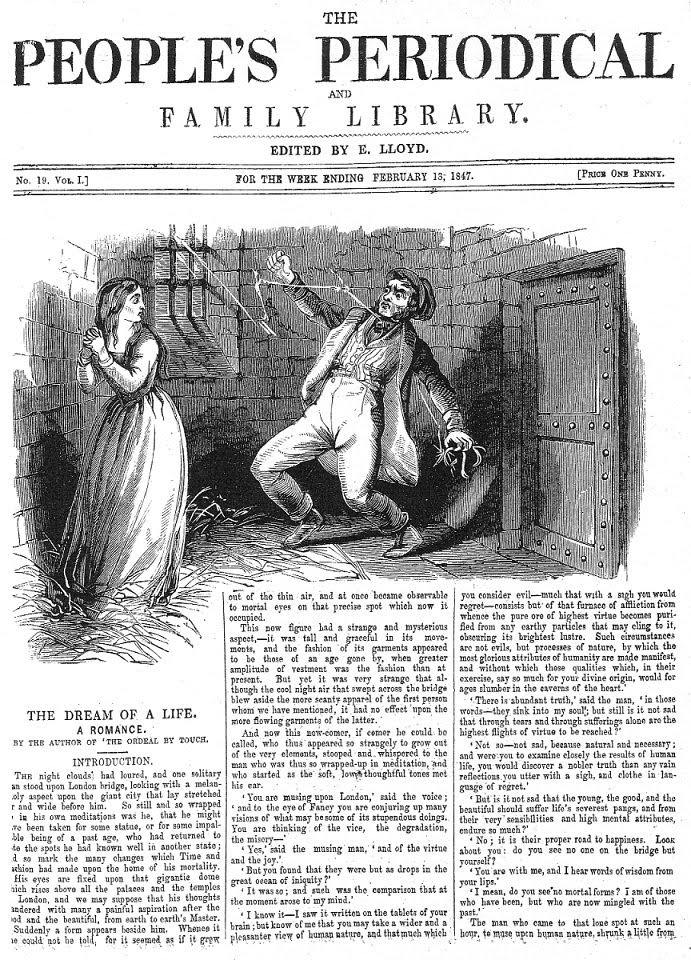
In my previous post on Edward Lloyd’s 1842 publication of Gentleman Jack; or, Life on the Road, I mentioned that the penny blood had somehow come to be associated with Elizabeth Caroline Grey, who appears in many catalogues of the eighteen-seventies and eighties as “Mrs. E. C. Grey.” Although her name never appeared on any title-page a large collection of Lloyd bloods have been attributed to her simply by following the “by author of” title-chains that did appear on title-pages. One example would be the penny parts work The Dream of a Life, which was “by the author of Vileroy; or, the Horrors of Zindorf Castle, The Ordeal by Touch, and Gentleman Jack” Before appearing in bound volume The Dream of a Life was serialized in Edward Lloyd’s People’s Periodical and Family Library, Vol. I No. 19, 13 February 1847.
It is hard to imagine that Elizabeth Caroline Grey, popular author of a large number of 3 volume silver fork novels, could have moonlighted as a penny-a-liner for Edward Lloyd. Helen R. Smith, in “New Light on Sweeney Todd, Thomas Peckett Prest, James Malcolm Rymer and Elizabeth Caroline Grey,” came to the conclusion that James Malcolm Rymer was the author of the string of novels confusingly attributed to Mrs. Grey, which I am in total agreement with. Rymer had an odd writing tell: the phrase “Pho! pho!” which appears in almost every one of his credited works, including Edith the Captive, The Dark Woman, Ada the Betrayed, Jane Brightwell, and Captain Hawke. “Pho! pho!” also appeared in Blueskin, a work usually attributed to Edward Viles, and in two works attributed to Mrs. Grey; Gentleman Jack and Claude Duval. It may seem silly, and it is still not proof, but it does buttress the idea that Rymer wrote Gentleman Jack and the other titles in the Grey title-chains.
Elizabeth Caroline Grey’s name never appeared in print on any of the Lloyd bloods, that attribution was made by a man named Andrew De Ternant in Notes & Queries in 1922. De Ternant even provided a ‘biography’ which has been repeated down the years so often that it has been reported as fact in reputable encyclopedias and Wikipedia to this day. My library’s catalogue entry for Gentleman Jack even provides Mrs. E. C. Grey’s DOB and DOD as 1798-1869.
Patrick Spedding has investigated the subject in a forthcoming work from The Papers of the Bibliographic Society of America entitled “The Many Mrs Grey: Confusion and Lies about Elizabeth Caroline Grey, Catherine Maria Grey, Maria Georgina Grey and Others,” in which he uncovers the fact that De Ternant was a notorious liar who invented in its entirety the “biography” of Mrs. Grey as told to him by a dead man who had worked for Edward Lloyd named Mr. Church. De Ternant provided much other dubious information on Lloyd authors including one story that I repeated myself in my recent post on Highwayman Literature, to wit; that Lloyd’s editor Thomas Catling, also deceased at the time, apparently told Andrew De Ternant he had seen John Frederick Smith, celebrated author of “Minnigrey,” working on the first fifty numbers of Black Bess in the office of Lloyd’s Weekly News at the rate of £3 10s.weekly. Thanks to Patrick Spedding this and all other statements by Andrew De Ternant in N&Q regarding penny bloods can safely be considered as malicious fabrications.
Ternant now joins a growing rogue’s gallery of hoaxers who have made life hell for historians and researchers of penny bloods; men like the Melbourne bookseller J. P. Quaine who sent collectors on a wild goose chase by inventing ‘ghost’ titles like The Skeleton Clutch; or, The Goblet of Gore, and Sawney Bean the Man-eater of Midlothian. The worst offender was popular anthologist Peter Haining who provided a spurious ‘biography’ of the fictional character Sweeney Todd, a story which spread like a virus on the internet, filled his Legend and Bizarre Crimes of Spring Heeled Jack with invented newspaper stories to pad what would have been a short book without them, and hoaxed Romany scholars with fabricated gypsy incantation that he claimed came from the Grimorium Verum, apparently a real book which has not survived, for which he gave a publication date of 1517.
Another claim of Peter Haining's was made in his book The Vampire Omnibus (1995) which reprints "The Skeleton Count; or, the Vampire Mistress," purportedly written by Elizabeth Caroline Grey for The Casket in 1825. This one is currently under investigation but undoubtedly, since there was no 'real' Mrs. Grey, will turn out to be another Haining hoax, possibly even a forgery.

My Thanks to Patrick Spedding for allowing me to read a draft of his forthcoming article “The Many Mrs Grey: Confusion and Lies about Elizabeth Caroline Grey, Catherine Maria Grey, Maria Georgina Grey and Others” and generously granting permission to publicize his findings.

Tuesday, June 22, 2010
Gentleman Jack

“Pull slowly and quietly,” said Dick.
The bucket came up to the surface, and then Claude stretched out his hand and got hold of it.”
“All’s right,” he said, “I have it.”
He drew it towards him, and then, in a rather odd voice, he said --
“The light, Jack.”
Jack picked up the lantern from the floor and held it over the bucket, and then they all three looked in silent horror at what it disclosed to them.
Floating in the water they had got up from the well was a portion of an infant’s hand and arm, and a large piece of a skull with hair still upon it.
The water itself had a shiny, oily look, and upon its surface floated fatty globules, and what appeared to be pieces of half decomposed flesh.
“Horrible!” said Claude.
Jack turned aside sick and faint at the sight.
“Good God!” said Dick.
That was Sixteen-string Jack (the Gentleman of the title,) Claude Duval, and Dick Turpin, the heroes of Gentleman Jack; or, Life on the Road, published by Edward Lloyd in 1842. It was published weekly in penny numbers for a total of 544 pages, Nos. 2, 3, & 4 Gratis with No. 1. The title-page enlarged on the title; Gentleman Jack; or, Life on the Road, a romance of interest abounding in hairbreadth escapes and of the most exciting character. The fanciful woodcut illustrations were by G. T. R. Bourne.
Nine years later, in 1851, Abel Heywood, a seller of cheap literature in Manchester told a House of Commons committee that his best selling penny weekly numbers were Claude Duval (550), Gentleman Jack (400), Paul Clifford (350), and Three-Fingered Jack (350). “Gentleman Jack” was pirated by New York publisher Robert M. De Witt who published the entire serial in 100 page installments at twenty-five cents a volume. From the looks of the De Witt cover below even the colorful Bourne woodcut was copied for the cover.

Gentleman Jack was anonymous but over time the authorship came to be attributed to Mrs. Elizabeth Caroline Grey (a hoax). More recently Helen Smith has attributed authorship of the Grey/Lloyd titles to James Malcolm Rymer. A good chunk of the De Witt piracy of Gentleman Jack (wrongly attributed to Edward Viles) is on Google Books HERE. James Malcolm Rymer’s Ada the Betrayed, and Jane Brightwell, HERE.
Saturday, June 19, 2010
Highwayman Literature

Highwayman literature crossed the boundaries between high and low literature. In the thirties and forties the penny-a-liner and the acclaimed literary author vied for the same audience, using the same subject matter. Each exerted a similar mutual organic influence on the other, leading on the one hand to the Newgate novel, and on the other to G. W. M. Reynolds’s “Mysteries of London” and Thomas Prest’s “Posthumous Notes of the Pickwickian Club.” 


Highwayman literature was described in the Athenaeum in 1870 as “”vulgar, but not indecent. The Highwayman Literature, the Black Bess, Turpin, or Sixteen-String Jack books, the Jack Sheppard adventures, still had, and have, their public. The highwayman, who, with the rope round his neck, swore that a gallop across a common by moonlight was delicious, is a hero now, when commons and highwaymen no longer exist as of old, but are far enough off to have a stirring poetry and rough romance in their details.”
The first known work of highwayman literature in England was about the life and execution of Elizabethan highwayman Gamaliell Ratsey who disguised his features with an owl mask while carrying out his criminal endeavors. Two pamphlets were published shortly after Ratsey's death in 1605; “The Life and Death of Gamaliell Ratsey,” and “Ratseyes Ghost.” The trade in broadsides and chap-books increased mightily in the years that followed. No sooner was a highwayman caught and convicted than his exploits became the subject of a “Life,” usually hawked to the crowds while the miscreant was nervously standing under the noose pondering his last moments on earth. Jack Rann, commonly called Sixteen-String Jack, was the subject of an illustrated “Life” the same year he was caught and hanged in 1774, William Hawke, also in 1774, Claude Duval in 1669, James Hind in 1652, and Henry Simms in 1747.
Various criminal anthologies collected the lives of highwaymen. Captain Alexander Smith wrote “A History of the most Noted Highwaymen, Footpads and other Thieves” in two volumes in 1714. Charles Johnson produced “History of Highwaymen, Murderers &c.” in 1734. “An Account of Highwaymen” was written by William Jones in 1774 and Charles Whitehead’s “Lives and Exploits of English Highwaymen” appeared in two volumes in 1823.
For the educated classes there was ample highwayman material to be found in “The Newgate Calendar; or Malefactors’ Bloody Register,” published about 1774 and running to five volumes. Between 1824 and 1826 Knapp and Baldwin, attorneys-at-law, issued four volumes of “The Newgate Calendar comprising interesting memoirs of the most notorious characters,” and followed up with six volumes of “The New Newgate Calendar.”
The highwayman was not exclusive to Britain. French highwaymen like Duval, Cartouche, Louis Mandrin, and Macaire were celebrated in pamphlets and chap-books in England and on the continent. Italy suffered the banditry of Il Birarro and Fra Diavolo, Germany had Schinder-Hannes, whose real name was John Buckler, Spain hosted Jose Maria de Hinojosa and Polinario. “The Life and Actions of Lewis Dominique Cartouche who was Broken Alive on the Wheel at Paris,” attributed to Daniel Defoe, was published in 1722. “Authentic Memoirs of the Remarkable Life and Surprising Exploits of Mandrin” was published in 1754 and cost one shilling. G. W. M. Reynolds wrote “Robert Macaire in England” in 1840.

In 1830’s Britain the onerous stamp duty, or “taxes on knowledge,” imposed on any publication dispensing “news,” led many of the penny publishers to diversify with weekly miscellanies, comic periodicals, political pamphlets, song-books and sensational criminal literature. The visual use of front-page caricatures, portraits, and sensational woodcuts helped many of the penny periodicals to outsell their more expensive mainstream rivals.
The penny “blood” has often been presented as following closely in the footsteps of gothic literature but whatever influence there was would appear to be minor. Thomas Frost, who wrote bloods for Edward Lloyd and George Purkess explained the genesis of such literature in Forty Years’ Recollections: “It was the connecting link between the Monmouth Street Ballads and ‘last dying speeches,’ lives of highwaymen, and terrific legends of diabolism which constituted the favourite reading of the masses fifty years ago, and the more wholesome refined literature enjoyed by them at the present day.” And W. E. Adams wrote, in Memoirs of a Social Atom: “Mr. Lloyd was the legitimate successor of the old Alnwick printer -- Catnatch of the seven Dials. He began business as the printer of sheets that were hawked and sold by the “flying stationers” -- records of prize-fights, of murders, of executions, and of what purported to be “last dying speeches and confessions.””
In London in 1832 John Duncombe published “Lives and Adventures of the Most Remarkable Highwaymen, Footpads, Notorious Robbers, and Other Daring Adventurers,” an eight-page penny parts weekly with a front-page woodcut illustration. The publisher’s description promised “illustrated popular accounts of crimes that are narrated in a sensational manner,” and the pamphlet was re-issued in 1833.
William Harrison Ainsworth published his highwayman novel, “Rookwood A Romance,” in April 1834, the first use of the character Dick Turpin outside of the chap-books and penny periodicals. “The chief object I had in view was to see how far the infusion of a warmer and more genial current into the veins of Old Romance would succeed in reviving her fluttering and feeble pulses.”
George Augustus Sala (1828-1895) described “Rookwood” as an “interesting but unequal romance -- Turpin’s ride to York, as a piece of word-painting, has been rarely, if ever, surpassed in prose in the Victorian era.” Punch, the comic journal, called Ainsworth, “the greatest axe-and-neck romancer of his time.”
The publication of “Rookwood” had an immediate effect on popular culture. The penny dreadful and the melodrama worked arm in arm in popularizing the criminal hero and his steed, Black Bess. The Gentleman’s Magazine described Dick Turpin melodrama as “thieves’ literature dramatized.”
In December 1834 John Duncombe issued “Adventures of Famous Highwaymen and Other Public Robbers -- New Edition,” capitalizing off “Rookwood’s” popularity. In 1836 George Purkess published “The History and Lives of the Most Notorious Highwaymen, Footpads, Murderers, Brigands, Pickpockets, Thieves, Banditti , and Robberies of Every Description” in 60 weekly parts. By the seventeenth number publishing was transferred to Edward Lloyd. “The History and Lives of the Most Notorious Highwaymen, Footpads and Murderers” began Saturday, April 30, 1836 and ran until June 10, 1837 to a total of 60 weekly numbers. The material was borrowed from such works as “The Newgate Calendar; or Malefactors’ Bloody Register,” (c. 1774) and various criminal anthologies collecting the lives of highwaymen.
In 1837 William Clarke published “Annals of Crime; or, the Highwaymen of Old” in 59 nos. “Rookwood’s” popularity brought forth various penny parts works featuring Dick Turpin. George Purkess issued “Dick Turpin’s Ride to York” in 1839 and Henry Downes Miles wrote “The Life of Richard Palmer better known as Dick Turpin” the same year.

William Harrison Ainsworth’s “Jack Sheppard” commenced in Bentley’s Miscellany in January 1839 and came to a conclusion in February of 1840. Almost immediately there appeared a plague of Jack Sheppard melodramas. In 1839 the Examiner noted that “Jack Sheppard is the attraction at the Adelphi; Jack Sheppard is the bill of fare at the Surrey; Jack Sheppard is the choice example of morals and conduct held forth to the young citizens at the City of London; Jack Sheppard reigns over the Victoria; Jack Sheppard rejoices crowds in the Pavilion; Jack Sheppard is the favorite at the Queen’s; and at Sadler’s Wells there is no profit but of Jack Sheppard.” Schiller’s 1781 drama “The Robbers” was said to have had a similar deleterious effect on the youth of Germany.
Like Dick Turpin the boy burglar was celebrated on stage and in penny fiction. He was a major character in highwayman romances like“Edith the Captive; or, the Robber’s of Epping Forest” (1860) and “Blueskin: A Romance of the Last Century” (1863). He was re-imagined as “Charlie Wag, the New Jack Sheppard,” and as “Cartouche, the French Jack Sheppard.”
Mrs. Elizabeth Caroline Grey was the only known female author of highwayman bloods in the forties, although the attribution is questionable. “Claude Duval, the Ladies Highwayman” and “Paul Clifford” were attributed to her authorship. All her works were published by Edward Lloyd. Grey’s most popular title was “Gentleman Jack; or, Life on the Road,” which ran to 544 pages and featured Sixteen-String Jack, Dick Turpin, and Claude Duval operating in the same time period. “Gentleman Jack” was pirated by New York publisher Robert M. De Witt who published the entire serial in 100 page installments at twenty-five cents a volume.
Pierce Egan wrote “Captain Macheath; or, the Highwayman of a Century Since” in 17 numbers in 1842. “Cartouche: the Celebrated French Robber” was published in 3 volumes by R. B. Peake in 1844. James Malcolm Rymer wrote “Captain Hawke; or, May Boyes and the Shadow of Death” (1845) for Lloyd. George Purkess published a highwayman novel by Thomas Frost, “The Black Mask; or, the Mysterious Robbers.”
One of the most prolific authors of highwayman tales in penny parts was James Lindridge who wrote almost exclusively for George Purkess in 1845. He wrote “Tyburn Tree; or, The Mysteries of the Past,” “The Life and Adventures of Jack Rann, Alias Sixteen-String Jack the Highwayman,” and “Jenny Diver, The Female Highwayman.” “Tyburn Tree” was a mixed bag of characters, real and imaginary, featuring Blueskin, Jonathan Wild, Captain Jem Macleane, Captain Fury, Dick Flybynight and the Black Gang, Sal the Gonoff, Blackmoor, Captain Grawler, Gipsey Betty, Jenny Diver, Handsome Jack, Lawyer Doom, Beauty Ellis, Tramping Ned, Mother Sin, and the alchemist Dr. Trotter. “Tyburn Tree” was pirated in America by numerous publishers from 1850 to 1866 in 100 page volumes.
Most penny bloods were “always in print” and most of the titles mentioned were still available throughout the entire decade of the fifties. A few new titles were “Jonathan Wild; or, The Thief-taker’s Daughter,” by Ambrose Hudson, and “Tom King, the Life and Adventures of the Highwayman,” published by Lloyd.
“Edith the Captive; or, The Robbers of Epping Forest,” by penny-a-liner James Malcolm Rymer, was published by John Dicks in 1860. Rymer’s previous employer Edward Lloyd had dropped penny bloods for newspaper publishing and after a fallow period Rymer began contributing penny dreadful romances to Reynolds’s Miscellany, also published by John Dicks. Rymer catered to a mixed audience of males and females, the title of “Edith the Captive” attracted women, while the serial contained enough blood and thunder to satisfy the male reader.
The hero of “Edith the Captive” was Captain Heron, riding a horse named Daisy, who, in company with Blueskin and Jack Sheppard took on the villainous Jonathan Wild. In 1861 “Edith” was adapted to melodrama, beginning at the Victoria Theatre and soon taking over most of the low theatres and penny gaffs. “Edith” was still being staged as late as 1866 at the Bower Theatre. Rymer followed up with “Nightshade; or, Claude Duval, the Dashing Highwayman” in 1863. Nightshade was Duval’s well-trained horse. In 1866 Rymer wrote “The Dark Woman; or, The Life and Adventures of Sixteen-string Jack,” which was published by John Dicks.
In 1863 Edward Harrison published the most famous highwayman penny dreadful of them all, “Black Bess; or, the Knight of the Road, a Tale of the Good Old Times,” which was published anonymously. Black Bess ran to 254 penny weekly numbers and 2028 pages, each number consisting of eight pages of eye-straining type. At its peak it was selling 30,000 copies a week. “Black Bess” ended in 1866 and was succeeded by a ‘sequel,’ “The Black Highwayman, Being the Second Series of Black Bess; or, The Knight of the Road,” which ran for a further two years. “Black Bess” was attributed to Edward Viles in 1888 by Robert Louis Stevenson, who may have gained his information from Walter Viles, Edward’s younger brother who he met through publisher James Henderson. Lloyd’s editor Thomas Catling, however, who was much closer to the source, apparently told Andrew De Ternant he had seen John Frederick Smith, celebrated author of “Minnigrey,” working on the first fifty numbers in the office of Lloyd’s Weekly News at the rate of £3 10s. weekly. The style of “Black Bess” changes so much throughout its long run that it probably ran through the hands of many writers.
The highwayman romances were often serialized in story papers and if successful made the rounds in penny weekly parts. Rymer, writing as Malcolm J. Errym, wrote “May Dudley; or, The White Mask” for Reynolds’s Miscellany in 1863, again appealing to female readers with a highway-woman heroine. In 1865 “The King’s Highway, A Romance of The Road 100 Years Ago,” featuring a young Paul Clifford, was published in the Miscellany. The writer was Edward Ellis, author of “Rook the Robber.” In 1866 Ellis contributed “A White face and a Black Mask.” Edward Ellis wrote “Ruth the Betrayer,” which was by the author of “Charley Wag, the New Jack Sheppard.” “Edward Ellis” was probably the pen-name of collaborators Charles Henry Ross and a fellow civil servant named Ernest Warren.

The serials of Rymer, Ross and Warren were written for an audience of mixed gender and appealed to adults, young adults and children. As the sixties wore on a large group of publishers in Fleet-street began publishing sensational penny dreadfuls and boys’ periodicals which were aimed at boy readers and often featured boy highwaymen, boy pirates and boy detectives. The Newsagents’ Publishing Company published a number of titles in 1864-65 including “Black Wolf; or, The Boy Highwayman” “May Turpin, The Queen of the Road, a Romance,” “Dick Turpin, a Romance of the Road,” and “Jack Sheppard and Jonathan Wild.”
Percival Wolfe’s “Red Ralph; or, the Daughter of Night a Romance of the Road in the Days of Dick Turpin” was published for the London Romance Company by the Newsagents' Publishing Company. “Starlight Nell, Queen of the Highwaymen; or, The Scarlet Riders of Hownslow Heath” by William L. Emmett was published by Temple Publishing Company, a precursor to Hogarth House run by the Emmett brothers. The NPC’s “Tales of Highwaymen; or, Life on the Road” was a serial weekly anthology of various sensational highwaymen fictions. In “The Blue Dwarf, a Tale of Love, Mystery and Crime” (1884) by Percy B. St. John, the dwarf of the title, Sapathwa, was joined by Dick Turpin and Tom King with adventures ranging from London through Scotland, Ireland, New York and the American west. Jonathan Wild was a character as was Rob Roy.
One reason for the longevity of the publics’ interest in Dick Turpin and the other knights of the road was explained by a writer on penny dreadful in the Pall Mall Gazette in 1882:
“Probably no living novelist has been rewarded by so extensive a circulation as is easily obtained by the boys “penny dreadful.” Many newsagents find the sale of these fictions the most lucrative portion of their trade. They keep files of back numbers, whereas with ordinary publications back numbers must be made the subject of a special order. There is a fortune in such books as that from which I have quoted. Some publishers grow rich on them. A good thieves’ romance will run through almost innumerable editions. “Blueskin,” “Black Bess,” and certain others, have been re-issued at the interval of a few months for over twenty years, and they are all of them announced for re-issue now.”
The highwayman dramas, which were staged as far back as the days of “The Beggar’s Opera,” had the advantage of spectacle with the use of real horses on the stage, even in the lowest of the “penny gaffs.” In 1859 the mare Beda played Black Bess in “The Life and Death of Dick Turpin,” “May Dudley; or, The White Mask,” introduced the celebrated horse, Black Eagle, “Cartouche, the French Jack Sheppard featured “a stud of beautiful and highly trained horses.”
“Cartouche”was the most successful of the continental highwaymen in the penny dreadfuls. The first version was published in the sixties by the Temple Publishing Company. In the eighties “Cartouche” was serialized in Fox’s “Boys’ Standard” and then issued in penny numbers by Charles Fox as “Cartouche, the French Jack Sheppard.” Collector Henry Steele wrote that it “may have been by Frank Mercer,” which was the pen-name of Walter Percy Viles, younger brother of Edward Viles.
In 1881 Alfred J. Isaacs and Sons, who were one of the publishers of the notorious ‘Anonyma’ series, issued “Ned Kelly: the Ironclad Australian Bushranger,” which was written by James Skipp Borlase. Occultist Arthur Edward Waite famously described the serial as “a Flatulent Farrago of Fatuous Fiction.” “Ned Kelly” veered widely from fact with the ironclad hero running into both Lola Montez and Charles Peace the burglar. Writing as J. J. G. Bradley Borlase had contributed “Bluecap the Bushranger the Australian Dick Turpin” to the “Boys’ Standard” in 1876.
How far did penny bloods penetrate onto the continent? The Journal des Debats noted in 1846 that “Mr. G. W. M. Reynolds’s “Mysteries of London” (First Series) have been reprinted in America; and translations have been published in four languages of Europe: namely, French, Spanish, Italian and German. The German Edition has sold to the extent of 8000 copies, of which great numbers have found their way into Russia in spite of the vigilance of the police. The book is literally devoured in Russia, and large sums are given for merely the loan of it.”
A late contribution to the penny dreadful was “Dashing Duvall; or, The Ladies’ Highwayman,” circa 1895, featuring Turpin, Tom King, Paul Clifford, Captain Blood and Van Vaughan the Vampyre. Illustrations were by the son of Robert Prowse, Robert Prowse Jr. The last substantial publishers of highwayman literature were the Aldine Publishing Company and George Newnes. Aldine’s “Dick Turpin Library,” which began in April 1902, ran 182 issues ending in 1904. Alfred Sherrington Burrage wrote the majority as ‘Charlton Lea,’ others were authored by Stephen Agnew. The painted cover illustrations were by Robert Prowse Jr.
The Aldine’s immediately began publishing a “Black Bess Library” which was taken over by George Newnes in January 1921. Newnes published a “Dick Turpin Library” which lasted from 1922 to 1930. The last of the Dick Turpin series was published by Pearson’s in 1935. They were reprints of the Aldine/Newnes material and lasted only six issues.
The highwayman never completely faded away, Dick Turpin and Claude Duval were picked up by British comic publishers, men who probably read the Aldines in their youth, and Ned Kelly and Dick Turpin were the subjects of motion pictures, but there is very little interest in highwayman literature today except among historians and penny dreadful collectors. Highwayman literature was a sub-genre of criminal literature from 1605 until 1935, a total of 330 years. The highwayman continues to appear sporadically in comics and literature but he is unlikely ever again to return to the level of popularity achieved in the nineteenth century.

*My thanks to Frederico Pagello for inspiring me to compile this brief incomplete history.
Subscribe to:
Posts (Atom)

