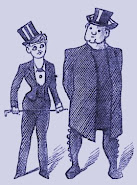
This autographed card, courtesy Don Kurtz, is the latest in our series of cartoon puzzlers. Was Tom Tracy the artist or was it Tom Tracy the character?
Monday, September 24, 2012
Tom Tracy – a Cartoon Puzzler
This autographed card, courtesy Don Kurtz, is the latest in our series of cartoon puzzlers. Was Tom Tracy the artist or was it Tom Tracy the character?
Friday, September 21, 2012
L.D. Bradley’s Children’s Books
by Richard Samuel West
LUTHER BRADLEY was one of the most admired and accomplished political cartoonists of the early twentieth century. But before that, he wrote and illustrated two charming children’s books that have largely been forgotten. Both were published in the fall of 1899 in a matching format by E.P. Dutton of New York and sold for $2 each. The first of the two, ostensively for boys, was Wonderful Willie! What He and Tommy Did to Spain It has the distinction of featuring cameo appearances by President McKinley, Spanish military men General Ramon Blanco and Admiral Pascual Cerveza, and the boy king Alfonzo XIII. The second of the two, ostensively for girls, was “Our Indians.” A Midnight Visit to the Great Somewhere-or-Other. It featured Bradley himself in a starring role.
Bradley was born in New Haven (Connecticut), September 29, 1853. He moved with his family to Chicago in 1857 and then a few years later just a bit farther north to Evanston. After attending Lake Forest Academy and studying at Northwestern University, he was admitted to Yale in the 1873. Two years later though he was compelled to drop out to return home to help his father in his real estate business. In 1882, Illness and boredom prompted him to take a sea voyage. After some time in Europe, he eventually landed in Melbourne Australia and took a job as the staff artist for a new weekly, Australian Tit-bits (published from June 12, 1884 to June 17, 1886; note the spelling; all American sources misspell its name as ‘Tidbits’) which became Life (June 24, 1886-91). In the late 80s, he switched allegiances and went to work for Life’s competitor, the Melbourne Punch (1855-1925). When his father took ill and died in 1892, Bradley reluctantly left Australian to return to Evanston to care for and support his widowed mother.
He was living with her in the family home, along with his sister Bessie, her husband, John R. Case, and their two children when he was inspired by the Spanish-American War to create his first children’s book, Wonderful Willie! What He and Tommy Did to Spain. It was a handsome oblong quarto full of color lithographs, some of them doublespreads, starring one of Bradley’s older sister’s sons, Willie and Tommy. Bradley explained in the opening words to the book:
![]() |
| [2] |
![]() |
| [3] |
“The following is mainly a facsimile of an old sketch book which was smeared with paint and ink to please a little boy who liked to be told stories and shown pictures “with animals in them.”
It was preceded by a smaller volume known as “Terrible Tommy” (now extremely rare as it has never been published) dealing with the adventures and misdemeanors of a youth of that name, who was reformed by the example of his brother, in cooperation with the well-disposed animals of a neighboring circus.
The simple idea of plugging the boys into the turmoil of war naturally suggested itself and was favorably received. So, in the hope that the little boy for whom the story was told is a sample boy of a large class, the author offers the book in its present form. The only distinction that he can claim for it is that it points no moral and hides no satire. And he even ventures to hope that it will not be taken seriously.”
![]() |
| [4] |
Inspired with his second work before he had completed his first, “Our Indians.” A Midnight Visit to the Great Somewhere-or-Other is actually set during the time Bradley was writing Wonderful Willie! He states in the foreword:
“These pages were originally painted and scribbled to please a little girl by materializing some fancies with which she had amused herself and others. The theme was the growth of numerous breakfast-table conversations in which the imaginary adventures of the preceding night were agreeably dwelt upon. A brother and an uncle having been gradually admitted to the favored circle, the three became accustomed to spend what was popularly supposed to be their sleeping hours in some mystic realm known as the place where “Our Indians” are. Why these kindly beings should have happened to be Indians is a puzzle with which this recital has nothing to do. But the illusion grew upon those who shared in it, until the Great Somewhere became almost a reality. The pictures served to bring a number of friends, big and little, into the charmed company, and in the belief that here and there about the world are others who would join in our mild diversions, we offer our experiences publicly.”
The story begins when Bradley’s niece Jane knocks on Bradley’s bedroom door at night while he is writing Wonderful Willie! to summon him as a companion on her trip to the Great Somewhere-or-Other. They climb a ladder into a waiting, floating canoe, steered by a friendly Indian and powered by a flock of reined geese.
When they arrive at the Indian village the Chief is distressed to see that Jack, Jane’s brother, has not accompanied them. Bradley explains that Jack had not been permitted to come because he had behaved badly (calling his uncle a ‘rubberneck’). The chief told two of his tribe to fetch Jack for chastisement. While the chief, Bradley and Jane wait for Jack, they dine and then go on the backs of water cranes in search of pond lilies.
Meanwhile Jack is on his way to the Indian village but has behaved so badly that his two Indian escorts abandon him in the wild. Jack is set upon by a bear, which he immediately vanquishes.
At the same time, Bradley and Jane lose their mounts because the water cranes cannot stand Bradley’s cigars. Left on a log in the marshes, Bradley and Jane are confronted by a crocodile, but their Indian friend in the flying canoe swoops in and saves them just in time. The Indian brings the trussed-up crocodile back to the Indian village at the same time that Jack appears with his bear.
Both get a hero’s welcome and a performance ensues. Then all the characters go fishing before returning home, where over breakfast they relive their midnight antics for their housemates who pay them no mind.
![]() |
| [12] |
![]() |
| [13] |
![]() |
| [14] |
![]() |
| [15] |
![]() | |
|
![]() |
[17] Note that an image from
Wonderful Willie is pictured on the wall of the dining room.
|
Both Wonderful Willie! and “Our Indians” were well publicized upon publication, but we could not find reviews or sales figures for either title. We can presume that they were not bestsellers since Dutton never asked Bradley for any sequels. By the time they appeared, Bradley had a new job: political cartoonist for the Chicago Daily News. His very first cartoon published July 5 revealed his mature, confident style. He was secure in his new position when in 1901 just after turning 48 he married Agnes Smith of Evanston. They went on to have four children: Francis, John, Sarah, and Margaret. Bradley in part due to his talent and in part to his relatively advanced age became regarded as one of the deans of American cartooning. Charles H. Dennis, editor of the Daily News, said of Bradley, “He had no patience with milk-and-watery cartoons.” When World War I began, he churned out one cartoon after another declaiming the “gigantic criminality of militarism.” He was at the height of his fame when he died at his home in Wilmette (where he had moved in 1909) on January 9, 1917, aged 63.
* Richard Samuel West’s new book Iconoclast in Ink; The Political Cartoons of Jay N. “Ding” Darling can be purchased HERE.
Wednesday, September 19, 2012
Dan Smith of the Journal – in the “Sunday Magazine Section”
![]() |
| “With Original Water Color Drawings by Dan Smith,” August 11, 1928 |
Dan Smith was a King Features artist in 1928 but so far I can find out very little about him. I have three crude photocopies from the Vancouver Sun featuring his romantic fantasy style, signed, and one comic strip, The Story of Superstitions, which may or may not have been illustrated by Smith. I found a photograph of an artist named Dan Smith in an old article in The Blue Pencil Magazine, an organ of The Blue Pencil Club, for June to October 1900. The photograph was from an article titled “Held by the Enemy.”
![]() |
| ‘The Story of Superstitions,’ after ‘The Golden Bough,’ by Sir James Frazer, Vancouver Sun, June 20, 1927 |
“One of the most pathetic incidents of the late unpleasantness with Spain – that is pathetic from the standpoint of the newspapers that paid their salaries while they waited – was the penning up of a score of brilliant American journalists and famous Park Row artists on the island of St. Thomas by the Spanish fleet… The speaking photograph above, now made public for the first time, shows how the New York section of that “round up” of newspaper men looked while they were held by the enemy… The picture was taken by the Journal’s boy photographer, Percy Byron, on May 16, 1898, in the front yard of Billy Sill’s headquarters, near the King’s wharf.”
Billy Sill was the representative of the Journal and Dan Smith was their artist. Cresson Schell, also pictured, was with Leslie’s Weekly. Sill went on to become dramatic editor of the Evening World.
![]() |
| ‘Diana’ by Dan Smith, July 15, 1928 |
The Blue Pencil Magazine can be browsed HERE.
![]() |
| ‘Andromeda’ by Dan Smith, July 21, 1928 |
Thursday, September 13, 2012
Bert Williams – King of Comedy
“They keep me out of a hotel where loafers are admitted without question, so long as they’re white. Then a professor or a lawyer or a doctor invites me up to his house. It’s a great, sad little world.” — Comedian Bert Williams
“NO NEGRO COMEDIAN EVER REACHED HIS HEIGHTS, AND NO WHITE COMEDIAN EVER SURPASSED HIM.” — Publisher and songwriter E.B. Marks
“He impressed himself vividly upon his time – notwithstanding that his time was one of keen, often cruel, competition, and the surging of vast conflicts, not propitious to the ministrations of a funmaker.” — Theatrical impresario David Belasco
“BERT WILLIAMS WAS THE FUNNIEST MAN I EVER SAW AND THE SADDEST MAN I EVER KNEW.” — Comedian W.C. Fields
I hate to see the evening sun go down,
Yes, I hate to see that evening sun go down,
’Cause it makes me think I’m on my last go ’round
St. Louis Blues by W.C. Handy
![]() |
| Williams caricature by Marius de Zayas |
BERT Williams was born Egbert Austin Williams in New Providence, British Bahamas in 1874 or 1876. Williams’ grandfather was the Danish consul in Antigua, who was married to a Spanish ‘senorita’ with African blood. His father was a papier-mâché maker, and his mother an octoroon. At least these were a few of the stories he told reporters over the years.
In an article for the American Magazine Williams wrote
“Williams, of course, is obviously not a Danish name. Nobody in America knows my real name, and, if I can prevent it no one ever will. That was the only promise I made to my father.”
When he was two years old the family moved to New York City then, in 1885, on to Riverside, California where the father worked as a conductor for the Southern Pacific. Williams told contradictory stories of how he came to the United States, once writing that he arrived “by way of Panama to San Pedro, California, now Los Angeles Harbor.”
Bert Williams graduated high school and began studying civil engineering in San Francisco while working as a bellhop in a hotel. His first theatrical job was with a mountebank minstrel company touring the mining and lumber camps of the great northwest in blackface.
“I took to studying the dialect of the American Negro, which to me was just as much of a foreign dialect as the Italian.”
![]() |
| Williams and Walker |
He joined comedian Ernest Hogan’s Minstrel Company where he met dancer and comedian George Walker (1873-1911). Williams played one of Hogan’s ‘ends’ and Walker the other. From Hogan’s troupe in 1899 emerged the ‘blackface’ duo “Williams and Walker” billed as “The Two Real Coons.” Once, while traveling through El Paso, Texas they were assaulted by a white mob, stripped and forced into burlap sacking. Humiliated, the pair never set foot in the South again.
![]() |
| NY Amsterdam News (Negro newspaper), August 3, 1919 |
Rennold Wolf, a journalist, described Williams’ and Walker’s act this way
“In all of their sketches, Williams was the slovenly hard luck coon and Walker the elegant bunco steerer. Just as Lew Fields, in all the Weber and Fields skits, invariably tricked the credulous Weber out of his money, so always did Walker, by some sort of a confidence game, gain control of Williams’ funds. Much of the fun of their acts was based upon Walker’s elegance, made possible by the unkempt Williams’ money.”
![]() |
| Ring Lardner in Chicago, around 1913 |
A young Chicago sports reporter, Ring Lardner, born in 1885, was smitten by Williams’ comic songs and the two became lifelong friends, even collaborating on songwriting together.
“He liked to take Williams to Stillson’s tavern, the hangout of Tribune reporters, and to other newspapermen’s haunts. But Williams did not feel at ease in such places; he rather sadly accepted discrimination, and even in later years, when, as a Ziegfeld Follies star, he was invited to stay in the same hotels as the rest of the cast, he used back entrances to avoid embarrassment.”
Williams and Walker made their first New York appearance at Tony Pastor’s in 1896. Their production of ‘Abyssinia’ ran ten weeks on Broadway, a record for colored attractions at that time. Williams and Walker began recording phonographs in 1901, first for Victor and then for Columbia. Williams was one of the most prolific of early black recording stars with 71 known recordings to his name. Williams’ last recording, Not Lately, was released in 1922.
His earliest songs were advertised as ‘coon songs’ but after 1927 Columbia promoted his songs as ‘race records’ in their blues catalog along with Bessie Smith, Ethel Waters, Clara Smith, Sadie Jackson, Barbecue Bob and “Peg Leg” Howell. Most of his releases were actually spoken or half-sung comic monologues. His biggest hits, ‘Nobody,’ ‘Jonah Man,’ and ‘I may be Crazy but I ain’t no Fool’ were written by Alexander Rogers.
![]() |
| April 9, 1920 |
“When I was a lad I thought I had a voice, but I learned differently in later years. I did not take proper care of it, and now I have to talk all my numbers.”
![]() |
| May 27, 1919 |
On June 28, 1902 the pair toured Europe and performed a command performance at Buckingham Palace. The partnership lasted until Walker’s death in 1909, which “deeply affected” his old partner. Walker ended his days in a sanatorium. It was said that Williams took care of Walker’s bills until the end.
When Walker retired in ill health Williams toured in a black production called ‘Mr. Lode of Coal’ which met with “indifferent success.” After closing he did vaudeville for a time before joining the Ziegfield Follies where he was the featured attraction for seven years.
In his early career Williams performed in ‘blackface’ just like the white minstrels as was the custom at the time. By 1916, when he was performing in Hark! Hark! Hark!, things had changed and Goodwin’s Weekly wrote
“This is not the Bert Williams of blackface. This is Herbert Williams, to speak correctly, and his face is very white and extends way up where his hair ought to be, but he’s surely a funny guy, and if we had the time we would make it a point to drop in on him again.”
![]() |
| A Natural Born Gambler 1916 |
Bert Williams made his debut as a film actor in Dark-town Jubilee in 1914. On July 24, 1916, Williams signed up for a series of two-reel comedies produced by Biograph Pictures. “Williams is especially noted for his droll pantomime, which should be very effective on the screen,” said the New York Dramatic Mirror. Unfortunately the films bombed when distributors refused to handle them for fear of offending Southern audiences. One of these films, A Natural Born Gambler, can be viewed online HERE.
![]() |
| The Crisis, June 1916 |
It was announced on June 15, 1918, that Bert Williams was quitting the Follies for vaudeville. His bit was a one-act turn as Uncle Tom and Simon Legree in Uncle Tom’s Cabin. In 1920 he signed up once again for a series of two-reel comedies produced by Tarkington Baker. Booth Tarkington, one of the partners was to write the scenarios. Williams had spent his summers studying with the great European pantomimist
Pietro.
“He is the one artist from whom
I can truthfully say that I learned. He taught me gesture, facial expression – without which I would never have been able to do the poker game stunt that was
so popular. And above all he taught me the value of poise, repose and pauses.
He taught me that the pause after a gesture or a movement is frequently more important
than the gesture itself, because it emphasizes the gesture.”
While playing in Edinburgh, Scotland Williams and other members of his company were made members of the Waverly Masonic Lodge. He held the rank of Captain in the Eighth Regiment of the Illinois National Guard.
BERT Williams collapsed during a stage performance in Detroit. He died at his home at 2309 Seventh Avenue in New York, on March 5, 1922, and was survived by his widow, Lottie Williams, two nieces and his mother. He was the first Negro in history to be buried by a white Masonic lodge, St. Cecile, the theatrical lodge, with special permission from the mother lodge in Scotland.
New York Day by Day columnist O.O. McIntyre believed that “the pongee puckster Bert Williams died of a broken heart.”
“As a reporter I talked to Williams a few months before his passing. While he made no direct statement, I garnered an impression that racial barriers which precluded his attaining the high dramatic place in the theater he deserved had worn him down. To my notion he was bankrupt of hope, did not care longer to trail his thin wisp of glory, and made no resistance to the ravages of a disease.”
![]() |
| Bert Williams Last Photograph. |
*A near complete set of Walker and Williams recordings can be found HERE. Complete Bert Williams recordings available from Archeophone Records HERE. In 1980 Dave Van Ronk recorded an album called Somebody Else Not Me, titled after the Bert Williams song. Van Ronk was a great ragtime guitarist, a student of Reverend Gary Davis. Just by chance I picked up an American Songwriter magazine this morning with a review of the re-issue of Van Ronk's 1966 album No Dirty Names. According to the review the Coen Brothers new movie is "loosely based" on the life of Dave Van Ronk.
Friday, August 31, 2012
Wartime Japanese Postcards
by E.M. Sanchez-Saavedra
The first official postcards appeared in Japan in December 1873, shortly after postage stamps were introduced under emperor Meiji. Return postcards were introduced in 1885, sealed postcards in 1900, and private postcards became common after 1900. Traditional cultural standards of illustration, design and meticulous craftsmanship were applied to the new medium of pictorial postcards. Half-tone photographic printing techniques, mated with delicate color separations, soon made Japanese postcards world famous.
![]() |
| Early 20th Century Japanese Postcard |
![]() |
| Rekishi Shashin, March 1939 |
![]() |
| Soldier’s Guide to the Japanese Army |
![]() |
| Tissue Paper Postcard Wrap |
![]() |
| Bloody Samurai Postcard |
♦
![]() |
| Italian Postcard |
![]() |
| Plain Japanese Military Cards |
![]() |
| Yasukuni Shrine Postcard Currency |
![]() |
| Soldier, Farmer, and Mechanic |
![]() |
| Japanese Machine Gunners with Captured US Flag |
![]() |
| Bataan Bombing Raid |
![]() |
| Artillery in the Jungle |
![]() |
| Japanese Army Heavy Bulldozer |
![]() |
| Pushing a Cart Through the Mud |
![]() |
| Japanese Paratroops in Palembang, Bullet Damaged |
![]() |
| Bridge Postcard with Bullet Damage |
![]() |
| Mountain Goat Pagoda |
![]() |
| Blue Tile House |
![]() |
| Camouflaged Vehicles |
![]() |
| Army Camp Show |
![]() |
| Yasukuni no Emaki Cover |
![]() |
| Yasukuni no Emaki 1 |
![]() |
| Yasukuni no Emaki 2 |
![]() |
| Yasukuni no Emaki 3 |
![]() |
| Tropical Wharf |
Subscribe to:
Posts (Atom)